If you have seen “TM” in a text message, chat, comment, or social media post, you may have wondered what it means
Like many internet abbreviations, “TM” can have more than one meaning depending on the conversation. In everyday texting, it may refer to “tomorrow” or “text message.
” In other situations, especially when written as ™, it can mean “trademark.” People often search for the TM in text meaning because the abbreviation is short, informal, and easy to misunderstand.
The good news is that figuring it out is usually simple when you look at the words around it. This guide explains the most common meanings of TM, how people use it on popular apps, and how to reply when someone sends it to you.
What Does TM Mean in Text & Chat?
The meaning of TM in text and chat depends on the context. There is no single definition that works for every conversation.
One common meaning is “tomorrow.” Some people shorten tomorrow to “tm” when they are typing quickly. For example, someone might say, “See you tm” to mean “See you tomorrow.” This use is casual and is more likely to appear in quick messages between friends.
Another possible meaning is “text message.” In this case, someone may use TM when talking about sending or receiving a message. For example, “I got your tm” could mean “I got your text message.” However, this meaning is less common in many casual conversations because people usually just say “text.”
The capital letters do not always change the meaning. Context matters more than capitalization.
Quick examples:
- “See you tm!” → See you tomorrow
- “Did you get my tm?” → Did you get my text message?
- “TM is used here as a trademark symbol.” → Trademark
- “I’ll call you tm.” → I’ll call you tomorrow
If someone sends only “tm” without any other words, the meaning can be unclear. In that situation, it is perfectly reasonable to ask what they mean.
Full Form, Stands For & Short Meaning of TM
The full form of TM changes according to how it is being used. In texting, there are a few meanings worth knowing.
The most common casual interpretation is “tomorrow.” This is a shortened form used in fast, informal conversations. It is similar to other texting shortcuts where people remove letters to save time.
TM can also stand for “text message.” This meaning usually appears when people are discussing messages themselves. For example, “I sent a TM earlier” may mean “I sent a text message earlier.”
Then there is ™, the familiar trademark symbol. It is different from simply typing the letters “TM,” although people sometimes write “TM” when they cannot easily enter the symbol.
Here is a simple breakdown:
- TM = tomorrow — common in casual texting.
- TM = text message — possible when discussing messages.
- ™ = trademark — used with a brand name, product, phrase, or business identity.
- TM in business/legal writing — usually refers to the trademark symbol rather than texting slang.
The safest way to understand TM is to read the complete sentence. For example, “Let’s meet tm” clearly points toward tomorrow, while “I sent you a tm” may refer to a text message.
For related slang, consider internal links to pages such as [TYT meaning], [TTYL meaning], [BTW meaning], and [IDK meaning].
Origin, History & First Known Use of TM
The history of TM depends on which meaning you are talking about.
The use of abbreviations for tomorrow is connected to the broader habit of shortening words in informal writing. People have long used shortened forms in notes, messages, and quick communication. Texting and mobile phones made this style even more popular because early messaging systems encouraged users to type quickly and, in some cases, stay within character limits.
The use of TM for “text message” developed alongside modern mobile communication. As texting became a normal part of daily life, people began using short forms to describe messages, conversations, and communication habits.
The trademark meaning has a different history. The ™ symbol is associated with claiming or identifying a trademark. It is commonly placed next to a word, name, logo, or phrase that a person or business uses as a brand identifier.
It is important not to assume that every use of “TM” comes from the same source. Texting slang and the trademark symbol developed in different contexts.
In online communication, abbreviations continue to change. A short form that is popular with one group may be unfamiliar to another. Age, country, platform, and personal texting habits can all affect how people use abbreviations.
That is why context remains the best clue when interpreting TM.
How People Use TM in Daily Conversations
People usually use TM when they want to make a message shorter and faster. This is especially common in casual conversations between friends, classmates, coworkers, or family members.
When TM means “tomorrow,” it normally appears near a verb or activity.
Examples include:
- “Are you free tm?”
- “I’ll finish it tm.”
- “Let’s talk tm.”
- “See you tm 😊”
- “Can you send it tm?”
In these examples, the intended meaning is easy to understand because the sentence is about a future day.
When TM means “text message,” the surrounding words usually involve sending, receiving, reading, or checking a message.
For example:
- “Did you get my TM?”
- “I sent a TM this morning.”
- “Check your TM when you can.”
However, people do not always follow fixed rules. Someone may use lowercase “tm,” uppercase “TM,” or another variation.
One important point is that TM is informal when used as texting slang. It may be fine in a casual chat but may not be the best choice in a formal email, school assignment, business report, or professional document.
If you are writing something formal, it is usually better to write the complete word:
- “tomorrow” instead of “tm”
- “text message” instead of “TM”
This makes your writing clearer and avoids confusion.
TM Meaning Across WhatsApp, Instagram, TikTok & Snapchat
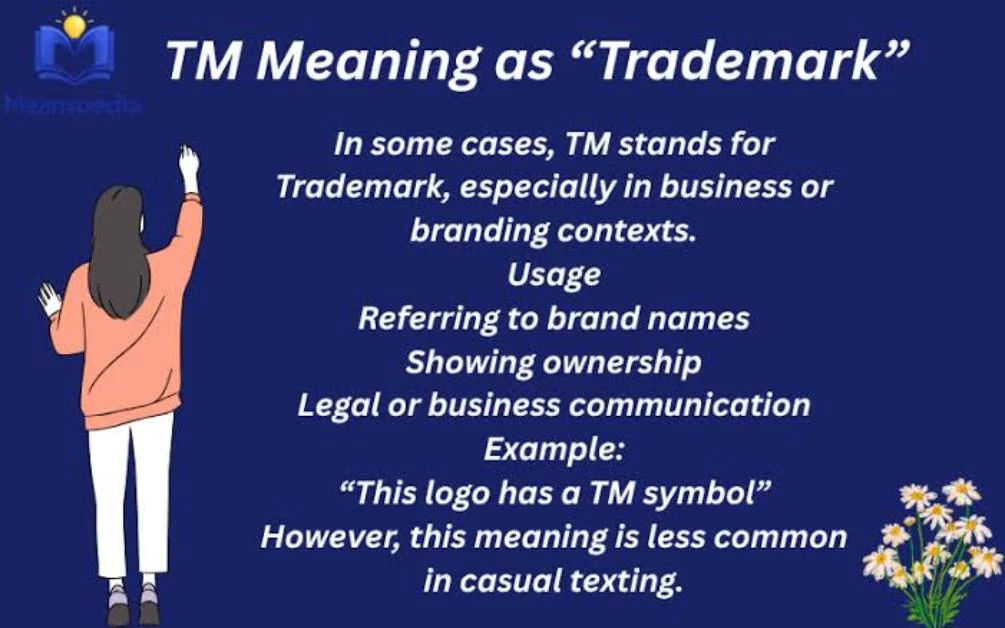
The TM meaning on WhatsApp, Instagram, TikTok, and Snapchat is generally determined by the conversation rather than by the app itself. There is no universal rule saying that TM has one special meaning on one platform.
On WhatsApp, TM may be used as a quick way to say “tomorrow.” For example, “Call me tm” usually means “Call me tomorrow.”
On Instagram, you may see TM in direct messages, comments, captions, or usernames. Its meaning depends on the surrounding content. A casual DM may use TM for tomorrow, while a business post might use ™ to identify a trademark.
On TikTok, users often combine abbreviations with other internet slang. TM can therefore appear in comments or private messages as part of informal conversation.
On Snapchat, where messages are usually short and casual, abbreviations can be especially common. A message such as “tm?” could mean “tomorrow?” if the conversation is about plans.
Quick platform examples:
- WhatsApp: “See you tm 👍” → See you tomorrow.
- Instagram DM: “I’ll reply tm.” → I’ll reply tomorrow.
- TikTok: “tm is better 😂” → Meaning depends on the topic.
- Snapchat: “Free tm?” → Are you free tomorrow?
- Business social post: “BrandName™” → Trademark.
The key is simple: do not decide the meaning from the platform alone. Read the full message.
Different Meanings of TM in Other Fields
Outside texting, TM has several important meanings. This is one reason the abbreviation can be confusing.
The best-known non-texting use is ™, which means trademark. Businesses may place this symbol next to a name, slogan, product name, or other brand identifier.
For example:
- “BrightWave™”
- “QuickLearn™”
- “SmartHome™”
In this context, TM has nothing to do with “tomorrow.”
TM can also appear as an abbreviation in different professional or technical fields. Its meaning may change depending on the industry, organization, or document.
Some possible interpretations include:
- Trademark in branding and business.
- Text message in communication.
- Tomorrow in casual texting.
- Transcendental Meditation in some health, lifestyle, or meditation discussions.
- Team member in certain workplace conversations.
- Other technical meanings in specialized industries.
This is why searching for “TM meaning” without context can produce many different answers.
If you see ™ directly attached to a brand or phrase, trademark is usually the intended meaning.
If you see “tm” in a casual sentence about plans, tomorrow is a strong possibility.
If the conversation is about messages, text message may make more sense.
Always consider the subject of the conversation before choosing a definition.
Common Confusions, Mistakes & Wrong Interpretations
One of the biggest problems with TM in text meaning is assuming that every “TM” has the same definition.
For example, imagine someone writes:
“I’ll see you tm.”
Here, “tomorrow” is the natural interpretation.
Now consider:
“Did you receive my TM?”
Here, “text message” may make more sense.
Another common mistake is confusing TM with ™. The letters TM can be used as a casual abbreviation, while the raised symbol ™ specifically represents a trademark.
People may also confuse TM with other short forms, especially when a message contains several abbreviations. A person unfamiliar with texting slang might interpret “tm” incorrectly.
Common mistakes include:
- Assuming TM always means “tomorrow.”
- Assuming TM always means “trademark.”
- Ignoring the words around the abbreviation.
- Using texting slang in formal writing.
- Confusing “TM” with another abbreviation.
- Treating capitalization as the only clue.
If you are unsure, look at the sentence as a whole.
For example, “Meeting tm at 5” clearly points to tomorrow, while “ProductName™” clearly points to trademark.
When there is still doubt, simply ask:
“Do you mean tomorrow?”
A quick clarification is better than making the wrong assumption.
Similar Terms, Alternatives & Related Slang
If you are learning internet slang, you will quickly notice that TM is only one of many short forms people use online.
When TM means tomorrow, similar expressions include:
- tomo — informal shortening of tomorrow.
- 2moro — older texting-style spelling.
- tom — sometimes used as a shortened form of tomorrow.
- next day — a clearer phrase when context requires it.
When talking about text messages, related terms include:
- text
- SMS
- message
- DM
- PM
Other common texting abbreviations include:
- BRB — Be Right Back.
- BTW — By The Way.
- IDK — I Don’t Know.
- IMO — In My Opinion.
- TBH — To Be Honest.
- TTYL — Talk To You Later.
- LOL — Laughing Out Loud.
- OMG — Oh My God.
These abbreviations are useful because they make casual communication faster. However, they are not always appropriate in formal writing.
For a website about texting meanings, useful internal links could include:
- BRB Meaning in Text
- BTW Meaning in Text
- IDK Meaning in Text
- TTYL Meaning in Text
- TBH Meaning in Text
- LOL Meaning in Text
- DM Meaning in Text
- SMS Meaning in Text
A good glossary can help readers understand these terms without making them search each abbreviation separately.
Examples of TM in Real Chat Situations
Seeing TM in real chat situations makes the meaning much easier to understand. Here are several short examples.
Example 1: Planning
- Person A: “Are you free tm?”
- Person B: “Yes, after 6.”
- Meaning: tm = tomorrow
Example 2: Meeting
- Person A: “See you tm 😊”
- Person B: “See you!”
- Meaning: tm = tomorrow
Example 3: Work
- Person A: “Can you finish the report tm?”
- Person B: “Sure.”
- Meaning: tm = tomorrow
Example 4: Text message
- Person A: “Did you get my TM?”
- Person B: “Yes, I just read it.”
- Meaning: TM = text message
Example 5: Trademark
- “FreshBite™ is our new brand.”
- Meaning: ™ = trademark
Example 6: Social media
- Person A: “I’ll post the video tm 😂”
- Person B: “Okay!”
- Meaning: tm = tomorrow
Example 7: Unclear context
- Person A: “TM?”
- Person B: “Do you mean tomorrow?”
- Meaning: The abbreviation is unclear without context.
These examples show why the surrounding words matter. A single abbreviation can have different meanings, but the complete conversation usually provides enough clues.
How to Reply When Someone Says TM
Your response to TM depends on what the sender appears to mean.
If they clearly mean tomorrow, you can simply respond to the message itself.
For example:
- “Sure, see you tomorrow!”
- “Yes, I’m free 😊”
- “Sounds good!”
- “What time tomorrow?”
- “Okay, talk then.”
If you think TM means text message, respond based on the message topic:
- “Yes, I got your text.”
- “I just saw it.”
- “I’ll check my messages.”
- “Can you send it again?”
If you are not sure what they mean, asking is completely normal.
Try:
- “Do you mean tomorrow?”
- “TM as in text message?”
- “What do you mean by TM?”
The best reply is usually short and natural. You do not need to overthink a simple abbreviation.
One useful rule is to avoid guessing when the meaning could change the plan. If someone says “I’ll send it tm,” and you are unsure whether they mean tomorrow or something else, clarification can prevent confusion.
Is TM Still Popular? Trends & Online Usage

TM is still understandable in online communication, but how often people use it can vary widely. Texting language changes constantly, and different age groups and online communities develop different habits.
The meaning “tomorrow” remains easy to understand in informal messages, but many people simply type “tomorrow” because smartphone keyboards and predictive text make longer words quick to enter.
The trademark meaning is also still widely recognized, especially when the actual ™ symbol is used.
Online communication has also become more visual. Emojis, GIFs, voice messages, stickers, and reactions can reduce the need for traditional abbreviations. Still, short forms remain common because they make casual conversations quick.
You may be more likely to see TM in:
- Fast private messages.
- Casual group chats.
- Informal social media conversations.
- Short comments.
- Conversations about plans.
- Older texting-style communication.
You may be less likely to see it in:
- Formal business writing.
- Academic work.
- Official documents.
- Professional reports.
- Customer-service communication.
The important point is that TM has not disappeared, but its meaning is strongly tied to context. If someone uses it in a casual chat, “tomorrow” is often a reasonable first guess. If it appears beside a brand name, the trademark meaning is much more likely.
FAQs
What does TM mean in texting?
TM can mean “tomorrow” in casual texting. It can also mean “text message,” depending on the sentence.
Does TM mean tomorrow?
Yes. In many informal conversations, tm means tomorrow. For example, “See you tm” means “See you tomorrow.”
What does TM mean on WhatsApp?
On WhatsApp, TM can commonly mean tomorrow when people are discussing plans. It can also have other meanings depending on the conversation.
What does TM mean on Instagram?
On Instagram, TM does not have one fixed meaning. In a casual DM, it may mean tomorrow. When written as ™, it means trademark.
What does ™ mean?
The symbol ™ means trademark. It is commonly used with a brand name, product name, slogan, or other brand identifier.
Is TM the same as trademark?
Not always. ™ specifically represents trademark. The plain letters TM can also be texting slang for “tomorrow” or “text message.”
What does “see you tm” mean?
“See you tm” normally means “See you tomorrow.”
Is TM formal English?
Not when it means “tomorrow” or “text message.” It is mainly an informal abbreviation. In formal writing, spelling out the words is clearer.
How do I know which meaning of TM someone intends?
Look at the context. If the message discusses plans or a future day, TM probably means tomorrow. If it discusses a message, it may mean text message. If it appears as ™ beside a brand, it means trademark.
Conclusion:
Understanding the TM in text meaning is easier once you look at the context. In casual chats, TM often means “tomorrow,” especially when people are talking about plans, meetings, or future activities.
It can also mean “text message” when the conversation is about sending or receiving messages. Outside texting, ™ means “trademark” and is commonly connected with brands and products
. Because abbreviations can have several meanings, it is best not to judge TM by the letters alone. Read the complete sentence and consider the topic of the conversation.
If the meaning is still unclear, asking a quick question is the simplest solution.
As online language continues to change, knowing common abbreviations like TM can make texting, social media, and everyday digital conversations much easier to understand
