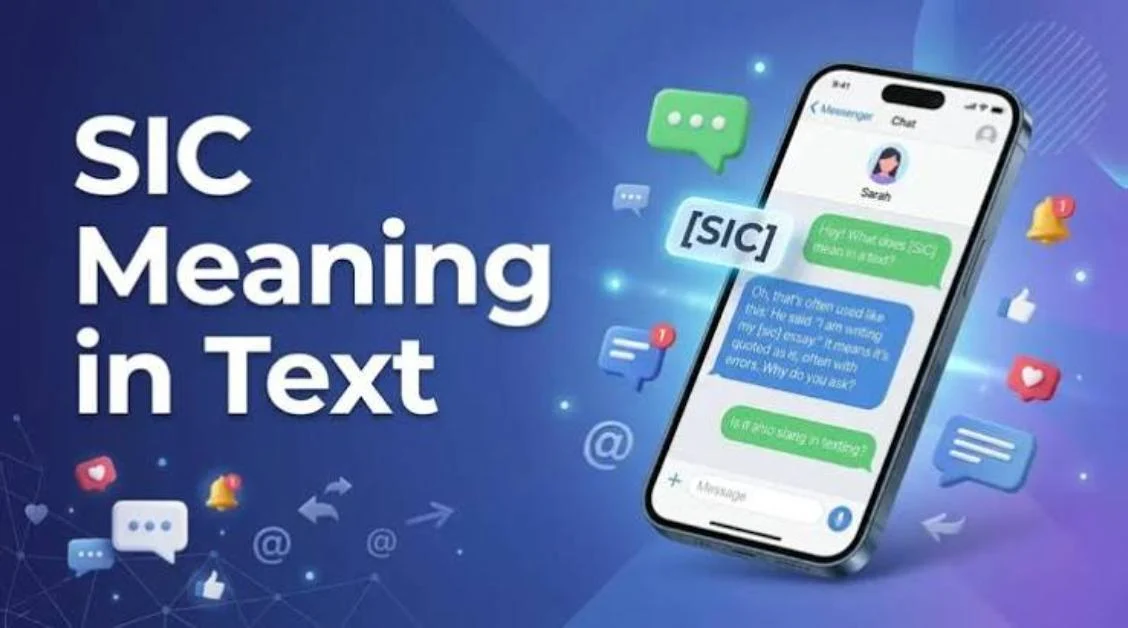
If you have ever seen [sic] inside a text, social media post, quote, or online comment, you may have wondered what it means.
Unlike common texting shortcuts such as “LOL” or “BTW,” sic meaning in text is a little different. It is usually used to show that a strange spelling, grammar mistake, or unusual statement was already present in the original words. In simple terms, [sic] means “this is exactly how it appeared in the original.”
People often search for the meaning of sic because they see it in screenshots, news articles, books, social media posts, or messages.
It can look like a typo or slang term at first.
This guide explains sic meaning in text and chat, where the word came from, how people use it online, and what it means on platforms such as WhatsApp, Instagram, TikTok, and Snapchat.
What Does Sic Mean in Text & Chat?
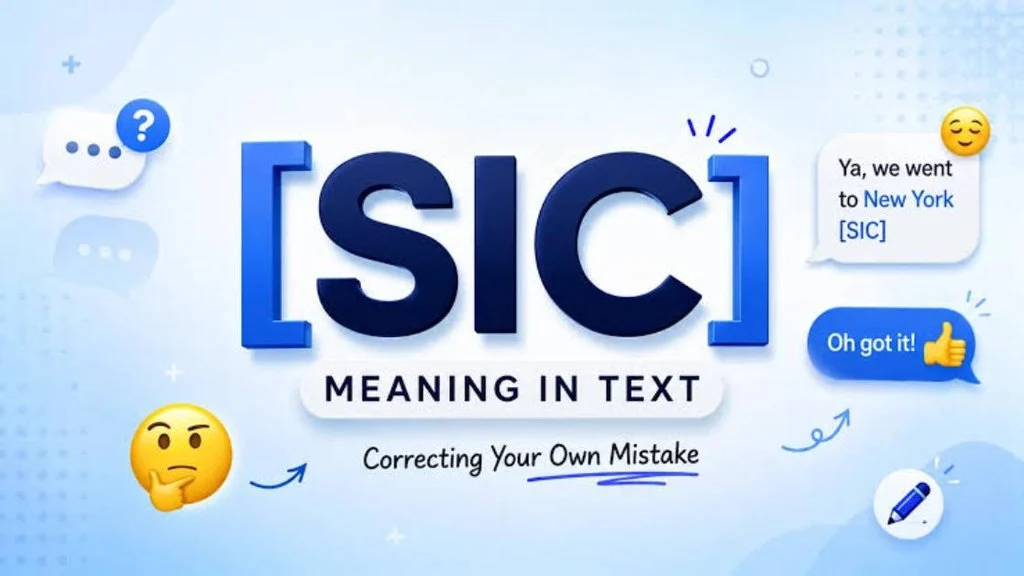
The word sic is usually placed inside square brackets like [sic]. It tells the reader that the writer has copied a word, spelling, grammar choice, or statement exactly as it appeared in the original source.
For example, imagine someone writes:
- “I definately want to go [sic].”
The word “definately” is misspelled. By adding [sic], the person quoting the message is saying, “I did not make this spelling mistake. This is exactly how it was written.”
In text and online conversations, [sic] is not normally used as casual slang. It is more common when someone is quoting another person’s words.
The basic idea is:
- [sic] = exactly as written
- It points out that an unusual word or mistake was in the original.
- It can appear after a spelling or grammar error.
- It can also appear after a strange fact, phrase, or wording.
- It helps prevent readers from thinking the person making the quotation made the mistake.
For example:
“She said she was ‘very exicted [sic]’ about the trip.”
Here, [sic] tells the reader that “exicted” was the original spelling.
In casual chat, however, people may sometimes use sic in a playful way. Someone might write “That outfit is wild [sic] 😂” to draw attention to an unusual phrase. This is less formal and depends on the person’s style.
So, when you see [sic] in text, think: “The original said it this way, and I am showing it exactly.”
Full Form, Stands For & Short Meaning of Sic
A common question is whether sic has a full form like “LOL” or “BRB.” It does not work that way.
Sic comes from Latin. The Latin word sic means “thus,” “so,” or “in this way.” In modern writing, it is used to show that the quoted wording has been reproduced exactly.
The easiest short meaning is:
Sic = exactly as written in the original.
It is usually written as [sic], especially when it is inserted into a quotation.
Here are some quick meanings:
- Sic meaning: exactly as written
- [sic] meaning: the original text contains this wording
- Sic in a quote: “I copied this exactly.”
- Sic in writing: “The unusual spelling or wording is not my mistake.”
- Sic in text: “This is how the original message appeared.”
For example:
“The customer said the product was ‘excellant [sic].’”
The writer is not claiming that “excellant” is correct English. The marker simply shows that the original person used that spelling.
It is important not to confuse sic with common internet abbreviations. It does not normally mean “see,” “sick,” “such,” or “send it quickly.”
The context matters.
If someone writes:
“That movie was sic!”
they may actually be using sick as slang for something impressive or exciting, with the spelling changed for style.
But if you see:
“The document said ‘recieve [sic]’”
then [sic] has its traditional editorial meaning.
Therefore, the simplest answer to “What does sic stand for?” is that it is a Latin word rather than a modern acronym.
Origin, History & First Known Use of Sic
The history of sic goes back to Latin. The Latin word means something close to “thus,” “so,” or “in this manner.” It was eventually adopted into English writing as an editorial marker.
Editors and writers use [sic] when they reproduce another person’s words but want readers to understand that an unusual spelling, grammatical error, or wording belongs to the original source.
This became especially useful in formal writing. Imagine a newspaper quoting a public statement that contains a spelling mistake. If the newspaper silently repeats the mistake, readers might believe the newspaper made the error.
Adding [sic] makes the situation clear.
For example:
“The report described the event as ‘unpresidented [sic].’”
The marker tells the reader that the spelling was present in the original quotation.
Over time, sic became familiar in books, newspapers, academic writing, legal documents, interviews, historical records, and other forms of quoted material.
Its use has also moved into the digital world. Today, people may encounter [sic] in:
- Online articles
- Social media posts
- Screenshots
- Forums
- Digital archives
- Comments
- Text-message discussions
- Academic papers
- News reports
The internet has made direct quoting extremely common, so the need to distinguish original wording from an editor’s wording still exists.
However, modern writing styles do not always require [sic] for every small mistake. Some writers prefer to correct obvious errors or simply quote the original without drawing attention to them.
The important point is that sic is not a new texting abbreviation. It is an old editorial term that has found a place in modern digital communication.
How People Use Sic in Daily Conversations

In everyday conversation, people do not normally say “sic” aloud. You are more likely to see [sic] when someone is quoting a message, post, comment, or statement.
The main purpose is to preserve the original wording.
For example:
“He texted me, ‘Your are coming tonight [sic].’”
The writer is showing that “Your” appeared exactly that way in the original message.
People may also use [sic] when sharing screenshots or reproducing comments that contain unusual wording.
Quick examples:
- “She wrote ‘I seen him yesterday [sic].’”
- “The post called it the ‘best resturant [sic] in town.’”
- “His message said, ‘I definately agree [sic].’”
- “The sign actually said ‘No Dog’s [sic].’”
In formal settings, this can be useful because it protects the person quoting the material from being blamed for the original error.
In casual online conversations, however, [sic] can sometimes sound humorous or sarcastic. Someone may deliberately point out a friend’s strange wording.
For example:
“You said you were ‘totally responsible [sic]’ 😂”
Here, the marker may be used for humor rather than serious editing.
Still, overusing [sic] can make a normal conversation feel overly formal. If you are simply chatting with friends, you usually do not need it.
A useful rule is:
Use [sic] when the exact original wording matters. Skip it when it does not.
Sic Meaning Across WhatsApp, Instagram, TikTok & Snapchat
The sic meaning in WhatsApp, Instagram, TikTok, and Snapchat is generally the same as its traditional meaning. There is no special platform-specific definition built into these apps.
If someone writes [sic], they usually want to show that a quoted word or phrase has been copied exactly.
On WhatsApp, you may see [sic] when someone shares part of another person’s message.
Example:
“He literally said, ‘I dont care [sic].’ 😂”
Instagram users may use it in captions, comments, screenshots, or posts.
Example:
“The comment said this was ‘the most beautifull [sic] place.’”
TikTok
TikTok captions and comments sometimes use unusual spellings for humor or style. If [sic] appears, it can indicate that the creator is quoting someone exactly.
Example:
“Someone commented ‘your the best [sic]’ and I couldn’t stop laughing.”
Snapchat
On Snapchat, [sic] may appear when someone posts a screenshot or quotes a friend’s message.
Example:
“My friend really texted ‘I am literaly dying [sic]’ 😂”
The key point is that none of these platforms gives sic a separate official meaning.
It is still an editorial marker.
However, social media has made its use more playful. People sometimes add [sic] to make a funny comment more noticeable or to highlight an odd phrase.
So if you see [sic] online, check the surrounding sentence before assuming it is slang.
Different Meanings of Sic in Other Fields
Although [sic] is best known as an editorial marker, the word can appear in other contexts where its meaning is different.
The context is especially important because SIC can also be an abbreviation for unrelated terms.
For example, in business and government classification systems, SIC may refer to Standard Industrial Classification. This is completely different from the editorial [sic] used in quotations.
There is also a distinction between sic and sick.
In informal English, “sick” can mean something impressive:
“That trick was sick!”
But sic in a quotation is usually an editorial word.
Another important distinction involves the Latin expression itself. In historical or formal texts, sic can retain its original Latin sense of “thus” or “so.”
You may also encounter related expressions such as:
- sic erat scriptum — a Latin phrase meaning roughly “thus was it written”
- SIC code — Standard Industrial Classification
- sic — an editorial indication that wording is reproduced as written
- sick — an everyday English word with several meanings
Capitalization can sometimes provide a clue. Editorial [sic] is normally written in lowercase and enclosed in brackets.
For example:
“He wrote ‘their coming [sic] tomorrow.’”
A business document might instead say:
“SIC Code: 5411”
These are entirely different uses.
Therefore, never assume every appearance of “sic” has the same meaning. Look at the sentence, formatting, and subject.
Common Confusions, Mistakes & Wrong Interpretations
Because sic is not a typical texting abbreviation, it can be confusing.
One common mistake is thinking that [sic] means the writer agrees with the incorrect wording. It does not. It simply identifies the wording as original.
Another mistake is assuming that sic means “wrong.”
It often appears next to a mistake, but its deeper purpose is to say:
“This is how the original source wrote it.”
Consider:
“The sign said ‘Your Welcome [sic].’”
The writer is not approving the grammar. They are preserving the sign’s wording.
Another common confusion is between sic and sick.
- Sick can describe illness.
- Sick can also mean impressive in slang.
- Sic can identify original wording in a quotation.
People may also assume that sic is rude. Sometimes it can sound critical, especially when someone uses it to highlight another person’s mistake. But the word itself is neutral.
Tone depends on how it is used.
For example:
“The historical document says ‘teh king [sic].’”
This is a neutral editorial use.
But:
“My genius friend wrote ‘I has no idea [sic]’ 😂”
This could be playful or mocking.
Another mistake is using [sic] when there is no need to quote the original wording. If you are writing your own sentence and make a typo, adding [sic] does not fix it.
The safest approach is to use [sic] only when preserving someone else’s exact words is important.
Similar Terms, Alternatives & Related Slang
There are several words and expressions that can appear similar to sic, but they do not have exactly the same meaning.
“Exactly”
“Exactly” can communicate that something matches the original.
Example:
“That is exactly what she said.”
“As written”
This phrase is often used in formal editing.
Example:
“The spelling is reproduced as written.”
“Quoted verbatim”
“Verbatim” means using the exact words.
Example:
“The statement was quoted verbatim.”
“Literally”
People often use “literally” in casual conversation to emphasize exactness, although it is not an equivalent of [sic].
“Sick”
This is a different word. In slang, “sick” can mean excellent or impressive.
Example:
“That new bike is sick! 🔥”
“LOL”
LOL means “laughing out loud.” It has nothing to do with [sic], even though both may appear in online conversations.
“BTW”
BTW means “by the way.” Again, it is a texting abbreviation rather than an editorial marker.
For related content, you could internally link this article to pages such as:
- What does LOL mean in text?
- What does BTW mean in texting?
- What does FYI mean in chat?
- What does IRL mean online?
- What does TBH mean in text?
- What does IDK mean in messages?
- What does IMO mean in texting?
These related pages can help readers understand the difference between genuine texting abbreviations and editorial terms like [sic].
Examples of Sic in Real Chat Situations
Seeing real examples makes sic meaning in text much easier to understand.
Here are some simple situations:
- Friend’s spelling mistake:
“She said, ‘I definately [sic] want pizza.’” - Funny social media comment:
“Someone commented, ‘Your the best [sic]!’ 😂” - Old document:
“The letter described him as ‘a truely [sic] honest man.’” - Screenshot of a message:
“He literally texted, ‘I dont no [sic].’ 😭” - Quoted public statement:
“The statement called the plan ‘unpresidented [sic].’” - Historical quotation:
“The original document used the phrase ‘allmost [sic] impossible.’”
Notice what all these examples have in common: the person using [sic] is showing the reader that the unusual wording came from the original source.
It does not mean:
- “This word is correct.”
- “I agree with this spelling.”
- “This is a slang abbreviation.”
- “I made a mistake.”
Instead, it means:
“I copied the original wording exactly, including this unusual part.”
In casual chat, you may also see [sic] used as a joke:
“I am the ‘most organized person ever [sic]’ 😂”
Here, the writer is intentionally playing with the traditional meaning.
This kind of humorous use is informal and depends heavily on context.
How to Reply When Someone Says Sic
If someone simply writes “sic” or includes [sic] in a message, you usually do not need a special reply.
If they are using it correctly in a quotation, you can simply respond to the actual content of the message.
For example:
“She wrote ‘I dont care [sic].’”
You could reply:
“Wow, she really wrote it like that? 😂”
If someone uses [sic] to point out your spelling mistake, you can keep the response relaxed:
“Haha, okay, you caught me 😂”
If the use feels sarcastic, you can ask what they mean:
“Wait, are you using [sic] seriously or joking?”
Useful replies include:
- “Oh, you mean exactly as written?”
- “Got it 😂”
- “Haha, I see what you did there.”
- “Was that supposed to be sarcastic?”
- “You mean the original message had that spelling?”
If someone says “sic” without any context, do not immediately assume they mean the editorial term. Ask for context.
For example:
“Do you mean [sic] as in ‘exactly as written’?”
That simple question can clear things up quickly.
The main thing to remember is that [sic] usually does not require a direct response. It is often just a note from the person quoting something.
Is Sic Still Popular? Trends & Online Usage

Yes, [sic] is still used today, especially in journalism, academic writing, research, legal documents, books, historical writing, and online discussions where exact quotations matter.
However, it is not as common in everyday texting as abbreviations such as LOL, OMG, IDK, or BTW.
Social media has created a slightly different environment for the word. People frequently quote screenshots, comments, posts, and messages. This gives [sic] a practical role when someone wants to show that a strange spelling or phrase came directly from another person.
It can also be used for humor.
For example:
“My friend says he is ‘never late [sic]’ 😂”
In this case, the marker may be playful rather than strictly editorial.
Still, there is an important trend in modern digital writing: many people prefer clear, simple language instead of formal editorial marks. As a result, some writers may explain the issue directly rather than using [sic].
For example, instead of:
“I definately agree [sic].”
someone might write:
“She spelled ‘definitely’ as ‘definately’ in the original message.”
Both approaches communicate the same basic idea.
So, while sic is not a trendy texting abbreviation, it remains useful and recognizable.
Its strongest use is still in situations where the exact original wording matters.
FAQs
What does sic mean in a text message?
Sic usually means that the quoted wording is exactly how it appeared in the original message. It is often written as [sic].
Does sic mean “wrong”?
Not exactly. It often appears next to a spelling or grammar error, but it does not mean “wrong.” It means the writer has preserved the original wording.
Is sic a texting abbreviation?
No. Traditional sic is not a texting abbreviation like LOL or BRB. It comes from Latin and is mainly used as an editorial marker.
What does [sic] mean on social media?
On social media, [sic] usually means that a word, spelling, or phrase has been copied exactly from the original post or comment.
Is sic the same as sick?
No. Sick is an English word that can mean ill or, in slang, impressive. Sic has a different meaning when used as an editorial marker.
Why do people put sic in brackets?
The brackets make it clear that [sic] was added by the person quoting the original material. They help distinguish the editorial note from the original words.
Can sic be used as a joke?
Yes. On social media and in casual chats, people sometimes use [sic] humorously to highlight an unusual or funny phrase.
Should I use sic when texting friends?
Usually, you do not need to. It is most useful when quoting someone’s exact words or when the original wording is important.
Conclusion:
Understanding sic meaning in text is simple once you know where the term comes from. [Sic] is an editorial marker that tells readers a word, spelling, grammar choice, or phrase has been reproduced exactly as it appeared in the original. It does not necessarily mean the wording is correct.
Instead, it protects the person quoting the material from being blamed for an error in the original.
Although sic is not a common texting abbreviation like LOL or BTW, you may still see it on WhatsApp, Instagram, TikTok, Snapchat, websites, news articles, books, and academic writing.
Online users may also use it humorously.
The easiest way to remember it is: [sic] means “this is exactly how it was written.” Once you know that, seeing sic in a message or online post becomes much less confusing.
