If you have seen “OBO” in a text, chat, social media post, or online listing, you may wonder what it means. In most everyday online use, OBO means “or best offer.”
It is often used when someone is selling something and is willing to consider a price other than the one they first listed. For example, “Selling my old phone for $200 OBO” means the seller wants $200 but may accept a reasonable lower offer.
People search for OBO meaning in text because abbreviations can have different meanings depending on the conversation.
A short word like OBO can look confusing when you see it without context.
This guide explains what OBO means, where it came from, how people use it on social media, and how you can reply when someone sends it. You will also see simple examples that make the meaning easy to understand.
What Does OBO Mean in Text & Chat?

In text messages and online chats, OBO usually means “or best offer.” It tells the other person that a stated price is not always final.
You will see OBO most often in conversations about buying and selling things. A person may post an item with a price and add OBO to show that they are open to negotiation.
For example:
- “Selling my headphones for $50 OBO.”
- “Bike available for $150 OBO.”
- “I can sell it for $80 OBO.”
- “Laptop is $500 OBO. DM me if interested.”
In these examples, the seller is saying that the listed price is their starting point. They may accept a different price if the offer is reasonable.
OBO can also appear in casual messages when people discuss prices, deals, or payments. However, it is not normally used to mean “or best offer” when there is no buying or selling context.
Context is important. Someone might write “$100 OBO” in a marketplace chat, and the meaning is clear. But if someone simply sends “OBO” in a random conversation, you may need to ask what they mean.
A useful way to remember it is:
OBO = Or Best Offer = “I may accept another price.”
It is similar to saying:
- “$100, but I’m open to offers.”
- “Price is negotiable.”
- “Make me an offer.”
- “Best reasonable offer gets it.”
Full Form, Stands For & Short Meaning of OBO
The most common full form of OBO is “Or Best Offer.”
It is a short form used to save space, especially in classified ads, marketplace listings, text messages, and social media posts.
OBO stands for:
- O = Or
- B = Best
- O = Offer
So, OBO = Or Best Offer.
The short meaning is simple: the seller is willing to consider offers instead of accepting only the listed price.
For example, imagine someone posts:
“Gaming chair — $120 OBO.”
This means the seller is asking for $120 but may accept a lower or different amount.
It does not always mean that the seller will accept any offer. “Best offer” suggests that the person wants a reasonable deal.
For example:
- Asking price: $120
- Your offer: $100
- Seller may accept: Yes
- Very low offer: The seller may reject it
OBO is especially common in informal sales. It may appear beside a price, after a price, or at the end of a sentence.
You may also see related wording such as “obo,” “O.B.O.,” or “or best offer.” The capitalization does not usually change the meaning.
One important point is that OBO is context-dependent. Although “or best offer” is the common meaning in sales, abbreviations can have other meanings in specialized fields. Always look at the surrounding words before deciding what OBO means.
Origin, History & First Known Use of OBO
The meaning of OBO as “or best offer” comes from the language of buying and selling. People have long used phrases such as “or best offer” in advertisements when they wanted to show that a listed price was negotiable.
The abbreviation became useful because classified advertisements traditionally had limited space. A seller could write a price followed by OBO instead of spelling out “or best offer.”
You can think of it as a compact version of a common sales phrase.
For example:
- “Car for sale — $5,000 or best offer.”
- “Car for sale — $5,000 OBO.”
The second version communicates the same basic idea in fewer characters.
As classified advertising moved online, OBO continued to appear in listings. It became common on forums, online marketplaces, social media groups, and community sales pages.
It is difficult to identify one single person or website that “invented” the abbreviation. OBO developed naturally as a shortened form of the phrase “or best offer.” Older sales advertisements used the full phrase, while abbreviations became more convenient as classified listings and digital communication grew.
Today, the term feels especially natural in online selling.
You may see it on:
- Used-car listings
- Furniture advertisements
- Electronics listings
- Clothing sales
- Collectibles
- Local marketplace posts
- Garage-sale advertisements
- Social media selling groups
So, rather than having a single famous origin, OBO is best understood as a practical abbreviation that grew from everyday sales language.
How People Use OBO in Daily Conversations
People usually use OBO when discussing a price that can be negotiated. It is much more common in buying and selling than in ordinary personal conversations.
Imagine your friend wants to sell an old phone. They might text:
“I’m selling my old iPhone for $250 OBO.”
You immediately know that $250 is the asking price, but your friend may consider another offer.
A buyer could respond:
“Would you take $210?”
The seller can then accept, reject, or negotiate.
OBO can make a message sound less strict. Compare these two examples:
- “The price is $250.”
- “The price is $250 OBO.”
The first sounds more like a fixed price. The second tells the buyer that there is room for discussion.
Quick examples
- “Desk is $75 OBO.”
- “Selling my monitor for $180 OBO.”
- “Tickets are $60 OBO.”
- “Old camera, $300 OBO.”
- “I’ll take $40 OBO for the jacket.”
In some conversations, people may use “OBO” casually even when they are not posting a formal advertisement.
For example:
“I was thinking $100 OBO. What do you think?”
Here, the person is clearly inviting a counteroffer.
If you see OBO after a number, think “negotiable price” first.
OBO Meaning Across WhatsApp, Instagram, TikTok & Snapchat
The meaning of OBO on WhatsApp, Instagram, TikTok, and Snapchat is usually the same: “or best offer.” The platform does not normally change the basic meaning.
However, the way people use it can vary.
On WhatsApp, OBO may appear in private messages or local buying-and-selling groups.
Example:
“The table is Rs. 15,000 OBO. Let me know if you’re interested.”
The seller is open to discussing the price.
Instagram users may use OBO in captions, Stories, or direct messages when selling clothes, accessories, collectibles, or other items.
Example:
“Vintage jacket — $90 OBO. DM me 📩”
TikTok
TikTok sellers may include OBO in videos, captions, or comments when showing an item for sale.
Example:
“Selling this camera for $400 OBO 👀”
Snapchat
On Snapchat, OBO may appear in direct messages when friends or users discuss buying or selling something.
Example:
“I can do $70 OBO.”
Across all four platforms, context is the key.
If OBO appears beside a price, it almost certainly means “or best offer.” If it appears by itself, the meaning may be less clear.
For SEO and content planning, useful related pages could include:
- [IMO Meaning in Text]
- [TBH Meaning in Text]
- [IDK Meaning in Text]
- [WYD Meaning in Text]
- [FR Meaning in Text]
- [DM Meaning in Text]
These can work as internal links to other abbreviation and texting-slang guides.
Different Meanings of OBO in Other Fields
Although “or best offer” is the meaning most people expect in a sales conversation, OBO can have other meanings in different industries and situations.
This is why context matters.
For example, in business or professional writing, abbreviations may have meanings that are completely unrelated to buying and selling. A person working in a particular industry may use OBO as an internal abbreviation or technical term.
In financial or organizational contexts, you may encounter specialized uses of the letters OBO. In some cases, the abbreviation may refer to a specific organization, process, title, or technical phrase.
That does not mean those meanings are common in everyday texting.
If someone sends:
“$200 OBO”
the likely meaning is clearly “$200 or best offer.”
But if OBO appears in a work document without a price, you should not automatically assume it means “or best offer.”
How to identify the correct meaning
Look for clues around the abbreviation:
- A price nearby: likely “or best offer.”
- A marketplace listing: likely “or best offer.”
- A negotiation: likely “or best offer.”
- A technical document: may have a specialized meaning.
- A company or organization name: could be an acronym.
- A random text with no context: ask the sender.
The most important rule is simple: never rely on the abbreviation alone when the context is unclear.
Common Confusions, Mistakes & Wrong Interpretations

One common mistake is assuming that OBO always means “or best offer.” That is usually correct in a sales conversation, but abbreviations can have different meanings in other fields.
Another mistake is thinking that OBO means the seller will accept the lowest price someone offers. That is not necessarily true.
If someone writes:
“$500 OBO”
they are saying they are open to offers. They are not promising to accept $300, $200, or any other amount.
The phrase “best offer” also does not always mean “highest offer” in a strict sense. A seller may consider factors such as how quickly the buyer can collect the item or whether the buyer can pay immediately.
Common misunderstandings
- OBO does not mean free.
- OBO does not guarantee a discount.
- OBO does not mean any offer will be accepted.
- OBO usually relates to a negotiable price.
- OBO can have other meanings outside sales.
Another mistake is confusing OBO with other texting abbreviations. For example, “IMO” means “in my opinion,” while “OBV” often means “obviously.” They look somewhat similar but have completely different meanings.
If someone uses OBO in a message and there is no price or sales context, the safest response is:
“What do you mean by OBO?”
A quick clarification is better than guessing.
Similar Terms, Alternatives & Related Slang
There are several phrases that communicate a similar idea to OBO.
The closest alternatives are:
- Or best offer
- Open to offers
- Price negotiable
- Make an offer
- Best reasonable offer
- Offers welcome
- Negotiable
- Taking offers
For example:
“Bike $150 OBO.”
could also be written as:
“Bike $150, open to offers.”
Both tell the buyer that the price is not completely fixed.
You may also see “ONO”, especially in some regions. ONO commonly means “or nearest offer.” It has a similar purpose because it indicates that the seller may accept an offer close to the asking price.
Another related term is “firm.” This means the opposite of a negotiable OBO price.
For example:
- “$200 OBO” = seller may negotiate.
- “$200 firm” = seller wants $200 and is generally not negotiating.
You may also see:
- P/U = pickup
- PPU = pending pickup
- NFS = not for sale
- ISO = in search of
- WTS = want to sell
- WTB = want to buy
These abbreviations often appear together in online marketplace conversations.
Internal linking suggestion: create supporting pages for ONO meaning, WTS meaning, WTB meaning, ISO meaning, and NFS meaning. These pages can naturally link back to your OBO guide.
Examples of OBO in Real Chat Situations
Seeing OBO in a real conversation makes the meaning much easier to understand.
Example 1: Selling a phone
Seller: “I’m selling my phone for $300 OBO.”
Buyer: “Would you take $250?”
Here, OBO tells the buyer that $300 is negotiable.
Example 2: Selling furniture
Seller: “Desk is $80 OBO. Good condition.”
Buyer: “Can you do $65?”
The buyer is making a counteroffer.
Example 3: Social media listing
Post: “Vintage sneakers — $120 OBO 👟 DM if interested.”
The seller wants $120 but is willing to consider another price.
Example 4: Friend-to-friend sale
Friend: “You can have my old monitor for $100 OBO.”
You: “How about $85?”
Again, the buyer is using the invitation to negotiate.
Example 5: Very clear wording
Seller: “Laptop is $600 OBO. I’m willing to negotiate.”
In this case, the seller has directly explained what OBO means.
Quick scanning examples
- “$50 OBO” → $50 or another reasonable offer.
- “Rs. 10,000 OBO” → Rs. 10,000 or best offer.
- “Car $5,000 OBO” → seller may negotiate.
- “DM for OBO” → contact the seller to discuss an offer.
- “Price OBO” → price is not necessarily fixed.
These examples show why OBO is most useful when it appears next to a price.
How to Reply When Someone Says OBO
If someone uses OBO in a buying or selling conversation, your reply depends on what you want.
If you are interested in buying the item, you can make a reasonable offer.
Simple replies
- “Would you take $80?”
- “Can you do $100?”
- “Would $75 work for you?”
- “I can offer $120.”
- “Is the price negotiable?”
- “What’s your best price?”
If you are selling something and someone asks about OBO, you can explain your lowest acceptable price without giving away more than you want.
For example:
“I’m asking $200, but I could consider $175.”
Or:
“I’m open to reasonable offers 👍”
If you are not sure what the person means, simply ask:
“By OBO, do you mean or best offer?”
That is a clear and polite way to avoid confusion.
A useful tip for buyers
Do not assume that OBO means you should make an extremely low offer. A very low offer may annoy the seller.
Instead:
- Check the listed price.
- Consider the item’s condition.
- Make a fair offer.
- Be ready for a counteroffer.
- Stay polite during negotiation.
Is OBO Still Popular? Trends & Online Usage
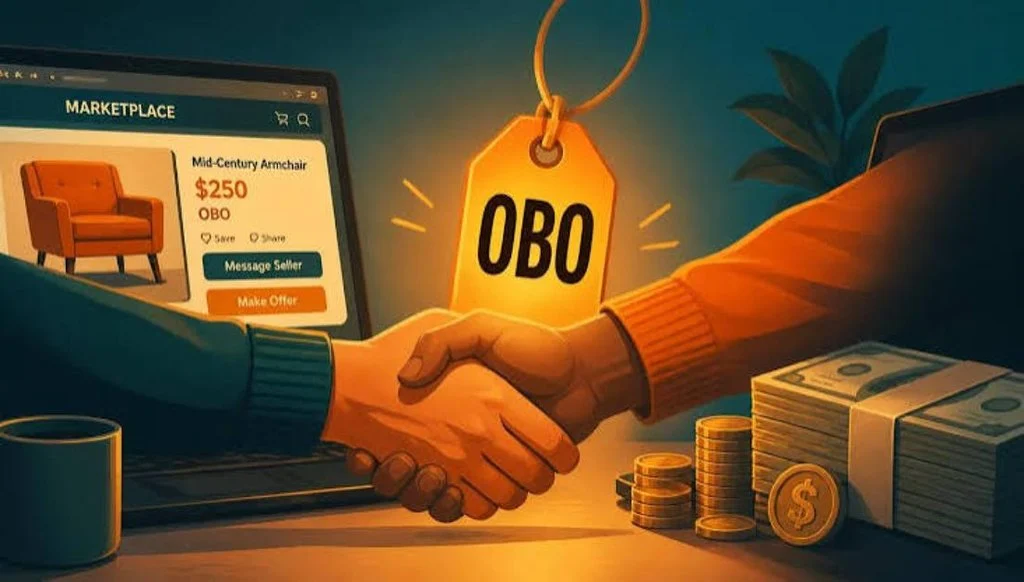
Yes, OBO is still commonly understood in online buying and selling, especially when people list prices on marketplaces, classified sites, social media, and community groups.
Its popularity comes from its simplicity. Three letters can communicate an important sales message: the price is negotiable.
OBO is particularly useful in informal listings because sellers often want to attract buyers without locking themselves into one fixed price.
For example:
“Gaming PC — $800 OBO.”
is shorter and easier to scan than:
“Gaming PC — $800, but I am willing to consider other reasonable offers.”
The exact frequency of OBO varies by platform, country, age group, and type of marketplace. Some users prefer plain language such as “negotiable” or “open to offers.” Others continue to use OBO because it is familiar and compact.
You may also see lowercase forms such as “obo.” Capitalization usually makes no difference.
Why people still use OBO
- It saves space.
- It is easy to understand in sales listings.
- It signals that negotiation is possible.
- It works well beside a price.
- It is widely recognized in online marketplaces.
If you are writing a listing for a broad audience, however, “or best offer” or “open to offers” may be clearer than OBO, especially for people who are unfamiliar with internet abbreviations.
FAQs
What does OBO mean in texting?
OBO usually means “or best offer.” It is most often used when discussing the price of something for sale.
What does OBO mean on Facebook Marketplace?
On Facebook Marketplace, OBO generally means “or best offer.” The seller is willing to consider offers instead of requiring the exact listed price.
Does OBO mean the price is negotiable?
Yes. In a sales context, OBO normally means the seller is open to negotiation.
What does “$100 OBO” mean?
“$100 OBO” means the seller is asking for $100 but may accept another reasonable offer.
Is OBO the same as “negotiable”?
They are very similar. OBO means “or best offer,” while “negotiable” directly says that the price can be discussed.
What should I offer when something is listed OBO?
Make a reasonable offer based on the asking price, condition, and market value. Avoid assuming that the seller will accept a very low price.
Can OBO mean something else?
Yes. OBO can have different meanings in specialized industries or organizations. However, “or best offer” is the common meaning in buying-and-selling conversations.
Is OBO rude?
No. OBO is a normal sales abbreviation. It simply tells potential buyers that the seller may consider other prices.
Conclusion:
The most common OBO meaning in text is “or best offer.” You will usually see it in buying-and-selling conversations, especially beside a price.
For example, “$200 OBO” means the seller is asking for $200 but is willing to consider another reasonable offer.
OBO is short, simple, and useful because it tells buyers that the listed price may not be final. It is common in online marketplaces, social media posts, classified listings, and private messages.
Remember that context still matters.
If OBO appears next to a price, “or best offer” is almost certainly the intended meaning. If it appears in a professional or technical conversation without a sales context, it may mean something else.
So, the next time you see “OBO”, think “or best offer” first—and check the surrounding conversation before making assumptions.
