If someone sends you “GPI” in a text, comment, or group chat, you may wonder what those three letters mean. The answer is usually simple, but context matters.
In Spanish-language internet slang, GPI means “Gracias Por Invitar,” which translates to “Thanks for inviting me.” However, it is often used sarcastically when someone was not invited.
For example, if your friends post pictures from a dinner you missed, you might comment, “GPI 😭” as a playful way of saying, “Wow, thanks for inviting me!”
The expression is especially useful in social media conversations because it turns a longer sentence into a quick, funny reaction.
In this guide, you will learn the GPI meaning in text, where it comes from, how people use it, and how to reply naturally.
What Does GPI Mean in Text & Chat?
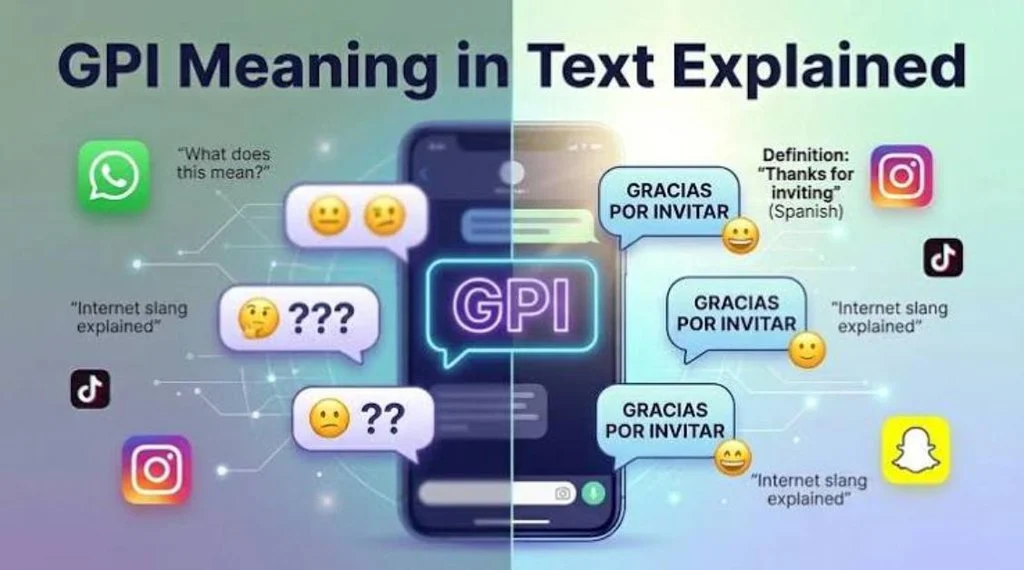
In casual online conversations, GPI most commonly means “Gracias Por Invitar.” This is Spanish for “Thanks for inviting me.” The interesting part is that the phrase is often not meant as a genuine thank-you.
Instead, people use GPI when they notice that friends, relatives, classmates, or other people went somewhere without them. It can be a humorous way to point out that they were left out.
For example:
- Friend: “We went out for pizza last night 🍕”
- You: “GPI 😭”
- Meaning: “Thanks for inviting me!” or “I see nobody invited me!”
The tone is usually playful. However, the exact feeling can range from mild teasing to genuine disappointment.
You can think of GPI as a short social-media reaction. Rather than typing, “Why didn’t you invite me?” a person can simply write “GPI.”
A few quick examples:
- “You guys went to the beach? GPI 😂”
- “Nice party. GPI 😭”
- “Everyone was there except me. GPI.”
- “Next time invite me too! GPI 😅”
It is important to remember that GPI does not have one universal meaning in every English-speaking chat. Acronyms can have different meanings in different communities. If the surrounding conversation is about business, technology, economics, or another specialized topic, GPI may mean something completely different.
So, when decoding GPI meaning in text, always look at the message around it first.
Full Form, Stands For & Short Meaning of GPI
The most relevant social-media expansion of GPI is:
- GPI = Gracias Por Invitar
- Language: Spanish
- English meaning: “Thanks for inviting me”
- Typical tone: Playful, sarcastic, teasing, or mildly disappointed
- Common situation: Someone was not included in a plan or event
The phrase comes from the first letters of the three Spanish words:
- G = Gracias
- P = Por
- I = Invitar
Although the literal translation sounds polite, its online use is often humorous. Someone might say GPI after seeing a photo of friends at a restaurant, a vacation, a party, or another event.
For example:
“Went shopping with the girls today 🛍️”
A friend who was not invited might reply:
“GPI 😂”
The hidden message is closer to “Wow, thanks for leaving me out!”
This is why translating GPI word-for-word is not enough. You also need to understand the social tone.
It is also worth noting that GPI can stand for other things outside casual texting. There is no single English full form that applies everywhere. In technical, economic, academic, and professional contexts, the letters can refer to completely different terms.
Therefore, if you are looking specifically for the GPI meaning in text or social media, “Gracias Por Invitar” is the key meaning to remember, especially when the conversation involves plans, outings, or people feeling left out.
Origin, History & First Known Use of GPI
The social-media use of GPI comes from the Spanish phrase “Gracias Por Invitar.” It became useful in online communication because Spanish-speaking users often shorten common expressions into initials.
However, there is an important distinction between the origin of the phrase and the origin of the abbreviation as internet slang.
“Gracias por invitar” is simply a normal Spanish expression. The abbreviation GPI is a digital shorthand that fits the fast, informal style of messaging and social media.
There is no reliable single person, website, or date that can be identified as the definite creator of the slang abbreviation. Internet slang usually develops gradually as users repeat and spread a short form across chats, comments, memes, and social networks.
The expression works particularly well online because it can communicate several things at once:
- “I noticed your plans.”
- “You didn’t invite me.”
- “I’m joking about being left out.”
- “I wish I had been there.”
- “I’m teasing you for forgetting me.”
Its popularity also reflects a wider trend in digital communication: people create short expressions that are easy to type and instantly recognizable within a particular community.
GPI should therefore be understood as informal internet shorthand rather than a formal abbreviation with one documented invention date.
If someone tells you that GPI definitely began on one specific platform or on one exact date, be cautious unless they can provide strong historical evidence. The development of internet slang is often difficult to trace precisely.
How People Use GPI in Daily Conversations
People normally use GPI when they discover that others did something without inviting them. It can appear in private messages, group chats, comments, captions, and replies.
The most common situation is a friend posting evidence of a fun activity.
For example:
- “We had dinner at our favorite place 🍔”
- “GPI 😂”
Here, the person is joking that they should have been invited.
Another common situation is a vacation or trip:
- “Beach weekend with the squad 🌊”
- “GPI 😭”
The message does not necessarily mean the person is seriously upset. The emoji often makes the playful tone clearer.
GPI can also be used when someone shares a party photo:
- “Last night’s party was crazy 🎉”
- “GPI bro 😂”
In this case, the speaker is teasing the group for leaving them out.
The tone depends heavily on the relationship between the people. Close friends may use GPI freely because everyone understands the joke. With someone you do not know well, however, it could sound passive-aggressive.
Short examples:
- GPI 😂 — playful complaint
- GPI 😭 — exaggerated feeling of being left out
- GPI bro — casual teasing
- GPI next time — “Invite me next time”
- GPI yaar 😭 — friendly complaint
The punctuation can also affect the tone. “GPI 😂” usually feels lighter than simply “GPI.” The latter may sound more serious depending on the conversation.
GPI Meaning Across WhatsApp, Instagram, TikTok & Snapchat
The basic idea behind GPI remains similar across social platforms, but the way people use it can change.
On WhatsApp, GPI is especially natural in group chats and private conversations.
Example:
- Friend: “We went for burgers after class.”
- You: “GPI 😭”
It can also appear when someone shares photos from a gathering.
On Instagram, GPI can appear in comments, story replies, and direct messages. A person may comment “GPI 😂” under a friend’s photo from an event they were not invited to.
Example:
- Instagram Story: “Girls’ night 💅”
- Reply: “GPI 😭”
TikTok
TikTok comments often turn short abbreviations into jokes. If a creator posts a video showing a fun trip or group activity, viewers or friends may use GPI humorously.
Example:
- “POV: best weekend ever”
- Comment: “GPI 😭😂”
Snapchat
Snapchat is another natural setting because users frequently share quick pictures of their daily activities.
If someone sends a snap from a restaurant or party, a friend might reply:
- “GPI bro 😂”
The important point is that GPI is not officially tied to one particular app. It is informal slang, so its use depends on the people and communities involved.
Also, not every person who sees “GPI” will understand the Spanish slang meaning. If your audience is unfamiliar with it, writing the full phrase may prevent confusion.
Different Meanings of GPI in Other Fields
Although GPI meaning in text usually points to informal slang, the letters GPI have several established meanings outside social media.
One well-known example is Genuine Progress Indicator. In economics and sustainability discussions, this term is used as an alternative way of thinking about progress by considering social and environmental factors alongside economic activity.
Another possible meaning is Global Peace Index, a ranking associated with measuring peacefulness across countries.
In technology and electronics, GPI can also appear in phrases such as General Purpose Input or related technical terminology. The exact expansion depends on the system or documentation being discussed.
This creates an important rule:
Never assume that GPI means “Gracias Por Invitar” just because you see the letters GPI.
Compare these examples:
- “GPI 😂” after a party photo → likely social slang
- “The country’s GPI score changed” → likely a formal index
- “Connect the signal to the GPI pin” → likely technical terminology
- “GPI is used to measure broader progress” → likely Genuine Progress Indicator
The surrounding words usually provide the answer.
This is also why online acronym dictionaries can sometimes appear contradictory. One website may describe a slang meaning while another describes a professional abbreviation.
For texting and social media, the Spanish slang meaning is the useful interpretation to remember. For professional or academic writing, check the surrounding subject before interpreting it.
Common Confusions, Mistakes & Wrong Interpretations
The biggest mistake people make with GPI is assuming that every three-letter abbreviation has one fixed meaning.
GPI is a good example of why context matters.
A common misunderstanding is taking “Gracias Por Invitar” literally. In normal Spanish, the phrase can genuinely mean “Thanks for inviting me.” But online, GPI is often sarcastic.
For example:
- “We went to the concert last night.”
- “GPI 😂”
The person probably does not mean that they were actually invited. They are joking because they were left out.
Another mistake is assuming that GPI is an English abbreviation. In the slang usage discussed here, it comes from Spanish.
People may also confuse GPI with other internet abbreviations. Since short forms can look alike, reading only the letters can lead to the wrong answer.
Keep these points in mind:
- GPI is context-dependent.
- The slang version comes from Spanish.
- It often has a sarcastic meaning.
- It is usually informal.
- It is not suitable for formal business writing.
- GPI can mean other things in technical and academic fields.
Tone matters too. Compare:
- “GPI 😂” → probably joking
- “GPI 😭” → playful but feeling left out
- “GPI.” → could sound annoyed
- “GPI next time pls” → direct but usually friendly
If you are unsure what someone means, the easiest solution is to ask:
“Wait, what do you mean by GPI? 😅”
A quick question is better than confidently misunderstanding the message.
Similar Terms, Alternatives & Related Slang
If someone uses GPI because they were not invited, several other phrases can express a similar idea.
Common alternatives include:
- “Why wasn’t I invited?”
- “You could’ve invited me!”
- “Next time, invite me 😂”
- “Wow, thanks for the invite.”
- “Guess I wasn’t invited 😭”
- “I see how it is 😂”
- “Could’ve told me!”
Some alternatives are more direct than GPI. Others are more sarcastic.
For example, “Wow, thanks for the invite” carries almost exactly the same playful feeling in English.
You may also see broader texting abbreviations such as:
- LOL — laughing out loud
- IDK — I don’t know
- IDC — I don’t care
- BTW — by the way
- TBH — to be honest
- LMK — let me know
- NGL — not gonna lie
These do not mean the same thing as GPI, but they belong to the same general world of short digital communication.
Suggested internal links
If you are building an abbreviation or slang website, useful internal links could include:
- What Does LOL Mean in Text?
- What Does IDK Mean in Text?
- What Does TBH Mean in Text?
- What Does NGL Mean in Text?
- What Does IDC Mean in Text?
- What Does LMK Mean in Text?
- What Does ION Mean in Text?
- What Does WYLL Mean in Text?
Use descriptive anchor text rather than repeatedly linking the exact keyword phrase. This makes the page easier to navigate and creates a more natural internal-link structure.
Examples of GPI in Real Chat Situations
Seeing GPI in realistic conversations makes its meaning much easier to understand.
Example 1: Restaurant
Friend: “We all went for pizza last night 🍕”
You: “GPI 😭”
Meaning: “Thanks for inviting me!” — joking because you were not invited.
Example 2: Beach Trip
Friend: “Beach day was amazing 🌊”
You: “GPI bro 😂”
Meaning: “Why didn’t you invite me?”
Example 3: Birthday Party
Friend: “Best birthday ever 🎂❤️”
You: “GPI 😭😂”
Meaning: “I can’t believe you had a party without inviting me.”
Example 4: Group Chat
Friend: “We’re going shopping after school.”
You: “GPI?? 😂”
Meaning: “Am I invited?”
Example 5: Instagram Story
Story: “Dinner with the crew 🍝”
Reply: “GPI 😭”
Meaning: “You guys went without me!”
Example 6: Slightly More Serious
Friend: “We went out yesterday.”
You: “GPI.”
Here, the lack of an emoji can make the message feel less playful. The person may genuinely be annoyed or disappointed.
The lesson is simple: GPI often communicates emotion as much as information. Emojis, punctuation, and the relationship between the speakers help determine whether it is a joke or a real complaint.
How to Reply When Someone Says GPI
If someone sends you GPI, your best reply depends on whether they are joking or genuinely upset.
If they are clearly teasing, you can answer with another playful message.
Try:
- “My bad 😂”
- “Next time, you’re coming!”
- “You were invited in spirit 😭😂”
- “Okay okay, next time!”
- “Bro, we forgot you 💀”
- “You should’ve called!”
If the person seems genuinely disappointed, a more sincere response is better:
- “Sorry! We should have invited you.”
- “My bad, I didn’t realize you wanted to come.”
- “Sorry about that. Come with us next time.”
- “I didn’t mean to leave you out.”
If you are not sure what they mean, ask before reacting:
“GPI as in thanks for inviting you? 😂”
That small clarification can save you from an awkward reply.
The safest response is usually one that matches the tone of the original message. If they use laughing or crying emojis, a playful answer is probably fine. If they send only “GPI.”, consider that they may actually feel excluded.
Is GPI Still Popular? Trends & Online Usage

GPI remains recognizable in Spanish-language social-media and messaging contexts, particularly when people use it humorously to react to plans, parties, trips, meals, or group activities. Its appeal comes from how quickly it communicates a familiar social feeling: “You did something fun without me.”
However, GPI is not a universal English texting abbreviation like LOL, OMG, or BRB. Its recognition depends heavily on the audience.
That means you may see it frequently in one social circle while another person has never heard it before.
Online slang also changes quickly. A phrase can become popular in one community, spread through memes and short-form videos, and then become less common as newer expressions appear.
This makes it difficult to assign a permanent popularity ranking to GPI. It is more accurate to describe it as informal, context-dependent internet slang rather than a universally dominant texting term.
A few practical points:
- GPI is most useful in casual conversations.
- Spanish-speaking communities may recognize it more easily.
- Social-media comments are a natural place to encounter it.
- Emojis often make the intended humor clearer.
- It should generally be avoided in formal emails and professional documents.
- Always consider context because GPI has established meanings outside slang.
So, if you see GPI under a photo of friends at dinner, a party, or a vacation, the playful “Gracias Por Invitar” interpretation is a strong possibility.
Frequently Asked Questions
What does GPI mean in text?
In Spanish-language internet slang, GPI means “Gracias Por Invitar,” which translates to “Thanks for inviting me.” It is often used sarcastically when someone was not invited.
Is GPI an English abbreviation?
Not in its common slang use. The popular social-media interpretation comes from Spanish: Gracias Por Invitar.
Is GPI rude?
Usually, no. GPI is often playful or humorous. However, it can sound slightly annoyed if the person genuinely feels excluded, so tone and context matter.
What does GPI mean on WhatsApp?
On WhatsApp, GPI can be used as a playful response when someone shares plans, photos, or activities that did not include you. For example, “We went out last night” followed by “GPI 😂.”
What does GPI mean on Instagram?
On Instagram, someone may comment or reply “GPI” to a story or post showing a party, trip, dinner, or other activity they were not invited to.
What does GPI mean on TikTok?
On TikTok, GPI can appear in comments as a humorous reaction to videos showing social activities. The Spanish meaning, “Gracias Por Invitar,” is especially relevant in Spanish-speaking online communities.
What should I reply to GPI?
If the person is joking, you can reply with “My bad 😂,” “Next time!”, or “You’re invited next time 😭.” If they seem genuinely upset, apologize and acknowledge that they were left out.
Can GPI have other meanings?
Yes. GPI can refer to different concepts in economics, technology, international rankings, and other fields. Always use the surrounding context to determine the correct meaning.
Is GPI used in formal writing?
The slang meaning of GPI is informal. It is best avoided in professional emails, academic papers, official documents, and other formal communication unless the abbreviation has a specific technical meaning in that field.
Conclusion:
The GPI meaning in text is most commonly connected with the Spanish phrase “Gracias Por Invitar,” meaning “Thanks for inviting me.”
Online, however, it is usually playful or sarcastic rather than a serious expression of gratitude. Someone may type “GPI 😂” after seeing friends at a party, restaurant, vacation, or other event they were not invited to.
The exact tone depends on the relationship, punctuation, emojis, and surrounding conversation.
It is also important to remember that GPI has other meanings in professional and technical fields, so context always matters.
If you see GPI in a casual social-media conversation, the “Thanks for inviting me” interpretation is a useful starting point. When in doubt, ask the sender what they mean rather than guessing.
