If you have seen “WTV” in a text message, chat, comment, or social media post, you may wonder what it means. Is it an abbreviation, slang, or simply a typing shortcut? In most cases, WTV means “whatever.”
People use it to save time when texting, especially when they do not want to type the full word. Depending on the conversation, WTV can sound casual, relaxed, funny, annoyed, or even a little dismissive.
That is why understanding the context is important. People often search for the WTV meaning in text message because the abbreviation can have different tones depending on who sends it and how it is used.
In this guide, you will learn what WTV means, where it came from, how people use it on popular apps, and how you can reply naturally.
What Does WTV Mean in Text & Chat?
In texting and online chat, WTV usually means “whatever.” It is a shortened version of the word that helps people type faster. Like many internet abbreviations, WTV is common in informal conversations rather than formal writing.
The exact feeling behind WTV depends on the sentence and the relationship between the people talking. Sometimes it is completely harmless. A person may use it to say that they do not have a strong preference. In other situations, it can show that someone is tired of discussing a topic.
For example:
- “WTV you want is fine with me.”
- “WTV, let’s just go tomorrow.”
- “WTV 😭 I’m too tired to argue.”
- “You can pick wtv you like.”
- “WTV happens, we’ll figure it out.”
The first example may simply mean “anything you want.” The second may sound like the person wants to end the discussion. The third can be playful or frustrated, depending on the conversation.
WTV is especially common in quick messages because texting encourages shorter words and phrases. People often leave out vowels or shorten common expressions to make communication faster.
You may also see wtv written entirely in lowercase. In casual texting, capitalization usually does not matter.
It is important to remember that WTV is informal slang. It is usually suitable for friends, family, gaming chats, comments, and casual social media conversations. It is generally not a good choice for professional emails, school assignments, business messages, or formal documents.
In simple terms:
- WTV = Whatever
- Type: Texting abbreviation / internet slang
- Common use: Casual conversations
- Tone: Casual, neutral, playful, annoyed, or dismissive
- Formal writing: Usually avoid it
Full Form, Stands For & Short Meaning of WTV
The full form of WTV in texting is “whatever.”
The abbreviation does not normally represent three separate words. Instead, it is a shortened spelling of “whatever.” People use it because the complete word can be reduced to three letters without losing much meaning in a casual conversation.
The basic meaning is:
WTV → Whatever
“Whatever” itself can have several meanings. It may mean “anything,” “it does not matter,” “I do not care,” or “regardless of what happens.” Because of this, WTV can also carry several slightly different meanings.
For example, if someone says:
“WTV movie you choose is okay.”
They probably mean “Whatever movie you choose is okay.”
But if someone says:
“WTV 🙄”
The message could suggest “Whatever, I don’t care” or even mild irritation.
Here are some common meanings depending on context:
- Anything: “Pick wtv you want.”
- It does not matter: “WTV, I’m okay with either.”
- I don’t care: “WTV, do what you want.”
- Moving on: “WTV, let’s talk about something else.”
- Playful dismissal: “WTV 😂 you know I’m right.”
The abbreviation is usually understood by people who are familiar with internet slang. However, someone who rarely uses texting abbreviations may not recognize it immediately.
WTV is also easy to confuse with other short forms because texting language changes quickly. Some people may write whatever, wtvr, or simply what depending on the context.
The safest way to understand WTV is to read the entire message instead of interpreting the three letters alone. The words before and after it usually reveal the intended meaning.
Quick meaning
- WTV: Whatever
- WTV I want: Whatever I want
- WTV you choose: Whatever you choose
- WTV happens: Whatever happens
- WTV 🙄: Often suggests “whatever” with an annoyed tone
Origin, History & First Known Use of WTV
WTV developed as part of the broader culture of internet abbreviations and texting shortcuts. There is no single person or exact moment that can be reliably credited as the creator of the slang form.
The idea behind WTV is simple: people shorten frequently used words to make typing faster. This became especially common as text messaging, online chat rooms, instant messaging, and social networks became part of everyday communication.
Words such as “whatever” are particularly easy to shorten because they are long enough to benefit from abbreviation but common enough that the meaning can usually be understood from context.
Over time, users began removing letters from everyday words and phrases. Internet communities created many similar shortcuts, including:
- BTW = By the way
- IDK = I don’t know
- TBH = To be honest
- IMO = In my opinion
- NVM = Never mind
- WYD = What are you doing?
- OMG = Oh my God
WTV fits naturally into this group.
Its use grew alongside mobile phones and social platforms where people communicate quickly. Short messages became normal, and users began relying on shared slang to communicate with fewer characters.
There is an important difference between the history of the word “whatever” and the history of the abbreviation “WTV.” The word “whatever” has been part of English for a very long time. WTV is the much newer informal abbreviation created by digital communication habits.
Because slang develops organically, it is difficult to identify one universally accepted “first use” of WTV. Online abbreviations can appear in different communities at different times.
So, rather than thinking of WTV as a word with one official inventor, it is better understood as a natural product of texting culture.
Its history follows a simple pattern:
- Common English word: whatever
- Digital communication becomes popular
- Users look for faster ways to type
- The word is shortened to WTV
- The abbreviation spreads through casual online conversations
How People Use WTV in Daily Conversations
People use WTV in many casual situations. The most common purpose is to express that a choice, situation, or result does not matter very much.
For example, two friends may be deciding where to eat:
Friend 1: “Pizza or burgers?”
Friend 2: “WTV you want 😂”
Here, WTV means that Friend 2 is happy with either option.
However, the abbreviation can change tone depending on the situation. If someone has been arguing with another person, WTV may sound more dismissive.
For example:
Person 1: “You never listen to me.”
Person 2: “WTV.”
In this case, the person may be saying, “Whatever,” in a way that suggests they do not want to continue the argument.
WTV can also be used casually before a noun or phrase.
Examples include:
- “Choose wtv color you like.”
- “Eat wtv you want.”
- “We can watch wtv movie you pick.”
- “I’ll do wtv works best.”
- “Wtv happens, don’t stress.”
People also use it humorously.
For example:
“WTV 😂 I already forgot what we were arguing about.”
The emoji makes the message feel lighter and less serious.
Tone is one of the most important parts of understanding WTV. A message containing WTV can be friendly, neutral, sarcastic, or irritated.
Look at these examples:
- “Wtv you prefer 😊” → Friendly
- “Wtv, I’m good.” → Neutral or relaxed
- “WTV 🙄” → Possibly annoyed
- “Wtv 😂 you’re impossible.” → Playful
- “WTV. Bye.” → More dismissive
The relationship between the people also matters. A close friend may use WTV without any negative meaning. Someone you do not know well may use it in a way that feels rude.
When in doubt, look at the rest of the conversation before deciding what the person means.
WTV Meaning Across WhatsApp, Instagram, TikTok & Snapchat
The meaning of WTV is generally the same across WhatsApp, Instagram, TikTok, and Snapchat: “whatever.” What changes is the style and tone of the conversation.
On WhatsApp, WTV is often used in private chats and group conversations. Friends may use it when making plans or ending a small disagreement.
Examples:
- “Wtv works for me.”
- “Come whenever, wtv.”
- “WTV 😂 just send me the address.”
On Instagram, WTV may appear in direct messages, comments, captions, or replies. Because Instagram conversations can be casual and short, abbreviations are common.
For example:
- “Wtv girl 😂”
- “Wear wtv you want.”
- “WTV this outfit is still cute.”
On TikTok, users may use WTV in comments and direct messages. The platform has a strong culture of short expressions, memes, and slang, so abbreviations can spread quickly.
Examples:
- “Wtv he says 😭”
- “WTV this is actually funny.”
- “Pick wtv sound you want.”
On Snapchat, WTV is especially natural because conversations are often quick and informal.
Examples:
- “Wtv, snap me later.”
- “WTV 😂 I wasn’t ready.”
- “Wear wtv you want.”
Across all these platforms, capitalization can vary:
- WTV
- wtv
- Wtv
They generally mean the same thing.
The important point is that social media does not usually give WTV a completely different definition. Instead, the tone changes according to the conversation, platform, emojis, and relationship between the users.
Quick platform guide
- WhatsApp: Casual chats and planning
- Instagram: DMs, comments, and casual replies
- TikTok: Comments, memes, and short reactions
- Snapchat: Fast conversations and replies
Different Meanings of WTV in Other Fields
Although WTV usually means “whatever” in texting, abbreviations can have different meanings in other fields. This is one reason context matters.
In casual online conversation, the most likely interpretation is the slang meaning. However, a technical document, company name, television reference, or professional discussion could use WTV for something completely different.
For example, in media-related contexts, WTV may appear as part of a television station’s call sign or another media-related abbreviation. In technical or organizational settings, the letters may also represent a specific term, project, system, or organization.
This does not mean that you should assume a different meaning every time you see WTV. If the surrounding conversation is clearly a text message between friends, “whatever” is almost certainly the intended meaning.
Context is the key.
Consider these examples:
- “WTV, I don’t care.” → Almost certainly “whatever”
- “Check the WTV report.” → Could be a specialized abbreviation
- “WTV channel is showing it?” → Could refer to a television-related term
- “Use the WTV setting.” → May be technical or product-specific
This is why abbreviation dictionaries can sometimes be confusing. A three-letter abbreviation may have several meanings across different industries.
When you see WTV, ask:
- Is this a casual conversation?
- Is the person using other texting slang?
- Does “whatever” make sense in the sentence?
- Is there a professional or technical context?
If the answer to the first three questions is yes, the texting meaning is usually the right one.
Simple rule
WTV in a casual text = usually “whatever.”
WTV in a specialized document = check the context.
Common Confusions, Mistakes & Wrong Interpretations
One of the biggest mistakes people make with WTV is assuming that it always sounds rude. That is not true.
The abbreviation can be completely neutral.
For example:
“WTV you choose is fine 😊”
This does not sound rude. The person is simply saying that they are comfortable with any choice.
Another common mistake is thinking WTV means something like “what the…” because of the letters W and T. In ordinary texting slang, that is not the standard meaning. The usual meaning is “whatever.”
People can also misunderstand WTV because they focus only on the abbreviation and ignore the rest of the message.
Compare:
- “Wtv you want ❤️” → Flexible and friendly
- “WTV.” → Could feel dismissive
- “WTV 😂” → Often playful
- “WTV 🙄” → More likely annoyed
The punctuation matters too.
A short message such as “WTV.” can feel colder than “wtv lol.”
Another mistake is using WTV in formal communication. Even though many people understand it, it is still casual internet slang.
Avoid using it in:
- Job applications
- Business emails
- Formal reports
- Academic essays
- Professional presentations
- Official requests
Use “whatever,” “any,” “either,” or another clear phrase instead.
You should also avoid assuming someone’s mood from WTV alone. Text messages do not contain facial expressions or voice tone, so a short abbreviation can be easy to misread.
If you are unsure, consider the person’s usual texting style. Someone who frequently uses slang may use WTV without any negative intention.
Common misunderstandings
- Mistake: Thinking WTV is always rude.
- Reality: It can be neutral, playful, or dismissive.
- Mistake: Assuming it has only one tone.
- Reality: Context changes the tone.
- Mistake: Using it in formal writing.
- Reality: It is mainly casual slang.
- Mistake: Judging the meaning from the letters alone.
- Reality: Read the full message.
Similar Terms, Alternatives & Related Slang
WTV belongs to a large family of texting abbreviations and casual slang. Knowing similar terms can make online conversations easier to understand.
The closest alternative is simply “whatever.” You can also use phrases such as “I don’t mind,” “anything is fine,” or “it’s up to you,” depending on what you want to say.
Some related texting terms include:
- IDK — I don’t know
- IDC — I don’t care
- NVM — Never mind
- TBH — To be honest
- BTW — By the way
- IMO — In my opinion
- WYD — What are you doing?
- WDYM — What do you mean?
- IKR — I know, right?
- LOL — Laughing out loud
WTV and IDC can sometimes seem similar, but they are not always interchangeable.
For example:
“WTV you choose.”
This means the person is okay with any choice.
“IDC what you choose.”
This can sound stronger and may suggest that the person genuinely does not care.
Likewise, NVM means “never mind,” not “whatever.”
For example:
“NVM, I found my phone.”
The person is withdrawing a previous question or statement.
Understanding these small differences helps you avoid confusion.
Useful alternatives to WTV
Depending on the tone you want, you could write:
- Whatever
- Anything is fine
- It’s up to you
- I don’t mind
- Either one works
- No preference
- It’s okay
- Doesn’t matter
For formal communication, these alternatives are usually better than WTV.
Examples of WTV in Real Chat Situations
The meaning of WTV becomes much easier to understand when you see it in realistic conversations.
Example 1: Choosing food
Alex: “Pizza or tacos?”
Sam: “Wtv you want 😂”
Meaning: Sam does not have a preference.
Example 2: Choosing a movie
Alex: “What movie should we watch?”
Sam: “WTV you pick.”
Meaning: Sam is happy for Alex to choose.
Example 3: Ending an argument
Alex: “You never believe me.”
Sam: “WTV.”
Meaning: Sam may be frustrated and does not want to continue the argument.
Example 4: A playful conversation
Alex: “I told you I was right.”
Sam: “WTV 😂”
Meaning: Sam may be teasing Alex rather than genuinely being annoyed.
Example 5: Making plans
Alex: “Do you want to meet at 6 or 7?”
Sam: “Wtv works for you.”
Meaning: Either time is acceptable.
Example 6: Clothing
Alex: “Which shirt should I wear?”
Sam: “Wear wtv you like 😊”
Meaning: The choice is completely up to Alex.
Example 7: Showing frustration
Alex: “You should have listened earlier.”
Sam: “WTV 🙄”
Meaning: Sam probably feels annoyed or dismissive.
Quick examples
- “Wtv you want.” → Your choice.
- “Wtv works.” → Either option is okay.
- “WTV 😂” → Often playful.
- “WTV 🙄” → May show irritation.
- “WTV happens.” → Whatever happens.
The same three letters can therefore communicate very different feelings.
How to Reply When Someone Says WTV
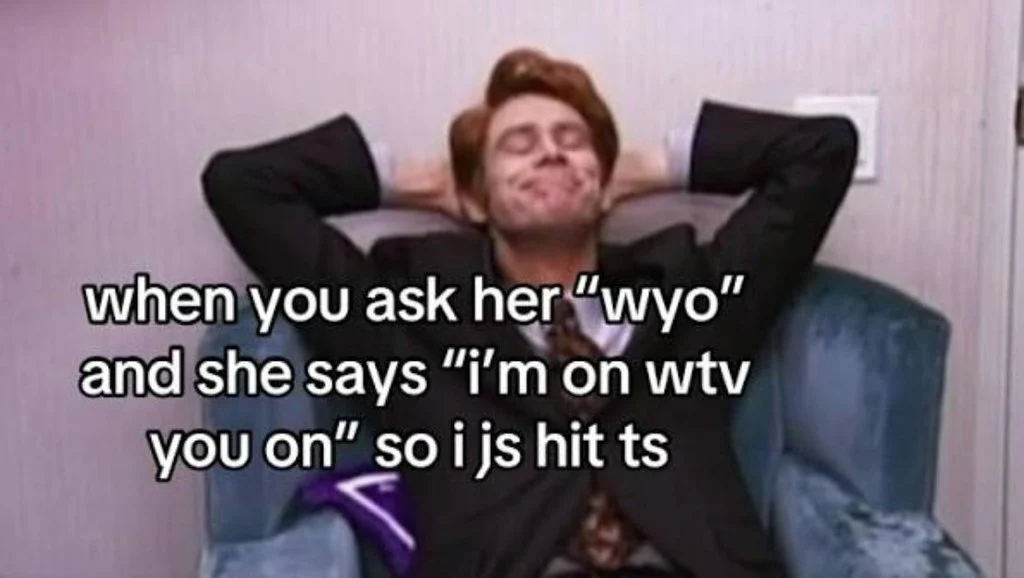
Your best reply depends on what the sender means by WTV.
If they are using it casually, there is no need to make the conversation serious. You can simply continue the conversation.
For example:
Them: “Wtv you want.”
You: “Okay, let’s get pizza 😄”
If WTV sounds dismissive, you can ask a calm question.
Them: “WTV.”
You: “Are you upset?”
This is often better than immediately assuming they are angry.
If the person seems frustrated, you can give them space.
Examples:
- “Okay, no worries.”
- “All good.”
- “Fair enough.”
- “Okay 😅”
- “Let’s talk later.”
- “I didn’t mean to annoy you.”
If the message is clearly playful, you can answer with the same energy.
Them: “WTV 😂”
You: “You know I’m right though 😂”
You do not always need to respond directly to WTV. Sometimes it is simply part of a longer sentence.
For example:
Them: “Wear wtv you want.”
You can reply:
“Cool, I’ll be there at 7.”
The most important thing is to match the tone.
Reply ideas by situation
- Friendly: “Sure 😊”
- Neutral: “Okay, sounds good.”
- Playful: “Haha, fine 😂”
- Unclear: “Everything okay?”
- Argument: “Let’s talk when we’re both calm.”
- Planning: “Either option works for me too.”
If you are unsure whether WTV was meant negatively, avoid sending an angry response. A short clarification can prevent a small misunderstanding from becoming a bigger one.
Is WTV Still Popular? Trends & Online Usage
WTV remains understandable and useful in casual online communication, especially among people who regularly use texting slang. However, internet language changes quickly. Some abbreviations become less common over time, while others remain useful because they are short and easy to understand.
WTV has an advantage because “whatever” is a common word. People often want a quick way to express that they have no preference or do not want to continue discussing something.
You may see WTV in:
- Text messages
- Group chats
- Social media comments
- Direct messages
- Gaming chats
- Memes
- Casual conversations
Lowercase “wtv” is also common because many people type quickly and do not bother with capitalization.
Online language is also becoming more flexible. People may combine abbreviations with emojis, repeated letters, punctuation, or slang.
For example:
- “wtv 😭”
- “WTV lol”
- “wtv 😂”
- “wtttv okay” — playful or exaggerated typing, depending on the person
However, popularity can vary by age group, platform, location, and online community. Not everyone uses the same slang.
That means you should not assume every person knows WTV immediately.
If someone asks what it means, a simple explanation is enough:
“WTV means whatever.”
The abbreviation is still useful because it is short, recognizable, and easy to type. But in situations where clarity matters more than speed, writing the full word is usually better.
Quick takeaway
- WTV is still used in casual online communication.
- Its meaning remains mainly “whatever.”
- The tone depends heavily on context.
- Lowercase “wtv” is common.
- It is best suited to informal conversations.
FAQs
What does WTV mean in a text message?
WTV usually means “whatever.” It is a casual abbreviation used in text messages, chats, comments, and social media conversations.
Is WTV rude?
Not always. WTV can be friendly, neutral, playful, or dismissive. The tone depends on the sentence, punctuation, emojis, and conversation.
What does WTV mean on Snapchat?
On Snapchat, WTV normally means “whatever.” It is commonly used as a quick way to say that something does not matter or that the other person can choose.
What does WTV mean on Instagram?
On Instagram, WTV usually means “whatever.” You may see it in DMs, comments, or casual conversations.
What does WTV mean on TikTok?
WTV on TikTok generally means “whatever.” Users may use it in comments, messages, or casual reactions.
Is WTV the same as whatever?
Yes. In most texting situations, WTV is simply a shortened form of “whatever.”
What is the difference between WTV and IDC?
WTV means “whatever,” while IDC means “I don’t care.” They can sometimes express a similar feeling, but IDC can sound more direct or stronger.
Can I use WTV in a formal email?
It is better not to. WTV is informal internet slang. In professional or academic writing, use the full word or a clearer phrase instead.
What does “WTV 😂” mean?
“WTV 😂” often means “whatever” in a playful or joking way. The laughing emoji can make the message feel less serious.
What does “WTV 🙄” mean?
“WTV 🙄” may suggest annoyance, frustration, or dismissal. The eye-roll emoji makes the negative tone more likely.
Conclusion:
The WTV meaning in text message is usually simple: WTV means “whatever.” It is a casual abbreviation that people use in texts, social media chats, comments, and other informal conversations
. However, the tone can change depending on the situation.
WTV may show that someone has no preference, does not care about a choice, is joking, or wants to end a discussion.
Emojis and punctuation can also change how the message feels. If you see WTV in a normal conversation with friends, “whatever” is almost always the meaning.
Just remember that WTV is informal slang, so it is better to use the full word in professional or academic writing. Once you understand the context, this three-letter abbreviation is easy to recognize
