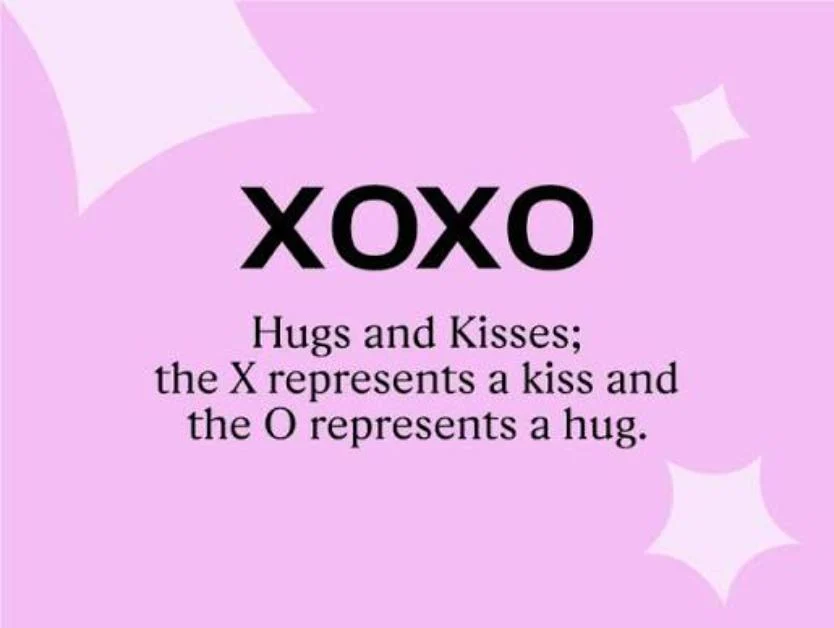
When someone sends you “XO” in a text, chat, or social media message, you may wonder what those two letters really mean.
Does it mean “hugs and kisses”? Is it romantic? Can friends use it too?
The XO meaning in text is usually connected with affection, warmth, hugs, and kisses. However, the exact feeling can change depending on who sends it and what the conversation is about. You may see XO at the end of a message, in a caption, or as part of a casual reply.
It is short, friendly, and easy to use. In this guide, we will explain what XO means, where it came from, how people use it on popular social platforms, and how you can reply naturally. We will also cover common mistakes and real chat examples so you can understand XO without confusion.
What Does XO Mean in Text & Chat?
The most common XO meaning in text and chat is “hugs and kisses.” The X is commonly understood as a kiss, while the O represents a hug. Together, XO gives a short way to show affection, care, or warmth.
People often place XO at the end of a message. It can make an ordinary sentence feel more personal.
For example:
- “Good night, XO”
- “Take care! XO”
- “Miss you XO”
- “Thanks for everything ❤️ XO”
- “See you tomorrow! XO”
The meaning is not always romantic. Friends, family members, partners, and even close acquaintances may use XO depending on their relationship and communication style.
Context matters a lot.
If your partner sends:
“Goodnight XO ❤️”
it may clearly have a romantic meaning.
If your best friend sends:
“Thanks for helping me today! XO”
it may simply show friendship and appreciation.
XO can also appear by itself. Someone might reply with:
“XO”
That can mean something like “hugs and kisses,” “love,” or “sending affection.”
The tone can change based on punctuation and emojis too. “XO ❤️” usually feels warmer than simply “Xo.”
It is also useful to remember that online slang does not always follow strict rules. One person may use XO frequently, while another may use it only with close friends.
So, if you are wondering “What does XO mean in a text?”, the safest short answer is:
XO usually means hugs and kisses and is used to express affection, warmth, care, or love.
Full Form, Stands For & Short Meaning of XO
There is no traditional “full form” of XO in the same way that abbreviations such as LOL or BRB have expanded forms. Instead, XO is a symbolic shorthand.
The most common interpretation is:
- X = kiss
- O = hug
- XO = hugs and kisses
The order can sometimes vary in casual use. You may also see XOXO, which usually means “hugs and kisses” with extra emphasis.
Here is a simple comparison:
| Term | Common meaning |
|---|---|
| X | Kiss |
| O | Hug |
| XO | Hugs and kisses |
| XOXO | Lots of hugs and kisses |
| XOX | Kisses and a hug, depending on context |
The symbols are more emotional than literal. When someone writes XO, they are not normally describing an actual physical hug or kiss. They are using the symbols to communicate a feeling.
For example:
“See you soon XO”
does not necessarily mean the sender is literally sending a hug and kiss. It is more like saying:
“See you soon, with affection.”
This is why XO can work in many different conversations.
It may express:
- Love
- Friendship
- Affection
- Warmth
- Care
- Appreciation
- A sweet goodbye
- Emotional closeness
The exact meaning depends on the relationship between the people involved.
It is also worth knowing that XO can have completely different meanings outside texting. In business, gaming, medicine, entertainment, or military contexts, the same letters may stand for something unrelated. That is why the surrounding words are important.
For ordinary texting, however, XO most often means hugs and kisses.
Origin, History & First Known Use of XO
The exact history of XO as a combined texting expression is difficult to pin down to one person or one date. It developed from older uses of X and O as symbols of affection.
The use of X to represent a kiss has a long history in written communication. People have used X marks in letters and notes as signs of affection or a kiss. Over time, the symbol became familiar in personal messages.
The O is commonly interpreted as a hug. The idea became especially popular in informal letters, greeting cards, notes, and later electronic communication.
Eventually, people combined the two symbols:
XO
and:
XOXO
These forms became popular in personal messages and casual communication.
The rise of email, instant messaging, mobile phones, and social media made expressions like XO even easier to use. Instead of writing a longer phrase such as “sending you hugs and kisses,” people could simply add XO at the end.
There is no need to assume that XO was invented specifically for modern texting. The symbols have older roots in personal communication, while their widespread use in digital messages grew naturally as people looked for quick ways to express emotion.
You may also see different explanations for why O represents a hug. The common explanation is that the circular shape of O resembles arms wrapped around someone. While this is a popular interpretation, the historical record does not give one universally accepted moment when the meaning was officially created.
The important point is that XO evolved as an affectionate shorthand.
Today, it feels completely natural in informal digital communication.
Its history can be summarized simply:
- X developed a connection with kisses.
- O became associated with hugs.
- XO became a short affectionate expression.
- XOXO added extra emphasis.
- Texting and social media helped spread these forms.
How People Use XO in Daily Conversations
People use XO in many everyday conversations, usually when they want their message to sound warmer or more affectionate.
It often appears at the end of a sentence.
For example:
- “Have a great day XO”
- “Call me when you get home XO”
- “Thanks for listening XO”
- “Sleep well XO”
- “Good luck tomorrow XO”
The expression can make a short message feel more personal.
XO between friends
Close friends may use XO to show affection without any romantic meaning.
Example:
“You were so funny today 😂 XO”
Here, XO can simply communicate friendship and closeness.
XO between family members
Parents, siblings, grandparents, and other family members may also use XO.
Example:
“Goodnight, sweetheart. XO”
The message may express care rather than romance.
XO in romantic conversations
Partners may use XO as a quick affectionate sign.
Example:
“Can’t wait to see you tonight ❤️ XO”
In this situation, the romantic context is obvious.
XO as a goodbye
Some people add XO at the end of a message almost like a warm sign-off.
For example:
“Talk tomorrow XO”
It can work like a digital version of ending a personal letter with an affectionate closing.
XO as a standalone message
Someone may simply send:
“XO ❤️”
This usually means they are sending affection, love, hugs, or kisses without needing a full sentence.
The key rule is simple: look at the relationship and the rest of the conversation before deciding exactly what XO means.
XO Meaning Across WhatsApp, Instagram, TikTok & Snapchat
The basic XO meaning in text stays similar across most social platforms. However, the tone can change depending on how people communicate on each app.
XO on WhatsApp
On WhatsApp, XO is often used in private conversations.
You might see:
“Goodnight XO ❤️”
or:
“Thanks for checking on me XO”
Because WhatsApp is commonly used for personal conversations, XO may feel warm and direct.
XO on Instagram
Instagram users may use XO in comments, direct messages, captions, or Stories.
Examples include:
- “Love this! XO”
- “You look amazing ❤️ XO”
- “Sending love XO”
On Instagram, it can sometimes have a playful or stylish tone.
XO on TikTok
TikTok communication is often casual and expressive. XO may appear in comments, captions, or private messages.
For example:
“This made my day 😂 XO”
Here, XO may simply add warmth to the comment.
XO on Snapchat
Snapchat messages are usually short and informal, so XO fits naturally.
A person might send:
“Goodnighttt XO”
or:
“Miss you XO ❤️”
The extra letters, emojis, or punctuation can make the message feel more emotional.
Across all four platforms, the meaning generally remains connected to affection.
However, XO does not automatically mean romantic interest.
That is one of the biggest things to remember.
A friend can send XO. A family member can send XO. A romantic partner can send XO. The platform does not decide the meaning; the relationship and context do.
Different Meanings of XO in Other Fields
Although XO usually means hugs and kisses in texting, the letters can mean very different things in other areas.
This is important because someone may see XO outside a personal chat and assume it means hugs and kisses when it does not.
Depending on the field, XO can refer to different words, titles, or concepts.
For example:
- XO in military language can mean Executive Officer, a senior officer who supports the commanding officer.
- XO in business or organizations may be used as an abbreviation for a particular executive or organizational role.
- XO in entertainment may refer to a company, label, brand, title, or project name.
- XO in gaming may have a special meaning depending on the game or community.
- XO in products or brands may simply be part of a name rather than an abbreviation.
- XO in science or technical writing can have field-specific meanings.
This is why context is essential.
Compare these two examples:
“Goodnight XO ❤️”
Here, XO almost certainly relates to affection.
But:
“The XO will speak to the crew.”
Here, XO may mean Executive Officer, not hugs and kisses.
The same two letters can therefore have completely different meanings.
If you are reading XO in a social media message, text, or casual chat, the affectionate meaning is usually the one to consider first.
If you see XO in a professional, technical, military, or academic setting, check the surrounding information before interpreting it.
Common Confusions, Mistakes & Wrong Interpretations
The biggest mistake people make with XO is assuming that it always means romance.
It does not.
XO means affection, but affection can be romantic or non-romantic.
For example:
“Thanks for being there for me XO”
A close friend could easily send this.
Another common confusion involves XOXO.
Many people treat XO and XOXO as exactly the same. Their meanings are very close, but XOXO usually feels more expressive or affectionate because it contains more symbols.
Common mistakes
- Assuming XO always means “I love you.”
- Assuming XO always indicates flirting.
- Thinking XO has one fixed meaning in every situation.
- Confusing XO with unrelated professional abbreviations.
- Reading too much into one XO without considering the full conversation.
- Assuming a person has romantic feelings simply because they use XO.
Tone also matters.
Compare:
“Thanks XO”
with:
“Thanks!! XOXO ❤️🥰”
The second message clearly carries more emotional energy.
Still, you should not decide what someone feels based on the abbreviation alone.
If you are unsure, look at the overall pattern of communication.
Ask yourself:
- How does this person normally talk to me?
- Do they use XO with other friends?
- Are there romantic words or emojis around it?
- Is the conversation personal or casual?
- Is XO part of a goodbye or thank-you?
These clues can help you understand the intended tone.
Similar Terms, Alternatives & Related Slang
XO belongs to a large group of short expressions used to show affection or emotion in digital conversations.
Some are very similar, while others have slightly different tones.
XOXO
XOXO is probably the closest alternative to XO.
It usually means:
Hugs and kisses.
It may feel more affectionate or playful than XO.
X
An X by itself can represent a kiss.
Example:
“Goodnight x”
This is especially common in some forms of casual messaging.
XOX
XOX can also be used as an affectionate sign-off. The exact interpretation may vary.
Hugs
Some people simply write:
“Hugs ❤️”
This is clearer than XO and usually feels warm rather than strongly romantic.
Kisses
“Kisses” or “😘” can be more directly connected to the kiss part of XO.
Love
A person may write:
“Love you!”
This is more direct and can carry stronger emotional meaning.
Related texting slang
Other abbreviations you may see include:
- ILY = I love you
- ILYS = I love you so much
- LOL = laughing out loud
- BRB = be right back
- OMG = oh my God
- TBH = to be honest
- IDK = I don’t know
For an SEO site, you can naturally add internal links from this page to related abbreviation pages such as [ILY meaning in text], [XOXO meaning], [LOL meaning in text], and [BRB meaning in chat].
These links can help readers discover related slang without forcing keywords into the article.
Examples of XO in Real Chat Situations
Seeing XO in real conversations makes its meaning much easier to understand.
Between close friends
Mia: Thanks for helping me study!
Sara: Anytime! XO 😊
Here, XO shows friendship and appreciation.
Between romantic partners
Alex: I can’t wait to see you tonight ❤️
Sam: Me neither. XO
Here, the romantic meaning is stronger because of the surrounding conversation.
Between family members
Mom: Drive safely and text me when you arrive. XO
You: I will ❤️
The XO expresses care.
After saying goodbye
Jamie: Okay, I have to go now. Talk tomorrow! XO
Taylor: Sure, sleep well 😊
Here, XO works as a warm goodbye.
After receiving help
You: Thank you so much for today! XO
Friend: Of course! Anytime.
The expression shows gratitude and affection.
A simple standalone XO
Person A: Good luck today!
Person B: XO ❤️
This can mean “sending you hugs and kisses” or simply “love and affection.”
A playful example
You: You still owe me coffee 😂
Friend: I knowww XO
Here, XO adds a playful, friendly tone.
The important lesson is that the surrounding conversation gives XO its emotional meaning.
How to Reply When Someone Says XO
How you should reply to XO depends on how comfortable you are with the sender and the tone of the conversation.
If you want to return the affection, you can simply use XO back.
Examples:
- “XO ❤️”
- “XOXO 😊”
- “Aww, XO!”
- “Sending hugs back 🤗”
- “You too ❤️”
- “Thanks! XO”
If the sender is a close friend, a casual reply works well:
“Haha, XO 😂”
If it is someone you are romantically interested in, you might respond:
“XO ❤️ Can’t wait to see you.”
If you are not sure what they mean, you do not have to immediately match their tone.
You can keep your reply friendly:
“Aww, thank you 😊”
That acknowledges the warmth without making a strong romantic statement.
If you think the person may be flirting and you want to understand their intention, you can ask naturally:
“Aww, is that a friendly XO or a flirty XO? 😄”
This keeps the conversation light.
Quick reply guide
- Want to be affectionate: “XO ❤️”
- Want to be friendly: “Aww, thanks 😊”
- Want to match their energy: “XOXO!”
- Want to keep it neutral: “Thanks!”
- Think they are flirting: “Is that a flirty XO? 😄”
You do not need to overthink it. A simple, natural reply is usually best.
Is XO Still Popular? Trends & Online Usage

Yes, XO is still understood and used in online communication, especially in personal and casual conversations.
It may not be used in exactly the same way by every age group or online community. Digital language changes quickly. New emojis, abbreviations, memes, and expressions appear all the time. Still, XO has an advantage: its meaning is easy to understand.
People continue to use it because it is:
- Short
- Easy to type
- Emotionally warm
- Familiar to many users
- Suitable for casual conversations
- Easy to combine with emojis
You may see it written as:
- XO
- xo
- Xo
- xoxo
- XOXO
- XO ❤️
- xo 😊
Capital letters can make it look slightly more noticeable, while lowercase xo often feels softer or more casual.
The use of XO also depends on personal style. Some people use it at the end of almost every friendly message. Others rarely use it.
Social media has not removed the expression. Instead, platforms give people more ways to combine it with emojis, GIFs, stickers, and other forms of digital expression.
For example:
“Miss you xo 🥺❤️”
feels more emotional than simply:
“xo”
Still, there is no universal rule about how often someone should use it.
The best way to understand modern XO usage is to treat it as a flexible sign of affection rather than a strict abbreviation with one emotional level.
If someone uses XO with you, look at the complete conversation rather than the two letters alone.
FAQs
What does XO mean in a text message?
XO usually means “hugs and kisses.” The X commonly represents a kiss, while the O represents a hug.
Does XO mean I love you?
Not necessarily. XO can express love, but it can also show friendship, care, warmth, or affection. The relationship and context matter.
Is XO romantic?
XO can be romantic, but it is not always romantic. Friends and family members can use it too.
What does XOXO mean?
XOXO usually means “hugs and kisses.” It is similar to XO but often feels more affectionate, playful, or expressive.
What does XO mean from a girl?
If a girl sends you XO, it generally means she is expressing affection or warmth. It does not automatically mean she is romantically interested in you.
What does XO mean from a guy?
The meaning is the same in general. A guy may use XO to show friendship, affection, care, or romantic interest depending on the situation.
Can I reply XO to a friend?
Yes. XO can be used between close friends. If you want to keep the tone friendly, you can also reply with “Aww, thanks 😊” or “Sending hugs!”
What does lowercase “xo” mean?
Lowercase xo usually carries the same basic meaning as XO. The lowercase form may simply look more casual or relaxed.
Is XO the same as XOXO?
They have almost the same basic meaning. XOXO usually adds more emphasis and may feel more affectionate.
Conclusion:
The XO meaning in text is usually “hugs and kisses.” The X is commonly linked with a kiss, while the O is associated with a hug.
People use XO in texts, WhatsApp chats, Instagram messages, TikTok comments, Snapchat conversations, and other casual online spaces.
It can express friendship, family affection, romantic feelings, appreciation, or a warm goodbye.
The most important thing is context. XO does not automatically mean someone is flirting or saying “I love you.”
Their relationship with you and the rest of the conversation provide the real clues. XO remains popular because it is short, familiar, and easy to combine with emojis.
So, the next time someone sends you “XO,” you can usually read it as a simple sign of warmth and affection.
