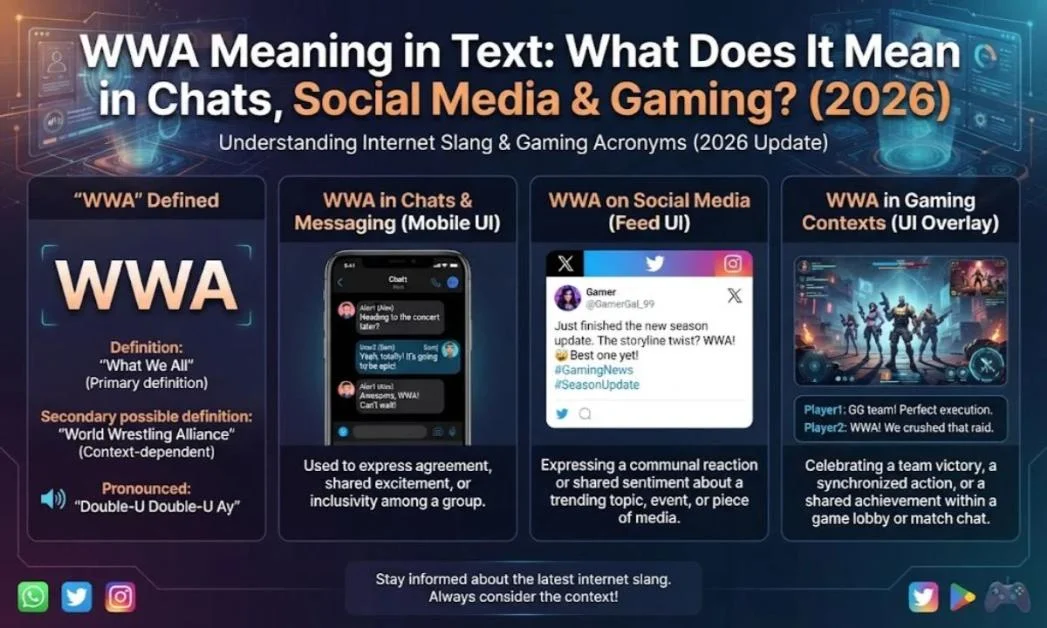
If you have received a message containing “WWA”, you may have wondered what the person meant. Texting slang can be confusing because short forms often have different meanings depending on the conversation.
So, what does WWA mean in text?
In casual online conversations, WWA can be used as a shortened form of “what was that?” It may appear when someone did not hear, understand, or catch something that another person said or sent.
However, WWA is not as universal as common abbreviations such as LOL, BTW, or IDK. Its meaning can change based on the platform, group, or subject.
People often search for the WWA meaning in text because they see the abbreviation in a chat, social media comment, or private message and want a quick explanation.
This guide breaks down WWA in simple language, shows how people use it, and explains other meanings you may encounter.
What Does WWA Mean in Text & Chat?
In texting and casual chat, WWA can mean “what was that?” when the writer wants someone to explain or repeat something.
For example, imagine that a friend sends you a strange message or says something surprising. You might respond:
- “WWA? 😂”
- “Wait, WWA?”
- “WWA supposed to mean?”
The exact meaning depends on the conversation. Unlike highly common texting abbreviations, WWA does not have one fixed definition that everyone uses.
When someone uses WWA to mean “what was that?”, it usually shows confusion, surprise, or a request for clarification. The tone can be playful or serious.
For example:
- Person A: “I just saw a dog riding in a shopping cart.”
- Person B: “WWA? 😂”
- Person A: “Seriously! It was wearing sunglasses.”
Here, WWA is basically asking, “What was that?” or “What did you just say?”
It can also be used after something unexpected happens:
- “WWA just happened?”
- “WWA was that noise?”
- “WWA did you send me? 😭”
However, context matters. If WWA appears in a business message, gaming discussion, school conversation, or technical document, it may stand for something completely different.
The safest approach is to look at the words around WWA. If the conversation is casual and someone seems confused or surprised, “what was that?” may be the intended meaning.
Full Form, Stands For & Short Meaning of WWA
The most useful casual-chat expansion of WWA is “what was that?” when the abbreviation is being used to express confusion or ask for clarification.
Here is the basic breakdown:
- WWA: What Was That?
- Type: Informal abbreviation
- Common setting: Casual texting and online conversations
- Tone: Usually casual, curious, confused, or surprised
- Similar idea: “What was that?” or “What did you mean?”
The three letters come from the first letters of the words:
- W = What
- W = Was
- A = That
This type of shortening is common in online communication. People often remove spaces and vowels to make phrases faster to type.
However, it is important not to treat WWA as a universal texting abbreviation. Some people may never use it, while others may use the same letters for a different phrase.
That is one reason online slang can be difficult for new users. An abbreviation may be obvious to one group but confusing to another.
For example, if someone writes:
“WWA happened?”
They may be asking what happened or what something was. But if WWA appears in a sentence about an organization, event, sport, technology, or another specialized subject, the intended meaning could be unrelated to texting.
A good rule is simple: use the surrounding conversation to understand WWA before choosing its meaning.
If you are writing for a broad audience, it is also better to write the full phrase first. WWA is not nearly as universally recognized as abbreviations such as:
- LOL — Laughing Out Loud
- IDK — I Don’t Know
- BTW — By The Way
- TBH — To Be Honest
- FYI — For Your Information
So, when someone asks for the WWA meaning in text, “what was that?” is a useful casual interpretation, but context should always be checked.
Origin, History & First Known Use of WWA
There is no single, well-established history showing that WWA began as one official texting abbreviation. This is different from some famous internet expressions that can be traced to a particular website, community, or period.
Short forms such as WWA can develop naturally as people try to type faster. Text messaging created a strong need for compact language, especially when phones had small keyboards or character limits.
People began shortening everyday phrases by using their first letters. This produced familiar forms such as:
- “What are you doing?” → WYD
- “What do you mean?” → WYM
- “I don’t know.” → IDK
- “Be right back.” → BRB
WWA follows a similar pattern when it represents “what was that?”
The important point is that WWA does not have one universally accepted origin story in texting culture. Different communities may have used the letters independently for different phrases.
This is common with short abbreviations. Three letters can easily represent several different expressions. As a result, an abbreviation may gain a meaning within one friend group without becoming widely recognized across the entire internet.
The rise of smartphones, messaging apps, social networks, and online communities has made this process even faster. New slang can spread quickly, but many terms remain limited to particular groups.
That is why it is risky to say that WWA has only one meaning everywhere.
If you discovered WWA in an old message, its meaning should be interpreted using the language and subject of that conversation. If you saw it in a modern social media chat, the surrounding messages are usually the best clue.
In short, WWA appears to follow the same basic pattern as many internet abbreviations: people shorten a familiar phrase to save time and space.
How People Use WWA in Daily Conversations
People who use WWA in casual conversation may use it to show that they are confused, surprised, or asking someone to explain something.
The meaning can be close to:
- “What was that?”
- “What did you just say?”
- “What was that supposed to mean?”
- “What just happened?”
- “Can you explain that?”
The exact interpretation depends on the sentence.
For example:
- “WWA? I didn’t hear you.”
- “WWA 😂 That was so random.”
- “WWA just happened?”
- “WWA did you mean by that?”
In friendly conversations, the abbreviation can make a response feel quick and informal. Emojis can also change its tone.
Compare these examples:
- “WWA?” — Could sound confused or direct.
- “WWA? 😂” — Sounds more playful.
- “WWA 😭” — May show disbelief or humorous confusion.
- “WWA??” — Shows stronger surprise.
People may also combine WWA with other texting slang.
For example:
“WWA 😭 I literally just opened the app.”
Or:
“WWA? IDK what you mean.”
However, because WWA is not universally understood, using it with someone unfamiliar with the abbreviation may create more confusion.
If clarity matters, writing “What was that?” is better than using WWA.
This is especially true in professional communication. A coworker, customer, teacher, or client may not understand the abbreviation.
For everyday conversations with friends, however, short forms can make messages feel relaxed and natural.
The key is to match the abbreviation to the person and situation. Slang works best when both people understand the same online language.
WWA Meaning Across WhatsApp, Instagram, TikTok & Snapchat
The WWA meaning in text does not automatically change just because you use a different social media platform. WhatsApp, Instagram, TikTok, and Snapchat all support casual communication, so an abbreviation may appear on any of them.
Still, the style of communication can affect how WWA is understood.
WhatsApp conversations are often direct and personal. WWA may appear in a private chat when someone wants clarification.
Example:
“WWA 😂 Why did you send that?”
On Instagram, WWA might appear in comments, direct messages, or replies to Stories.
Example:
“WWA 😭 I was not ready for that.”
The person may be reacting to a surprising photo, video, or message.
TikTok
TikTok has its own fast-changing slang culture. Users often create or reuse abbreviations in comments and captions. WWA may therefore have a local or community-specific meaning.
Example:
“WWA is going on here? 😂”
The surrounding comments are important because TikTok slang can change quickly.
Snapchat
Snapchat conversations are usually short and informal. If WWA is used there as “what was that?”, it may simply be a quick reaction to a photo, video, or message.
Example:
“WWA 😭”
Because the abbreviation is not universally standardized, you should avoid assuming that every person using WWA means the same thing.
If you are unsure, look at the sentence around it or simply ask:
“What do you mean by WWA?”
That is often faster than guessing.
Different Meanings of WWA in Other Fields
One reason the WWA meaning can be confusing is that the same three letters may appear outside texting.
In different fields, WWA can be used as an abbreviation for organizations, technical terms, events, programs, or other names. The meaning can depend heavily on the industry.
For example, someone discussing a professional organization may use WWA as initials for that organization’s name. A person discussing entertainment, sports, education, business, technology, or science may also use WWA differently.
This creates an important distinction:
WWA in a casual text is not necessarily the same as WWA in a professional document.
Consider these situations:
- A friend texts “WWA?” → likely a casual question or reaction.
- A company document mentions “WWA” → could be an organizational abbreviation.
- A technical article uses “WWA” → may have a specialized definition.
- A social media comment says “WWA 😂” → likely informal slang or community language.
Because there are multiple possibilities, you should never expand an abbreviation based only on the letters.
The surrounding words provide the strongest clue.
For SEO and online content, this is especially important. A page explaining WWA should mention that the abbreviation can be context-dependent. Otherwise, readers may assume that one definition works everywhere.
If you encounter WWA in a field-specific article, check:
- The title of the document
- The subject being discussed
- Nearby abbreviations
- The first time WWA appears
- Any glossary or abbreviation list
Professional writers often define an abbreviation the first time they use it. If they do not, context usually reveals its meaning.
So, while “what was that?” is a useful interpretation in casual texting, WWA can have unrelated meanings outside chat.
Common Confusions, Mistakes & Wrong Interpretations
WWA can easily cause confusion because it is not one of the most universal texting abbreviations.
One common mistake is assuming that every person who writes WWA means “what was that?” That may be true in a casual conversation, but it is not guaranteed.
Another mistake is confusing WWA with similar abbreviations.
For example:
- WYA = Where You At?
- WYD = What You Doing?
- WYM = What You Mean?
- WBU = What About You?
- WWYD = What Would You Do?
Because these abbreviations look similar, someone unfamiliar with texting slang may easily mix them up.
A second problem is adding WWA to a message without considering the audience. A close friend may understand it immediately. A customer or coworker may not.
Another common issue is punctuation.
Compare:
- “WWA?”
- “WWA??”
- “WWA 😂”
- “WWA happened?”
Each version can communicate a slightly different tone.
The first may simply ask for clarification. The second shows stronger surprise. The emoji version feels more playful. The last version makes the intended question clearer.
When you see WWA and cannot understand it, do not automatically assume it has a slang meaning. Check the full conversation.
You can also ask:
“Does WWA mean ‘what was that’?”
This removes the guesswork.
For writers, the best practice is even simpler: spell out the phrase when your audience may not know the abbreviation.
That keeps the message clear and avoids unnecessary confusion.
Similar Terms, Alternatives & Related Slang
If you are researching the WWA meaning in text, you may also come across several similar abbreviations.
These terms can be useful because they express related questions or reactions.
- WYD — What You Doing?
- WYA — Where You At?
- WYM — What You Mean?
- WBU — What About You?
- IDK — I Don’t Know
- BTW — By The Way
- OMG — Oh My God
- WTH — What The Heck / What The Hell
- Huh? — A direct request for clarification
- What? — A simple reaction to something unclear
WWA is especially close in meaning to expressions such as “What was that?” and “What did you just say?”
For example:
“WWA?”
could be rewritten as:
“What was that?”
or:
“Wait, what did you say?”
The shorter form is useful when the conversation is fast and informal.
However, similar abbreviations are not always interchangeable.
For instance, WYM usually asks about someone’s meaning:
“WYM by that?”
WWA, when used as “what was that?”, focuses more on what was just said, shown, or experienced.
Likewise, WYD asks about what someone is doing, while WWA does not.
Knowing these differences can help you understand fast-moving conversations.
If you are building an abbreviation website, this is also a good place to add internal links to related pages, such as:
- [Internal link suggestion: WYM meaning in text]
- [Internal link suggestion: WYD meaning in text]
- [Internal link suggestion: WYA meaning in text]
- [Internal link suggestion: WBU meaning in text]
- [Internal link suggestion: IDK meaning in text]
- [Internal link suggestion: BTW meaning in text]
These related pages can help readers move naturally from one slang term to another.
Examples of WWA in Real Chat Situations
Seeing WWA in real conversations makes its possible meaning much easier to understand.
Example 1: Something surprising
- Alex: “I just quit my job.”
- Sam: “WWA? 😭”
- Alex: “Yeah. It was a long story.”
Here, WWA shows surprise and asks for more information.
Example 2: Someone did not hear
- Alex: “I said the meeting starts at five.”
- Sam: “WWA?”
- Alex: “Five o’clock.”
Here, WWA works like “What was that?” or “What did you say?”
Example 3: A strange message
- Alex: “Look at this picture.”
- Sam: “WWA 😂”
- Alex: “I told you it was weird.”
The abbreviation expresses confusion and amusement.
Example 4: Unexpected news
- Alex: “They are moving to another city.”
- Sam: “WWA??”
- Alex: “Yep. They told me yesterday.”
The extra question marks show stronger surprise.
Example 5: Casual reaction
- Alex: “I accidentally sent the message to my boss.”
- Sam: “WWA 😭”
- Alex: “I know. I wanted to disappear.”
The emoji makes the response humorous and dramatic.
Quick examples
- “WWA? I missed that.”
- “WWA 😂”
- “WWA just happened?”
- “WWA was that noise?”
- “WWA did you mean?”
These examples show why context matters. WWA can function as a quick reaction, a request for repetition, or a way to express surprise.
How to Reply When Someone Says WWA
If someone sends you “WWA?”, the best response depends on what they seem to be asking.
If they did not understand what you said, simply explain or repeat yourself.
For example:
Them: “WWA?”
You: “I said I’m leaving at six.”
If they are reacting to something surprising, you can give more context.
Them: “WWA 😭”
You: “I know! I couldn’t believe it either.”
If you are unsure what they mean, you can ask for clarification.
Try:
- “What do you mean?”
- “You mean what I just said?”
- “Are you asking what happened?”
- “Which part confused you? 😂”
A casual response is usually enough.
The important thing is not to overthink the abbreviation. If the conversation makes the meaning obvious, simply continue the conversation.
If WWA seems to have a different meaning in the chat, look at the surrounding messages before replying.
For example, if someone writes WWA after discussing a company, game, event, or organization, they may not be using the phrase “what was that?” at all.
When you are unsure, a short clarification question is better than an incorrect assumption.
You can say:
“What does WWA mean here?”
That works especially well when talking to someone you do not know closely.
In informal conversations, emojis can also help match the tone:
- “Ohhh 😂”
- “Wait, what? 😭”
- “I mean…”
- “Haha, I’ll explain.”
The best reply is therefore based on context, tone, and the relationship between the people chatting.
Is WWA Still Popular? Trends & Online Usage
WWA is not among the most universally recognized texting abbreviations. Terms such as LOL, OMG, IDK, BTW, FYI, and TBH are much more familiar to a broad online audience.
That does not mean WWA cannot appear in modern chats. Internet slang is constantly changing, and people often create short forms within friend groups, fandoms, gaming communities, and social platforms.
The important difference is recognition.
A highly popular abbreviation can usually be understood without context. A less common abbreviation may require the reader to look at the surrounding conversation.
WWA belongs in the second category when it is used as a casual texting abbreviation.
People today also have more typing tools than earlier generations did. Predictive keyboards, voice typing, GIFs, stickers, emojis, and reaction buttons reduce the need to shorten every phrase. As a result, some older texting abbreviations have become less important.
At the same time, short forms remain popular because they are fast and expressive.
You may still see forms such as:
- LOL
- IDK
- OMG
- BTW
- FYI
- TBH
- WYD
- WYA
WWA can appear alongside these terms, but its recognition varies between users.
Another trend is that social media users often invent temporary slang. A phrase may become popular in one online community and then disappear or change meaning later.
That is why it is better to describe WWA as a context-dependent abbreviation rather than claim that it has one fixed meaning for every internet user.
If you see WWA in a current conversation, focus on the sentence around it. That will usually tell you more than the three letters alone.
FAQs
What does WWA mean in text?
In casual texting, WWA can mean “what was that?” It may be used when someone is confused, surprised, or wants another person to repeat or explain something.
What does WWA stand for in chat?
When used as a texting abbreviation, WWA can stand for “What Was That?” However, the meaning can change depending on the conversation or subject.
Is WWA a common texting abbreviation?
WWA is less common and less universally understood than abbreviations such as LOL, IDK, BTW, or OMG. Some people may recognize it, while others may need context.
What does WWA mean on WhatsApp?
On WhatsApp, WWA can be used casually to mean “what was that?” if the conversation suggests confusion or surprise. However, it can have another meaning in a different context.
What does WWA mean on Instagram?
On Instagram, WWA may be used as a quick reaction to a post, Story, message, or comment. If it is being used as texting slang, it can mean “what was that?”
How should I reply to “WWA?”
You can explain what you just said or what happened. A simple response such as “I meant…” or “I was asking about…” can work well.
Is WWA the same as WYM?
Not exactly. WYM commonly means “what you mean?” or “what do you mean?” WWA, when used as “what was that?”, is more focused on something that was just said, shown, or experienced.
Can WWA have other meanings?
Yes. WWA can represent different names, organizations, terms, or phrases outside casual texting. Always use the surrounding context to determine the intended meaning.
Conclusion:
The WWA meaning in text is usually understood as “what was that?” when it appears in an informal conversation.
People may use it to show confusion, surprise, or a need for clarification. It can be especially useful in fast chats where people prefer short messages.
However, WWA is not a universal abbreviation. Its meaning can change between communities, platforms, and professional fields. That is why context is always important.
If someone sends you “WWA?”, look at what was said immediately before it. They may simply be asking you to repeat or explain something. If you are still unsure, asking what they mean is the easiest solution.
For everyday texting, WWA can be a quick and casual expression. For formal communication, spelling out the full phrase is usually clearer.
