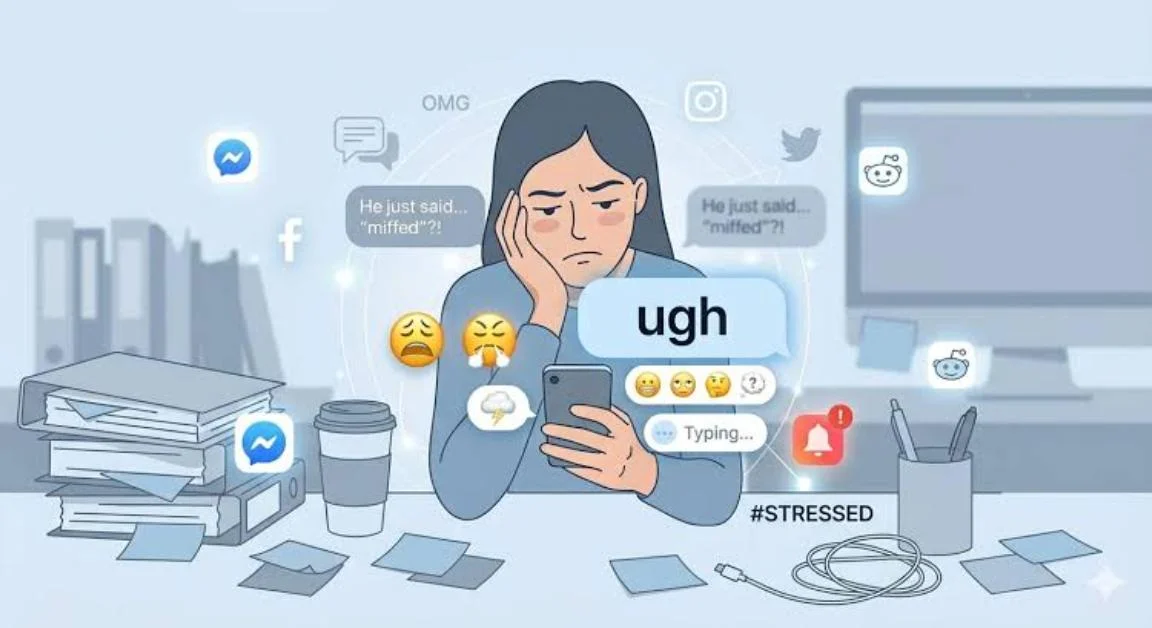
If someone sends you “ugh” in a text, you may wonder what they really mean. Is the person annoyed, disgusted, tired, upset, or simply having a bad day?
The answer depends on the conversation, but ugh meaning in text is usually connected with a strong negative reaction. It can show annoyance, frustration, dislike, disgust, boredom, disappointment, or emotional exhaustion.
Unlike many internet abbreviations, ugh is not normally a shortened phrase or acronym. It is an interjection that represents a sound people make when something feels unpleasant.
People search for the meaning of “ugh” because its tone can change with context. “Ugh!” can sound dramatic, while “ugh 😩” may show tiredness or frustration.
In this guide, we will explain what ugh means in texting, how it is used on social media, where it came from, and how you can reply naturally.
What Does Ugh Mean in Text & Chat?
In text messages and online chats, “ugh” usually expresses a negative feeling or reaction. The exact feeling depends on what happened before the message. It can mean something like “That is annoying,” “I hate this,” “This is unpleasant,” or “I cannot deal with this right now.”
The word is useful because it communicates emotion without needing a full sentence. Instead of typing, “I am really frustrated that I have to do this again,” someone may simply write:
- “Ugh, not again.”
- “Ugh 😩 I have so much work.”
- “Ugh, that smell.”
- “Ugh, I don’t want to go.”
- “Ugh! Why did he say that?”
The tone can range from mild annoyance to strong disgust. It can also show emotional tiredness.
For example, if your friend says, “I have to wake up at 5 a.m. tomorrow,” you might reply, “Ugh 😭”. Here, you are not showing disgust. You are showing sympathy and frustration.
Likewise, “Ugh, this food smells terrible” clearly expresses disgust.
Context matters more than the word itself. A message containing “ugh” should not automatically be read as anger toward you. Sometimes the person is simply reacting to a situation.
Quick meaning
- Ugh = annoyance
- Ugh = frustration
- Ugh = disgust
- Ugh = dislike
- Ugh = tiredness or emotional exhaustion
- Ugh = “I really don’t like this”
So, when someone texts “ugh”, think of it as an emotional reaction rather than a traditional abbreviation.
Full Form, Stands For & Short Meaning of Ugh
One common mistake is assuming that every short word used online has a hidden full form. Ugh does not normally stand for a longer phrase. It is not like “LOL,” which comes from “laughing out loud,” or “BRB,” which means “be right back.”
Instead, ugh is an interjection. It represents a sound associated with an unpleasant reaction. Dictionaries describe it as a sound or exclamation used to express feelings such as disgust, horror, annoyance, or dislike.
In simple terms, the short meaning of ugh can be:
“I don’t like this,” “This is annoying,” or “This feels unpleasant.”
However, the meaning changes according to the situation.
For example:
- “Ugh, this traffic.” → The person is frustrated.
- “Ugh, that food looks gross.” → The person feels disgusted.
- “Ugh, I have an exam tomorrow.” → The person feels stressed or unhappy.
- “Ugh, Monday again.” → The person dislikes the situation.
- “Ugh, I miss him.” → The person may be emotionally tired or sad.
Capital letters and punctuation can also affect the tone:
- ugh → casual or tired
- Ugh → stronger reaction
- UGH! → very strong emotion
- ugh 😩 → frustration or exhaustion
- ugh 🙄 → annoyance or disbelief
- ugh 🤢 → disgust
Therefore, there is no official “full form of UGH” in ordinary texting. If a website claims that UGH always stands for a particular phrase, be careful. That may be a made-up backronym rather than the normal meaning of the word.
Origin, History & First Known Use of Ugh
The history of ugh is much older than modern texting. It did not begin with WhatsApp, social media, or internet slang. It developed as a written representation of a sound people use when reacting to something unpleasant.
The exact history is interesting because different reference works give slightly different dates for early uses. Merriam-Webster lists 1678 as the first known use of “ugh” in its dictionary entry. Etymological sources connect the word with an imitative sound, including sounds resembling a cough, grunt, or reaction of discomfort.
Older uses were not always identical to the modern texting meaning. The word could represent an inarticulate sound, while later uses became strongly associated with disgust, horror, aversion, and dislike. Historical discussions of the word also connect it with expressions of shuddering or horror.
This makes “ugh” an example of an echoic or imitative expression. In simple language, the spelling tries to capture a sound people naturally make.
Over time, writers began using the word in dialogue and informal writing. Modern digital communication made it even more useful because texting does not include facial expressions, voice tone, or body language.
Today, “ugh” can communicate a surprisingly wide range of emotions with only three letters.
A simple timeline
- Earlier English: used to represent an inarticulate sound.
- Later usage: became linked with disgust, horror, and aversion.
- Modern conversation: expanded to include annoyance and frustration.
- Internet communication: became a quick emotional reaction in chats and social media.
So, “ugh” is not new slang. The internet simply gave an old expression a new and very convenient home.
How People Use Ugh in Daily Conversations
People use ugh in everyday conversations whenever they want to show an immediate emotional reaction. It often appears at the beginning of a sentence, but it can also appear by itself.
One reason it is popular is that it sounds natural. When people speak, they may make a similar sound without planning it. Writing “ugh” gives that spoken reaction a visual form.
For example:
- “Ugh, I forgot my keys.”
- “Ugh, this weather is awful.”
- “Ugh, I have to clean my room.”
- “Ugh, that was so awkward.”
- “Ugh, why is my phone so slow?”
The word does not always mean serious anger. Often, it describes a small annoyance.
Imagine a friend says, “The restaurant is closed today.” You might respond:
“Ugh, seriously? 😩”
That does not mean you hate the restaurant. It simply means you are disappointed.
The word can also be playful. Friends may exaggerate their reactions for humor:
Friend: “You have to watch this three-hour movie.”
You: “Ughhh, that’s so long 😂”
The extra letters can make the emotion feel stronger or more dramatic.
- ugh → normal reaction
- ughh → slightly more dramatic
- ughhh → stronger frustration
- UGH!!! → very strong reaction
The surrounding words and emojis help readers understand the intended tone.
A useful rule is this: “Ugh” tells you that the person has a negative reaction, but the conversation tells you exactly what caused it.
Ugh Meaning Across WhatsApp, Instagram, TikTok & Snapchat
The ugh meaning in text stays mostly the same across messaging and social platforms, but the style can change depending on the platform.
On WhatsApp, people commonly use “ugh” in private conversations. It may describe stress, tiredness, relationship problems, work, school, or everyday annoyances.
- “Ugh, I have to work tomorrow 😩”
- “Ugh, my internet stopped again.”
On Instagram, “ugh” often appears in comments, captions, Stories, or DMs. It can react to something annoying, embarrassing, attractive, exhausting, or emotionally difficult.
- “Ugh, this weather 😭”
- “Ugh, why does she look so good?”
On TikTok, the word can be playful or dramatic. A creator may use “ugh” as part of a reaction, joke, caption, or relatable post. The surrounding video usually gives the word its real meaning.
On Snapchat, “ugh” is often short and spontaneous. People may send it with an emoji or a picture:
- “Ugh 😒”
- “Ughhh 😭”
- “Ugh, Monday.”
The same word can therefore have different emotional shades.
Platform-specific patterns
- WhatsApp: personal frustration or everyday complaints
- Instagram: reactions, captions, comments, and DMs
- TikTok: humor, exaggeration, and relatable reactions
- Snapchat: quick emotional responses
The important point is that ugh is not a platform-specific abbreviation. Its core meaning remains an emotional reaction, while the context and style change from platform to platform.
Different Meanings of Ugh in Other Fields
Outside texting, ugh still works mainly as an interjection or written representation of a sound. It does not have one standard technical meaning across science, medicine, business, or technology.
In linguistics, ugh can be discussed as an interjection. Interjections are words or sounds that express sudden feelings or reactions. Ugh is especially interesting because its sound and meaning are closely connected.
In literature, writers may use “ugh” in dialogue to show disgust, fear, discomfort, or an immediate emotional response. It can make written speech feel more natural.
In comic books and graphic storytelling, short expressions such as “ugh,” “ugh!” or “ugh…” can represent a character’s reaction. The punctuation helps readers imagine the voice.
In gaming and online communities, people may use ugh in chat when a match goes badly, a player makes a mistake, or a frustrating event happens:
- “Ugh, we lost again.”
- “Ugh, that boss fight 😭”
- “Ugh, my game crashed.”
There can also be unrelated uses of the letters UGH as names, initials, codes, or abbreviations in specific organizations or technical settings. Those meanings should not be confused with everyday texting.
The key distinction
If you see ugh in a normal personal message, the safest interpretation is an emotional reaction.
If you see UGH in a technical document, company name, database field, or specialist context, check the surrounding information before assigning it the texting meaning.
Common Confusions, Mistakes & Wrong Interpretations
Because “ugh” is short, people sometimes misunderstand its tone. The biggest mistake is assuming that it always means disgust.
Disgust is one meaning, but it is not the only one. Someone can write “ugh” because they are tired, annoyed, disappointed, stressed, embarrassed, or overwhelmed.
For example:
“Ugh, I have three assignments due tomorrow.”
This probably means frustration or stress, not disgust.
Another common mistake is thinking that UGH has a universal full form. It does not in ordinary texting. It is an interjection, not a standard acronym.
People also sometimes assume “ugh” means the sender is angry at them personally. That is not necessarily true.
Compare:
- “Ugh, this traffic is terrible.” → frustration with traffic
- “Ugh, you did it again.” → possible annoyance with the person
- “Ugh 😭 I miss you.” → sadness or longing
Tone can also change with punctuation.
- “ugh.” may feel flat or tired.
- “Ugh!” sounds stronger.
- “UGH!!!” feels dramatic or intense.
- “ughhh…” can suggest exhaustion or reluctance.
- “ugh 😂” may be playful.
Avoid these assumptions
- “Ugh always means disgust.” ❌
- “UGH always has a full form.” ❌
- “Someone saying ugh is definitely angry with me.” ❌
- “The word has exactly one emotional meaning.” ❌
The best way to understand it is to read the sentence before and after “ugh.”
Similar Terms, Alternatives & Related Slang
Several words can express feelings similar to ugh, but they are not exact replacements. Each one has its own emotional flavor.
“Ew” is usually stronger when the reaction is specifically disgust.
- “Ew, that smells awful.”
“Yuck” also focuses on disgust or something unpleasant.
- “Yuck, I don’t want that.”
“Oof” often shows pain, sympathy, embarrassment, or the impact of bad news.
- “Oof, that must have hurt.”
“Meh” usually shows indifference, boredom, or a lack of enthusiasm.
- “Meh, the movie was okay.”
“Sigh” represents tiredness, disappointment, or resignation.
- “Sigh, I guess I’ll do it.”
“Argh” is often used for strong frustration or irritation.
- “Argh, my computer froze!”
“Yikes” usually signals alarm, shock, awkwardness, or concern.
- “Yikes, that’s not good.”
Quick comparison
- Ugh → annoyance, dislike, disgust, frustration
- Ew → disgust
- Yuck → disgust
- Oof → pain, sympathy, impact
- Meh → indifference
- Sigh → tiredness or resignation
- Argh → frustration
- Yikes → alarm or awkwardness
These words can overlap, but the emotional tone is different. Choosing the right one makes your message sound more natural.
Internal linking suggestions
If you are building a slang or abbreviation website, useful internal links could include:
- LOL Meaning in Text
- OMG Meaning in Text
- Oof Meaning in Text
- Meh Meaning in Text
- BRB Meaning in Text
- IDK Meaning in Text
- TBH Meaning in Text
- FR Meaning in Text
- WTF Meaning in Text
These related pages can help readers move from one texting term to another without making the article feel repetitive.
Examples of Ugh in Real Chat Situations
The meaning of “ugh” becomes much easier to understand when you see it in realistic conversations. Here are some short examples.
1. Work frustration
Alex: “Your meeting starts at 7 a.m. tomorrow.”
Sam: “Ugh 😩 why so early?”
Here, ugh means frustration or dislike.
2. Disgust
Alex: “I think the milk has gone bad.”
Sam: “Ugh 🤢 throw it away!”
Here, ugh clearly means disgust.
3. School stress
Alex: “Did you finish the assignment?”
Sam: “Ugh, not yet. I still have two pages.”
Here, ugh means stress or frustration.
4. Disappointment
Alex: “The concert is sold out.”
Sam: “Ughhh 😭 I really wanted to go.”
Here, ugh expresses disappointment.
5. Relationship frustration
Alex: “He canceled again.”
Sam: “Ugh, seriously?”
Here, ugh shows annoyance or sympathy.
6. Playful reaction
Alex: “You have to watch this embarrassing video of me.”
Sam: “Ugh 😂 okay, send it.”
Here, ugh is playful, not genuinely angry.
7. Monday mood
Alex: “It’s Monday.”
Sam: “Ugh.”
This one-word reply can communicate a whole feeling: “I am not ready for this week.”
The key lesson is simple: look at the situation, not just the word.
How to Reply When Someone Says Ugh
Your reply should match the reason behind the person’s “ugh.” If they are complaining, you can show sympathy. If they are joking, you can joke back. If they sound upset, ask what happened.
For simple frustration, try:
- “I know 😩”
- “Seriously!”
- “That sounds annoying.”
- “Ugh, I feel you.”
- “What happened?”
If the person seems disgusted:
- “Eww, that’s gross 🤢”
- “No way!”
- “Yeah, definitely avoid that.”
If they seem tired or stressed:
- “Long day?”
- “You okay?”
- “Take a break 😭”
- “I feel you. Today has been rough.”
If they are upset about something personal, a caring response is better:
- “What happened?”
- “Want to talk about it?”
- “I’m listening.”
- “That sounds really frustrating.”
If the conversation is playful, you can match the tone:
Them: “Ughhh, I have to study tonight.”
You: “Ughhh, tragic 😂”
The most important thing is not to overthink a simple “ugh.” You can use the previous messages to understand the emotion.
A good rule for replying
- Mild complaint: agree or sympathize.
- Strong frustration: ask what happened.
- Disgust: react to the unpleasant thing.
- Sadness: be supportive.
- Joke: keep it playful.
A short, natural response is usually better than a long explanation.
Is Ugh Still Popular? Trends & Online Usage

Yes. Ugh is still widely understandable and useful in modern English, especially in informal writing, texting, social media, and everyday conversation. Current dictionary examples continue to show “ugh” being used for reactions such as annoyance, disgust, and dislike.
Its popularity is partly explained by how flexible it is. Online communication often needs quick ways to show emotion. A three-letter reaction can replace an entire sentence.
For example:
“Ugh 😩”
could communicate:
“I am so tired of dealing with this.”
The word also works well with modern emoji culture. Adding an emoji can make the intended meaning clearer:
- Ugh 😩 → exhaustion
- Ugh 😒 → annoyance
- Ugh 🤢 → disgust
- Ugh 😭 → dramatic frustration or sadness
- Ugh 😂 → playful frustration
Another reason it remains useful is that it does not feel tied to one particular social platform. Unlike some short-lived internet slang, “ugh” existed long before today’s social networks.
It can appear in private texts, comments, captions, group chats, memes, online communities, and spoken conversation.
The spelling may change for emphasis. People often write “ughhh,” “ughhhh,” or “UGH” when they want to make the reaction feel bigger.
So while internet slang constantly changes, ugh has strong staying power because it represents a basic human reaction rather than a temporary online trend.
Frequently Asked Questions
What does ugh mean in a text message?
“Ugh” usually expresses annoyance, frustration, dislike, disgust, tiredness, or another negative reaction. The exact meaning depends on the conversation.
Is ugh a bad word?
No. “Ugh” is generally not considered a swear word. It is an informal interjection used to express a reaction.
Does UGH have a full form?
No standard full form exists for “ugh” in ordinary texting. It is normally an interjection, not an acronym.
What does ugh mean from a girl?
A girl using “ugh” can mean the same things as anyone else: annoyance, frustration, disgust, disappointment, tiredness, or playful exaggeration. Context matters more than gender.
What does ugh mean from a guy?
A guy saying “ugh” can also express frustration, annoyance, dislike, disgust, tiredness, or disappointment. The surrounding conversation tells you which meaning is intended.
What does “ughhh” mean in texting?
“Ughhh” is an extended version of “ugh.” The extra letters usually add emphasis and can make the message sound more dramatic, tired, frustrated, or emotional.
What does “ugh 😩” mean?
“Ugh 😩” usually suggests frustration, exhaustion, stress, or feeling overwhelmed. The 😩 emoji makes the emotional reaction clearer.
Is ugh the same as ew?
Not exactly. “Ew” is more strongly connected with disgust, while “ugh” can express disgust but is also commonly used for frustration, annoyance, tiredness, and dislike.
What is the difference between ugh and oof?
“Ugh” usually signals annoyance, dislike, or disgust. “Oof” more often reacts to pain, embarrassment, bad news, or something difficult.
Conclusion:
Understanding the ugh meaning in text is simple once you focus on the context. In most chats, “ugh” is an emotional reaction that can express annoyance, frustration, disgust, dislike, disappointment, or tiredness.
It is not normally an acronym and does not have a standard full form. Instead, it is an interjection that represents a sound associated with an unpleasant reaction.
The meaning can change slightly depending on punctuation, repeated letters, emojis, and the conversation.
“Ugh 😩” may mean exhaustion, while “Ugh 🤢” clearly suggests disgust. “Ughhh 😂” may be completely playful.
The word is also much older than modern texting. Historical sources trace its written use back centuries, while modern social media has simply made it an easy way to show emotion quickly.
So, when you see “ugh” in a message, read the context first. In most cases, it simply means: “I really don’t like this” or “This is frustrating.”
