If you have received a message containing “OKG”, you may have wondered what the sender meant. Is it a typo?
A short form of “okay”? Or does the “G” stand for something else? The OKG meaning in text is not completely fixed, which is why people often search for it online.
In casual messages, OKG can be used as a quick way to show agreement, acknowledgment, or understanding. Some people also use it as a playful variation of “OMG,” especially when reacting to something surprising.
Because OKG is much less established than terms such as LOL, IDK, or OMG, the surrounding message matters a lot.
In this guide, we will explain the most likely meanings of OKG, how people use it on popular apps, how to reply, and how to avoid misunderstanding it.
What Does OKG Mean in Text & Chat?
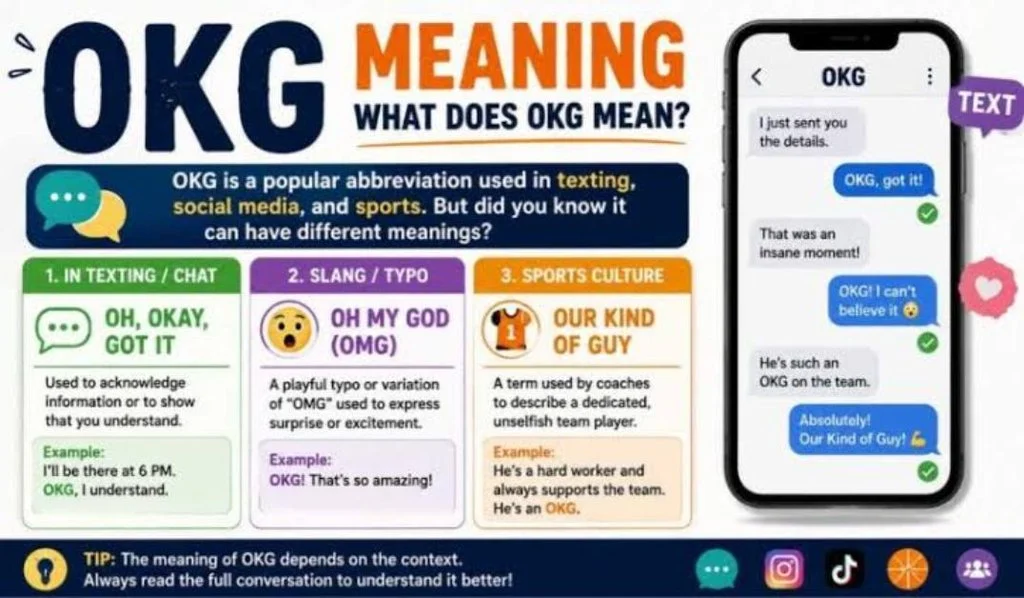
The simplest answer is that OKG is an informal texting expression whose meaning depends on context. It does not have one universal definition used by everyone.
In many casual conversations, OKG is understood as something close to “Okay, good,” “Okay, got it,” or simply “okay.” It can be used when someone wants to confirm that they understand a message or agree with what was said.
For example:
- “I’ll send you the notes tonight.”
- “OKG 👍”
Here, the reply probably means something like “Okay, got it” or “Okay, good.”
However, there is another possible interpretation. Some people type OKG as a playful or accidental variation of “OMG,” meaning “Oh My God.” This is more likely when the message expresses surprise, excitement, shock, or disbelief.
For example:
- “OKG 😭 That was so funny!”
- “OKG, did you actually do that?”
In these cases, the intended meaning may be closer to “OMG.”
This makes context especially important. Look at the words around OKG, the emoji, punctuation, and the topic of the conversation before deciding what it means.
A useful rule is:
- After information or instructions: likely “okay/got it.”
- Before an emotional reaction: it may mean “OMG.”
- In a very short reply: it may simply be a typo or casual “okay.”
Because OKG is not a standard English abbreviation, it is better to avoid assuming one meaning every time.
Full Form, Stands For & Short Meaning of OKG
Unlike well-known abbreviations such as LOL or BRB, OKG does not have one officially recognized full form in everyday texting.
Several interpretations appear in online conversations, but they are not equally common or established. The most useful interpretations are:
| OKG | Possible meaning | Typical use |
|---|---|---|
| OKG | Okay, good | Agreement or approval |
| OKG | Okay, got it | Acknowledgment |
| OKG | Oh, okay | Understanding or mild reaction |
| OKG | OMG variation | Surprise or excitement |
| OKG | Simple typo | Fast or accidental typing |
When someone asks, “What does OKG stand for in text?”, the safest answer is that OKG is context-dependent rather than a fixed acronym.
If the conversation is about plans, instructions, or information, “okay, got it” is a reasonable interpretation.
Example:
“The meeting starts at 8 instead of 9.”
“OKG.”
This likely means “Okay, got it.”
But consider this:
“She actually won the competition!”
“OKG 😭🔥”
Here, the sender may have intended “OMG.”
The difference comes from context rather than the three letters themselves.
It is also important not to treat every meaning found online as a standard definition. Informal slang can be created inside a friend group, gaming community, or social-media community. A person may give OKG their own meaning.
So, if the message seems unclear, the best approach is to read the entire conversation rather than translating OKG by itself.
For related slang terms, consider internal links to pages such as [OMG meaning in text], [OK meaning in text], [LOL meaning in text], [IDK meaning in text], and [BRB meaning in text].
Origin, History & First Known Use of OKG

There is no strong evidence that OKG has a single inventor, official launch date, or clearly documented first use in texting.
That is common with internet slang. Many short forms develop naturally as people communicate through SMS, messaging apps, gaming chats, forums, and social media. Users shorten words, create playful spellings, and sometimes turn typing mistakes into repeatable expressions.
OKG appears to belong to this wider pattern.
The letters OK have long been used as a quick form of “okay.” People also regularly modify familiar expressions. For example, digital conversations have produced forms such as:
- “ok”
- “okay”
- “okayy”
- “okkk”
- “oki”
- “k”
- “OMG”
Because of this flexible style, OKG can emerge in different ways. A person might use the G for “good” or “got it,” while another person might type it accidentally when intending to write “OMG.”
This is why claims that OKG began in one specific year or on one specific social platform should be treated carefully. There is no widely accepted historical record showing a single origin.
Its development is better understood as part of the larger history of internet shorthand.
As messaging became faster, users began favoring short replies that could communicate a basic reaction without full sentences. Social platforms also encouraged quick comments and reactions.
Today, OKG remains relatively uncommon compared with established abbreviations such as LOL, OMG, FYI, and IDK. Its meaning is therefore more flexible and more dependent on the individual conversation.
How People Use OKG in Daily Conversations
People generally use OKG in informal conversations where a short response is enough. It may acknowledge information, show agreement, or add a quick emotional reaction.
One common use is to confirm that the sender understands something.
Example:
- Person A: “Please bring your ID tomorrow.”
- Person B: “OKG 👍”
Here, OKG can be read as “Okay, got it.”
Another use is simple agreement.
- “We can meet at 6.”
- “OKG, works for me.”
The tone is short and relaxed. It does not necessarily show excitement.
OKG may also appear when someone wants to keep a conversation moving.
- “I already sent the document.”
- “OKG.”
Depending on the relationship, this can sound neutral, friendly, or slightly dry.
Punctuation can change the feeling:
- “okg” → casual and relaxed
- “OKG!” → more energetic
- “okg 👍” → friendly acknowledgment
- “okg…” → possibly confused, tired, or uninterested
- “OKG 😭” → could be an emotional reaction or playful version of OMG
The safest way to understand it is to consider the message before and after OKG.
For everyday use, OKG is best kept to informal situations. It may work with friends, classmates, gaming friends, or social-media contacts. In a formal email, business document, or professional message, writing “Okay,” “Understood,” or “Got it” is clearer.
OKG Meaning Across WhatsApp, Instagram, TikTok & Snapchat
The meaning of OKG does not automatically change from one app to another. However, the style of communication on each platform can affect how a reader interprets it.
On WhatsApp, OKG may be used as a short reply to a friend or group message.
- “Dinner at 8?”
- “OKG 👍”
It can mean “Okay” or “Okay, good.”
On Instagram, OKG may appear in DMs, comments, or story replies. Because Instagram conversations often include emojis and casual language, OKG can have a playful tone.
- “You need to see this 😂”
- “OKG 😭”
If the message is clearly emotional, the sender may be using OKG as a playful version of OMG.
TikTok
TikTok language changes quickly. Users often experiment with spellings and short expressions. As a result, OKG may be used jokingly or as an alternative-looking reaction.
For example:
- “This ending was crazy.”
- “OKG 😭”
The surrounding content is the key to understanding it.
Snapchat
Snapchat conversations are usually quick and informal. A person might use OKG simply to acknowledge a snap or message.
- “I’ll send it later.”
- “okg”
Here, it is more likely to mean “okay” or “got it.”
Overall, the platform itself does not give OKG a fixed meaning. Context remains more important than the app.
Different Meanings of OKG in Other Fields
OKG is primarily something you may encounter in informal digital communication. It is not a universally recognized technical term with one standard definition across science, medicine, business, or education.
That matters because abbreviations can have completely different meanings in specialized fields.
For example, a three-letter abbreviation may be used internally by a company, school, gaming group, or organization. In such cases, the meaning could be unique to that group.
So, if you see OKG in a professional document, do not automatically assume it means “okay, good” or “OMG.” Look at the surrounding material.
Possible contexts include:
- Internal company abbreviations
- Usernames or account names
- Gaming terminology
- Organization names
- Project codes
- Informal group shorthand
- Typographical errors
There is also an important distinction between OKG as slang and OKG as a formal abbreviation. A casual text interpretation cannot safely be applied to a technical document.
For example:
“Please review the OKG report before Friday.”
Here, OKG could be the name of a project or report. It would not make sense to automatically translate it as “okay, good.”
Similarly, if you see OKG in a medical, legal, academic, or business context, check the document’s glossary or ask the writer.
For SEO content about texting slang, it is useful to make this distinction clear. The OKG meaning in text is informal and context-based. It should not be presented as a universal abbreviation used in every professional field.
Common Confusions, Mistakes & Wrong Interpretations
The biggest problem with OKG is that it can look like other familiar abbreviations.
The most common confusion is OMG.
Because OKG and OMG contain the same first and last letters, a reader may wonder whether the sender simply made a typing mistake.
Compare:
- OMG! That was amazing! → clear surprise or excitement
- OKG! That was amazing! → could be a playful OMG variation or typo
Another common mistake is assuming that OKG always means “Okay, good.” That interpretation can make sense in one conversation but not another.
For example:
“She just told me she got the job!”
“OKG 😭”
This does not naturally read as “okay, good.” It may be intended as an emotional reaction.
Tone also causes confusion. A short message such as “okg.” can feel cold even if the sender meant it as a simple acknowledgment.
Emoji use can provide clues:
- 😂 → humor
- 😭 → strong emotion
- 😮 → surprise
- 👍 → agreement
- ❤️ → warmth or affection
Another mistake is assuming that OKG is a highly popular slang term simply because you have seen it several times. Compared with major abbreviations such as LOL, OMG, IDK, and BTW, OKG is relatively uncommon and less standardized.
If you are unsure, ask:
“Do you mean okay/got it or OMG?”
That is often easier than guessing.
The main lesson is simple: do not interpret OKG from the letters alone. Read the whole message.
Similar Terms, Alternatives & Related Slang
If someone uses OKG, several more familiar expressions may communicate a similar idea.
For acknowledgment or agreement, common alternatives include:
- OK — simple agreement
- Okay — neutral and clear
- Got it — confirms understanding
- Understood — more formal
- Sure — agreement
- Sounds good — positive agreement
- K — very short acknowledgment
- Alright — casual agreement
If OKG appears to mean surprise, alternatives may include:
- OMG — Oh My God
- OMG! — strong surprise
- Whoa — surprise
- Wow — amazement
- No way! — disbelief
- LOL — laughter, depending on context
- WTF — strong surprise or disbelief, but more informal and potentially offensive
The important difference is that these terms have clearer and more widely recognized meanings than OKG.
For example:
“I’ll meet you at 7.”
“Got it 👍”
This is much clearer than:
“OKG.”
Likewise:
“You won the whole thing!”
“OMG 😭”
is immediately understandable as a surprised reaction.
For website SEO, this section is also a good place for internal links. You could link OKG meaning in text to related pages such as:
- [OMG meaning in text]
- [IDK meaning in text]
- [IKR meaning in text]
- [TBH meaning in text]
- [BTW meaning in text]
- [LOL meaning in text]
- [FR meaning in text]
- [WYD meaning in text]
These related pages can help readers understand the wider world of texting abbreviations.
Examples of OKG in Real Chat Situations
The meaning of OKG becomes much easier to understand when you see it in realistic conversations.
Example 1: Confirming information
- A: “The class starts at 9 tomorrow.”
- B: “OKG 👍”
Meaning: “Okay, got it.”
Example 2: Agreeing with a plan
- A: “Let’s meet outside the café.”
- B: “okg, sounds good.”
Meaning: “Okay, that works.”
Example 3: Reacting to surprising news
- A: “He actually bought the car!”
- B: “OKG 😭”
Meaning: Possibly “OMG!” or a playful surprise reaction.
Example 4: Casual acknowledgment
- A: “I sent the file to your email.”
- B: “OKG.”
Meaning: “Okay, thanks/got it.”
Example 5: Funny or playful use
- A: “I accidentally deleted the whole playlist 😂”
- B: “OKG 😭😂”
Meaning: Likely an emotional or humorous reaction rather than “okay, good.”
Example 6: When the meaning is unclear
- A: “I changed my plans.”
- B: “OKG.”
Here, you cannot know the exact meaning from OKG alone. It might mean “okay,” “got it,” or something else.
That is why context matters so much.
How to Reply When Someone Says OKG
Your reply should depend on what you think the sender means.
If OKG means “okay, got it,” you may not need to say much.
Try:
- “Perfect 👍”
- “Thanks!”
- “Great.”
- “See you then!”
- “Awesome 😊”
If OKG seems to be a reaction like “OMG,” respond to the emotion.
For example:
- “I know 😂”
- “Right?! 😭”
- “I was shocked too!”
- “Seriously! 😂”
- “Exactly!”
If you are not sure what the sender means, simply ask.
- “Do you mean okay or OMG? 😂”
- “What do you mean by OKG?”
- “OKG as in okay, got it?”
There is nothing strange about asking. Since OKG is not a universally standardized abbreviation, clarification can prevent misunderstandings.
In professional conversations, you should usually respond with clear language instead.
Instead of copying the slang, use:
- “Understood.”
- “Thanks, I’ll do that.”
- “Sounds good.”
- “Got it.”
This is especially useful when communicating with someone you do not know well.
The best reply is therefore not based on the abbreviation alone. Match your response to the tone and purpose of the conversation.
Is OKG Still Popular? Trends & Online Usage
OKG exists in online communication, but it is important not to confuse visibility with widespread popularity.
Unlike major texting abbreviations such as LOL, OMG, IDK, BTW, and BRB, OKG is not a highly standardized or universally understood expression. Current web results show several competing interpretations, including “okay, good,” “okay, got it,” and a playful variation of “OMG.”
That variation tells us something important: OKG is still a context-based expression rather than a fixed piece of internet vocabulary.
People are more likely to experiment with unusual abbreviations in:
- Private chats
- Group conversations
- TikTok comments
- Instagram DMs
- Snapchat messages
- Gaming communities
- Meme-based conversations
Online language also changes quickly. A spelling that looks unusual today can become familiar in a particular community tomorrow. The opposite can happen too: a slang term can disappear when users move on to a newer expression.
For readers searching “OKG meaning in text,” the most useful takeaway is therefore not that OKG has one permanent definition. Instead, it is a flexible abbreviation whose meaning should be understood from context.
If you see it frequently from one person, their personal texting style may be the best clue.
And if the meaning still seems unclear, asking the sender is better than assuming.
FAQs
What does OKG mean in text?
OKG is a context-dependent informal expression. It may mean “okay, good,” “okay, got it,” or simply “okay.” In some emotional messages, it may also be a playful variation or typo of “OMG.”
Is OKG the same as OMG?
Not necessarily. OMG clearly means “Oh My God.” OKG may sometimes be used like OMG, but it can also mean “okay” or “okay, got it.” Context is important.
What does OKG mean on WhatsApp?
On WhatsApp, OKG is usually a casual acknowledgment or agreement. It may mean “okay,” “got it,” or “okay, good.” If it appears with an emotional emoji, it could have another meaning.
What does OKG mean on Snapchat?
On Snapchat, OKG may be used as a quick casual reply. Depending on the message, it can mean “okay,” “got it,” or possibly be a playful reaction similar to OMG.
Is OKG a rude word?
No. OKG is not inherently rude. However, a very short reply can sometimes sound cold or dismissive. Tone depends on punctuation, emojis, and the relationship between the people chatting.
Can OKG mean “Okay, good”?
Yes. “Okay, good” is one reasonable interpretation of OKG, especially when someone is confirming information or agreeing with a plan.
Can OKG mean “Okay, got it”?
Yes. In a conversation involving instructions or information, OKG can be understood as a short form of “Okay, got it.”
Should I use OKG in a professional email?
It is better to avoid it in formal communication because the abbreviation is ambiguous. Use “Okay,” “Understood,” “Got it,” or “Sounds good” instead.
How can I tell what OKG means?
Read the surrounding message. Look at the topic, punctuation, emojis, and the sender’s usual style. If the meaning is still unclear, ask the person directly.
Conclusion:
The OKG meaning in text can be confusing because it does not have one fixed definition. In casual conversations, it can mean “okay,” “okay, good,” or “okay, got it.
” In some situations, people may also use it as a playful variation or typo of “OMG” when reacting to something surprising or funny.
The surrounding conversation is therefore the best clue. WhatsApp, Instagram, TikTok, and Snapchat do not give OKG a completely different official meaning; users simply adapt the expression to their own online style.
Because OKG is less established than common slang such as LOL, OMG, or IDK, it is wise not to assume its meaning immediately.
When the context is unclear, a quick question can solve the problem. For formal communication, choose clearer words such as “Understood” or “Sounds good.”
