
If you have seen “IMAO” in a text message, comment, or social media post, you may have wondered what it means.
Is it a typo for “LMAO”? Is it another way to say “in my opinion”? Or does it have a completely different meaning? The answer depends on the context.
The established meaning of IMAO is “In My Arrogant Opinion.
” It is an internet abbreviation that people use when giving an opinion in a playful, bold, sarcastic, or self-aware way. It is closely related to IMHO, which means “In My Humble Opinion.”
However, lowercase “imao” can also be confused with “lmao” because the lowercase letters i and l can look similar in some fonts.
This makes context especially important. In this guide, we will explain the IMAO meaning in text, its full form, history, examples, social media use, and the best ways to reply.
What Does IMAO Mean in Text & Chat?
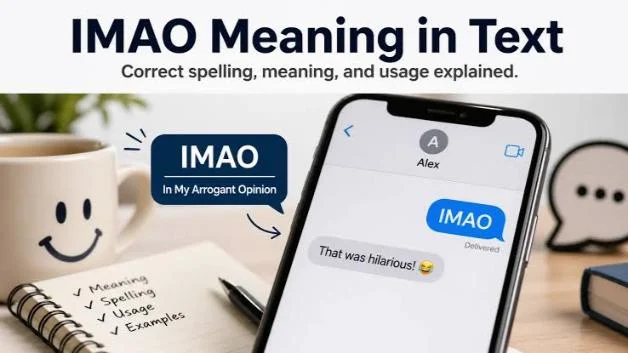
IMAO means “In My Arrogant Opinion.” In texting, it is usually used before or after an opinion. The phrase has a humorous twist because the speaker openly calls their own opinion “arrogant.”
Instead of sounding completely serious, IMAO can make a strong opinion feel more playful.
For example:
- “IMAO, this is the best movie of the year.”
- “That was the easiest exam ever, IMAO 😂”
- “IMAO, pizza is better than burgers.”
- “You should definitely pick the blue one, IMAO.”
The word “arrogant” does not always mean that the person is truly arrogant. Very often, it is part of the joke. The writer may be poking fun at themselves for sounding too confident.
IMAO is closely connected with IMHO, or “In My Humble Opinion.” IMAO basically flips the idea of humility into deliberate confidence. Dictionary sources describe it as an internet and texting initialism that developed as a playful variation of IMHO.
There is one important warning: IMAO can sometimes be a typo for LMAO. If someone writes “imao” after a joke, funny picture, or hilarious story, they may actually mean LMAO — Laughing My Ass Off. Dictionary.com specifically notes this possible confusion because lowercase “l” and uppercase “I” can look alike in some fonts.
So, when you see IMAO, look at the sentence around it before deciding what the writer means.
Full Form, Stands For & Short Meaning of IMAO
The full form of IMAO is:
In My Arrogant Opinion
Its short meaning is:
“This is my very confident or slightly arrogant opinion.”
Unlike some abbreviations that simply shorten a common sentence, IMAO also adds a layer of humor. It tells the reader that the following statement is an opinion, while jokingly admitting that the speaker may sound overly confident.
Here is a simple breakdown:
- I = In
- M = My
- A = Arrogant
- O = Opinion
The closest common abbreviation is IMHO, which means In My Humble Opinion.
You may also see related expressions such as:
- IMO — In My Opinion
- IMHO — In My Humble Opinion
- IMNSHO — In My Not-So-Humble Opinion
- IMVHO — In My Very Humble Opinion
IMAO is generally less common than IMO and IMHO. It is more likely to appear when someone wants to add humor, irony, or exaggerated confidence to an opinion.
For example:
“IMAO, my cooking deserves a five-star review. 😂”
The speaker probably does not seriously believe they are a world-class chef. The phrase makes the statement intentionally funny.
Another example:
“IMAO, nobody makes better fries than me.”
Here, IMAO makes the boast sound playful rather than completely serious.
The safest short definition is therefore “In My Arrogant Opinion — a humorous way to introduce a strong personal opinion.”
Origin, History & First Known Use of IMAO
IMAO grew out of the same internet abbreviation culture that produced expressions such as IMHO. IMHO means “In My Humble Opinion” and became associated with online discussions where people wanted to mark a statement as their personal view.
IMAO turns that idea around. Instead of saying the opinion is humble, the writer jokingly calls it arrogant.
Historical evidence shows that the phrase “in my arrogant opinion” existed before modern social media. Dictionary.com reports an early IMAO example from a May 1989 Usenet discussion, where a contributor used the abbreviation while discussing the history of the Grateful Dead. The contributor also explained what the abbreviation meant.
This is important because it shows that IMAO is not a slang term invented by TikTok or modern messaging apps. Its roots go back to early online discussion communities.
The broader pattern was simple:
- IMHO presented an opinion as humble.
- IMAO humorously presented an opinion as arrogant.
- Online users used the contrast to add personality to written conversations.
Dictionary.com notes that IMAO appeared repeatedly in Usenet discussions during the late 1980s and became more widespread during the 1990s. However, it never became as common as IMHO.
The exact phrase “in my arrogant opinion” can also be found outside the abbreviation itself. For example, language references have documented the expression in earlier written material. This suggests that the phrase existed as a humorous construction before IMAO became a recognizable internet initialism.
Today, IMAO is mainly an informal internet expression. Its meaning remains connected to playful confidence and opinion-sharing.
How People Use IMAO in Daily Conversations
People use IMAO when they want to share an opinion while making it sound bold, cheeky, or humorous.
It usually appears in casual conversations rather than formal writing. You would not normally use IMAO in a school essay, business report, legal document, or professional email.
Common uses include:
- Giving a strong personal opinion
- Making a playful claim
- Joking about being overly confident
- Adding sarcasm to a statement
- Making a debate feel less serious
- Poking fun at yourself
For example:
Friend: “Which phone should I buy?”
You: “IMAO, the black one looks much better 😎”
Here, IMAO tells your friend that this is your personal judgment.
Another example:
Friend: “Who is the best football player?”
You: “IMAO, nobody comes close to him.”
The phrase adds confidence to the statement.
It can also be used after the opinion:
- “That restaurant is overrated, IMAO.”
- “You are definitely the funniest person here, IMAO 😂.”
- “This game needs a better ending, IMAO.”
The tone can range from friendly to sarcastic. Context matters.
If someone writes:
“IMAO, you are absolutely wrong.”
They may be joking, but they could also be deliberately challenging another person.
That is why you should not automatically assume IMAO is rude. The surrounding words, relationship between the people, and overall conversation usually reveal the intended tone.
A good rule is simple: IMAO usually signals a strong opinion with a humorous or self-aware edge.
IMAO Meaning Across WhatsApp, Instagram, TikTok & Snapchat
The IMAO meaning in text does not normally change from one major social platform to another. Whether you see it on WhatsApp, Instagram, TikTok, Snapchat, Reddit, Discord, or another chat service, the established meaning remains “In My Arrogant Opinion.”
What changes is the style of the conversation.
On WhatsApp, IMAO may appear in private chats or group conversations.
Example:
“IMAO, we should order pizza again 😂”
It can make a strong suggestion sound playful.
On Instagram, you may see IMAO in comments or direct messages.
Example:
“IMAO, this is your best outfit yet 🔥”
Here, it introduces a confident personal opinion.
TikTok
TikTok comments often use short slang and exaggerated humor. IMAO can fit this style when someone makes a strong claim.
Example:
“IMAO, this is the funniest video on my FYP.”
However, because IMAO can look like LMAO, some TikTok users may simply be making a typing mistake.
Snapchat
Snapchat conversations are usually quick and informal, so abbreviations are common.
Example:
“IMAO you really thought that would work 😂”
The meaning depends heavily on the surrounding message.
One important point is that “imao” is not always intentional IMAO. Some people type it when they actually mean LMAO. This confusion is especially possible in lowercase text.
So, if someone sends:
“That video was crazy imao 😂😂”
They may have intended LMAO rather than “In My Arrogant Opinion.”
Different Meanings of IMAO in Other Fields
In ordinary English texting, IMAO most commonly refers to “In My Arrogant Opinion.” However, abbreviations can have different meanings in specialized fields or different languages.
This is why context matters.
For example, in Spanish-language medical terminology, IMAO can be associated with inhibidor de la monoaminooxidasa, referring to a monoamine oxidase inhibitor. That is a completely different use from the English internet slang.
You should therefore consider where you found the term.
In casual English chat
IMAO = In My Arrogant Opinion
In medical Spanish
IMAO = a term associated with monoamine oxidase inhibitors
In online conversations
The lowercase “imao” may sometimes be a mistaken version of “lmao.”
This creates three possible situations:
- The person intentionally means In My Arrogant Opinion
- The person accidentally typed imao instead of lmao
- The abbreviation is being used in a specialized field
If the conversation is about movies, food, games, jokes, fashion, sports, or personal opinions, the internet-slang meaning is usually the most relevant.
If you see IMAO in a medical document or technical text, do not assume it means internet slang. Look at the surrounding terminology.
Common Confusions, Mistakes & Wrong Interpretations
The biggest confusion around IMAO is its similarity to LMAO.
At a quick glance, these can look almost identical:
- IMAO
- LMAO
But their established meanings are different.
IMAO = In My Arrogant Opinion
LMAO = Laughing My Ass Off
This is especially confusing when both are written in lowercase:
- imao
- lmao
The letters can be difficult to distinguish in some fonts. Dictionary.com specifically identifies this as one reason people may use or interpret IMAO incorrectly.
Another mistake is assuming that IMAO always means the writer is genuinely arrogant. Usually, that is not the point. The “arrogant” part is often humorous or self-aware.
For example:
“IMAO, I make the best pancakes.”
This could simply be a joke.
Another common mistake is treating IMAO like a formal phrase. It is internet slang and works best in casual communication.
Avoid using it in:
- Formal business reports
- Academic assignments
- Professional applications
- Official documents
- Formal customer messages
You should also avoid reading too much into the abbreviation without considering context.
If someone says:
“IMAO, this song is terrible.”
They may be joking, confidently sharing an opinion, or trying to sound sarcastic.
The surrounding conversation gives you the clue.
Similar Terms, Alternatives & Related Slang
IMAO belongs to a large family of internet abbreviations used to express opinions, reactions, and emotions.
Here are some useful related terms:
- IMO — In My Opinion
- IMHO — In My Humble Opinion
- IMNSHO — In My Not-So-Humble Opinion
- IMVHO — In My Very Humble Opinion
- LMAO — Laughing My Ass Off
- LOL — Laughing Out Loud
- TBH — To Be Honest
- IDK — I Don’t Know
- IKR — I Know, Right?
- FYI — For Your Information
The closest alternatives to IMAO are IMO and IMHO.
The difference is mainly tone:
| Slang | Meaning | Typical Tone |
|---|---|---|
| IMO | In My Opinion | Neutral |
| IMHO | In My Humble Opinion | Polite or modest |
| IMAO | In My Arrogant Opinion | Playful or confident |
| IMNSHO | In My Not-So-Humble Opinion | Humorous or sarcastic |
For example:
IMO:
“IMO, this is the better option.”
IMHO:
“IMHO, you should give it another chance.”
IMAO:
“IMAO, this is obviously the best option 😂.”
The last one sounds more exaggerated and playful.
If you are writing for a professional audience, IMO is usually safer. If you are chatting with friends, IMAO can add personality when the context is clear.
Internal linking suggestions:
- Link IMHO meaning to your article about “IMHO Meaning in Text.”
- Link IMO meaning to your “IMO Meaning in Text” page.
- Link LMAO meaning to your “LMAO Meaning in Text” guide.
- Link LOL meaning to your “LOL Meaning in Text” article.
- Link TBH meaning to your “TBH Meaning in Text” page.
- Link IDK meaning to your “IDK Meaning in Text” article.
Examples of IMAO in Real Chat Situations
Seeing IMAO inside a real conversation makes its meaning much easier to understand.
Example 1: Food
Alex: “Which is better, pizza or burgers?”
Sam: “IMAO, pizza wins every time 🍕”
Meaning: Sam is confidently giving a personal opinion.
Example 2: Movies
Alex: “Did you like that movie?”
Sam: “IMAO, the first one was much better.”
Meaning: Sam thinks the first movie was better and is presenting the opinion in a playful way.
Example 3: Gaming
Friend 1: “Who is the best player in our group?”
Friend 2: “IMAO, obviously me 😂”
Meaning: The person is jokingly bragging.
Example 4: Fashion
Friend 1: “Which jacket should I wear?”
Friend 2: “IMAO, the black one looks perfect.”
Meaning: A confident personal recommendation.
Example 5: Possible LMAO typo
Friend: “Did you see that video? imao 😂😂😂”
Here, context suggests the person may have intended LMAO, especially because the message is reacting to something funny.
Quick rule
If IMAO comes before an opinion, it probably means:
In My Arrogant Opinion
If it comes after something funny, especially with laughing emojis, consider whether the person meant:
LMAO
Context is your best guide.
How to Reply When Someone Says IMAO
How you reply to IMAO depends on what the person is trying to say.
If they are simply giving an opinion, you can respond normally.
Friendly response
“Fair enough 😂 I can see your point.”
If you agree
“IMAO, I actually agree with you.”
If you disagree
“I don’t know about that one 😅 I think the other option is better.”
If they are joking
“That is a very confident opinion 😂”
If you are confused
“Wait, did you mean IMAO or LMAO?”
That last response is useful when the context makes the meaning unclear.
You do not need to use another abbreviation just because the other person did. A normal sentence is perfectly fine.
For example:
“Haha, I get what you mean.”
or:
“Interesting opinion. I disagree, though.”
If the person is clearly joking, matching their tone can make the conversation feel natural.
For example:
Friend: “IMAO, I’m the best cook here.”
You: “Sure, Chef 😂”
The best response depends on the relationship. With close friends, teasing may work well. With someone you do not know well, a neutral response is safer.
Is IMAO Still Popular? Trends & Online Usage
IMAO is still recognized as internet slang, but it is not as common as major abbreviations such as IMO, IMHO, LOL, or LMAO. Dictionary.com notes that IMAO never reached the same level of popularity as IMHO.
Its use today is more niche and often depends on the personality of the person writing it.
You are more likely to encounter IMAO in:
- Casual online discussions
- Meme comments
- Gaming chats
- Forums
- Social media comments
- Private messages
- Humorous debates
At the same time, “imao” can be mistaken for “lmao.” This is one reason searches for “IMAO meaning in text” can produce confusion. Some examples online use the spelling intentionally, while others appear to use it as a typo or visual substitute for LMAO.
The safest way to understand current usage is therefore to look at the sentence.
If someone writes:
“IMAO, this is the best restaurant in town.”
They probably mean In My Arrogant Opinion.
If they write:
“That was hilarious imao 😂😂”
They may have intended LMAO.
So, while IMAO is still understood, it is not one of the most widely used internet abbreviations today. Its main appeal is its playful twist on IMHO.
FAQs
What does IMAO mean in text?
IMAO usually means “In My Arrogant Opinion.” It is used to introduce a strong personal opinion in a humorous, confident, or self-aware way.
Is IMAO the same as LMAO?
No. IMAO normally means “In My Arrogant Opinion,” while LMAO means “Laughing My Ass Off.” However, people sometimes type IMAO by mistake when they mean LMAO.
Is IMAO rude?
Not necessarily. IMAO is often playful or sarcastic. The word “arrogant” is frequently used as part of the joke rather than as a serious statement about the writer’s personality.
What does IMAO stand for?
IMAO stands for In My Arrogant Opinion.
What is the difference between IMO and IMAO?
IMO means “In My Opinion” and is neutral. IMAO means “In My Arrogant Opinion” and usually adds humor, confidence, or sarcasm.
Can I use IMAO on WhatsApp?
Yes. IMAO can be used in casual WhatsApp conversations, group chats, and private messages.
What does lowercase “imao” mean?
Lowercase “imao” can mean the same thing as IMAO. However, it can also be a typo for lmao, so the context should be checked.
Is IMAO still used today?
Yes, but it is relatively niche. It remains understandable online, although more common abbreviations such as IMO, IMHO, LOL, and LMAO are generally more familiar.
Conclusion:
The IMAO meaning in text is usually “In My Arrogant Opinion.” It is a playful internet abbreviation used when someone wants to share an opinion with a confident, humorous, or slightly sarcastic tone.
The phrase is closely related to IMHO, but it replaces “humble” with “arrogant” for comic effect. Historical evidence places the abbreviation in early internet discussion culture, including Usenet use dating back to 1989.
The biggest thing to remember is that IMAO can sometimes be confused with LMAO, especially when written in lowercase.
If the message is about an opinion, IMAO probably means “In My Arrogant Opinion.” If it follows something funny, the writer may have intended LMAO.
Once you understand the context, this small piece of internet slang becomes easy to read and use.
