Have you ever received a message with “IAN” and wondered what the person was trying to say? You are not alone
. Short forms can make online conversations confusing, especially when the same letters can have different meanings. The phrase IAN meaning in text usually points to “I Am Not” in online communication.
In some casual chats, lowercase “ian” can also be a phonetic way of writing “I ain’t.”
People search for this term because they may see it in a text, comment, DM, or group conversation and mistake it for the name “Ian.”
The good news is that the meaning is easy to understand once you look at the words around it.
In this guide, you will learn what IAN means, how people use it, where it came from, what it means on popular social platforms, and how to reply naturally.
What Does IAN Mean in Text & Chat?
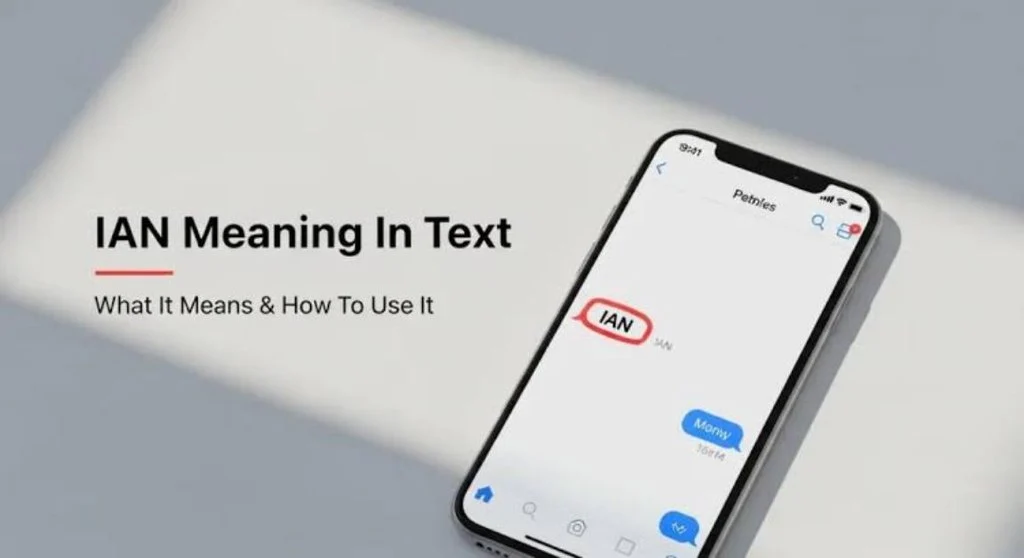
In text and chat, IAN most commonly means “I Am Not.” It is a short form people use when they want to deny something, clarify a statement, or explain that they are not a particular thing.
For example:
- “IAN a doctor, but that sounds serious.”
Meaning: “I am not a doctor, but that sounds serious.” - “IAN ready yet.”
Meaning: “I am not ready yet.” - “IAN sure about this.”
Meaning: “I am not sure about this.”
There is another informal use worth knowing. Some people type “ian” as a phonetic version of “I ain’t.” In that use, it can mean “I’m not,” “I don’t,” or another negative expression depending on the sentence.
This is why context is important.
Compare these two messages:
- “Ian is coming later.” → Ian is probably a person’s name.
- “IAN going anywhere.” → IAN is probably a texting abbreviation or slang form.
Capitalization can offer a clue, but it is not a perfect rule. Many people type everything in lowercase online.
Quick meaning
- IAN = I Am Not in common abbreviation use.
- ian = I ain’t in some informal slang use.
- It is mainly suited to casual digital communication.
- It is not normally appropriate for formal writing.
So, if you see IAN in a sentence, read the whole sentence before deciding what it means.
Full Form, Stands For & Short Meaning of IAN
The most useful full form of IAN in text is “I Am Not.”
It works like a compact version of a sentence beginning with “I am not.” This can make online conversations faster and less formal.
IAN full form
IAN = I Am Not
Examples include:
- IAN an expert. → I am not an expert.
- IAN interested. → I am not interested.
- IAN sure. → I am not sure.
- IAN responsible for that. → I am not responsible for that.
- IAN saying that. → I am not saying that.
In some slang-heavy conversations, ian may instead represent “I ain’t.” This is different from the standard letter-by-letter expansion “I Am Not,” although both can communicate a negative idea.
The easiest way to understand it is to look at what comes next.
For example:
“IAN a gamer, but I like this.”
The person is clearly saying:
“I am not a gamer, but I like this.”
Another example:
“ian doing that 😂”
This may be understood as:
“I ain’t doing that” or “I’m not doing that.”
Simple rule
If IAN comes before a noun, it often works naturally as “I am not”:
- IAN a teacher.
- IAN an expert.
- IAN a fan.
If ian appears in a very casual sentence, it may be intended as “I ain’t”:
- ian going.
- ian doing that.
- ian worried.
Origin, History & First Known Use of IAN
The history of IAN as a texting abbreviation is not as clear-cut as the history of older abbreviations such as “LOL” or “BRB.” There is no single confirmed moment when everyone suddenly started using IAN.
Instead, two language patterns help explain its modern use.
First, “I am not” is naturally easy to shorten into the initials I-A-N. Online communication has long encouraged people to turn common phrases into compact abbreviations.
Second, “I ain’t” is often pronounced quickly in casual speech. Some internet users represent that sound in writing as “ian.” This is an example of phonetic or sound-based internet spelling.
Digital communication made this style easier to spread. People began using short forms to save typing time and create a relaxed tone.
You can see the same general idea in expressions such as:
- gonna → going to
- wanna → want to
- idk → I don’t know
- imo → in my opinion
- ian → I am not / I ain’t, depending on context
However, IAN should not be treated as one universally standardized abbreviation. Its meaning can change between communities.
Why does it look like a name?
The name Ian is also common in English-speaking countries. That creates an easy misunderstanding.
For example:
“Ian will call you later.”
Here, Ian is almost certainly a person’s name.
But:
“IAN an expert lol.”
Here, the sentence structure strongly suggests an abbreviation.
The surrounding words usually solve the mystery.
How People Use IAN in Daily Conversations
People use IAN when they want to make a quick negative statement without writing the full phrase. The style is casual and often appears in conversations between friends or people who already understand internet slang.
One common use is to show that someone is not an expert.
For example:
“IAN a lawyer, but I think you should check the contract.”
This tells the reader that the person is giving an opinion rather than claiming professional authority.
Another use is simple denial:
“IAN mad, I’m just tired.”
This means:
“I am not mad. I am just tired.”
IAN can also be used to express a lack of interest:
“IAN interested in that drama 😂”
The tone may be relaxed, humorous, or slightly dismissive.
Common conversation patterns
- IAN a fan.
- IAN sure.
- IAN worried.
- IAN ready.
- IAN an expert.
- ian doing that.
- ian going anywhere.
The tone depends heavily on the rest of the message.
For example:
“IAN going 😭”
sounds casual and playful.
But:
“IAN responsible for this.”
could sound defensive or serious.
That is why the abbreviation itself does not determine the emotion. The words, punctuation, emojis, and relationship between the speakers all matter.
In professional communication, it is safer to use the complete phrase. Instead of writing “IAN available today,” write “I am not available today.”
IAN Meaning Across WhatsApp, Instagram, TikTok & Snapchat
The basic meaning of IAN does not automatically change from one social platform to another. WhatsApp, Instagram, TikTok, and Snapchat all support informal communication, so users may use the abbreviation in similar ways.
WhatsApp conversations often use short forms because people are sending quick messages.
Example:
Friend: You coming tonight?
You: IAN sure yet 😭
Meaning:
“I am not sure yet.”
On Instagram, IAN may appear in comments, DMs, or replies.
Example:
“IAN a fashion expert, but that outfit looks great.”
Here, the writer is making it clear that the comment is only a personal opinion.
TikTok
TikTok comments often use highly casual language. A user might write:
“ian watching that again 😂”
Depending on the community, this could mean:
“I ain’t watching that again.”
The lowercase style is especially common in casual social-media writing.
Snapchat
Snapchat messages are usually short and conversational, so abbreviations can fit naturally.
Example:
“IAN ready lol.”
Meaning:
“I am not ready.”
The important point
Do not assume that every IAN you see has the same meaning.
Always check:
- The words before and after it.
- Whether it appears as Ian, IAN, or ian.
- Whether the conversation is serious or playful.
- Whether someone is clearly referring to a person named Ian.
Different Meanings of IAN in Other Fields
Outside texting, IAN can have completely different meanings. This is one reason context is so important.
In dentistry and anatomy, IAN commonly means Inferior Alveolar Nerve. It is a branch of the mandibular division of the trigeminal nerve and travels through the mandible, supplying structures associated with the lower jaw.
For example, a dental article might say:
“IAN injury is a possible complication of some dental procedures.”
That obviously has nothing to do with texting slang.
In aviation, IAN can mean Integrated Approach Navigation. It is an aircraft navigation system used for certain instrument approaches and is associated with Boeing flight-deck systems.
So you might see:
- Texting: IAN = I Am Not
- Casual slang: ian = I ain’t
- Dentistry: IAN = Inferior Alveolar Nerve
- Aviation: IAN = Integrated Approach Navigation
- Names: Ian = a personal name
This is why searching only for “IAN definition” may produce confusing results.
The phrase “IAN meaning in text” gives a much clearer clue because it specifies the communication context.
Common Confusions, Mistakes & Wrong Interpretations
The biggest mistake is assuming that Ian always means the person’s name.
Imagine receiving:
“IAN a fan of that movie.”
If you read it as a name, the sentence makes little sense. But when you read IAN as “I Am Not,” everything becomes clear:
“I am not a fan of that movie.”
Another common mistake is assuming that IAN always means “I ain’t.” That can work in some casual messages, but “I Am Not” is the clearer standard expansion for the abbreviation.
Common mistakes
- Mistake: Treating every “Ian” as a person’s name.
- Mistake: Assuming IAN has only one meaning everywhere.
- Mistake: Using IAN in formal business writing.
- Mistake: Ignoring the words around the abbreviation.
- Mistake: Assuming lowercase and uppercase always have different meanings.
Another issue: tone
A short message can sound harsher than the writer intended.
For example:
“IAN doing it.”
could sound blunt.
Adding a little context changes the feeling:
“IAN doing it 😂 I’m too tired.”
Now it sounds more playful.
If someone sends you IAN and you are unsure what they mean, do not guess too quickly. Look at the complete sentence first.
Similar Terms, Alternatives & Related Slang
IAN belongs to a larger group of abbreviations and informal expressions used in digital conversations.
If you are building a slang or abbreviation glossary, these terms are useful to understand alongside IAN:
- IDK — I don’t know
- IMO — in my opinion
- IMHO — in my humble opinion
- TBH — to be honest
- IKR — I know, right?
- IDC — I don’t care
- IRL — in real life
- NGL — not gonna lie
- FR — for real
- BTW — by the way
There are also natural alternatives to IAN itself.
Instead of:
“IAN sure.”
You could write:
“I’m not sure.”
Instead of:
“IAN interested.”
You could write:
“I’m not interested.”
And instead of the very informal:
“ian doing that 😂”
you could write:
“I’m not doing that 😂”
Internal linking suggestions
If this article is part of an abbreviation or slang website, consider linking to related pages such as:
- What Does IDK Mean in Text?
- What Does IMO Mean in Text?
- What Does TBH Mean in Text?
- What Does IDC Mean in Text?
- What Does FR Mean in Text?
- What Does NGL Mean in Text?
- What Does IKR Mean in Text?
- What Does BRB Mean in Text?
These links can help readers move naturally from one abbreviation guide to another.
Examples of IAN in Real Chat Situations
Seeing examples is often the fastest way to understand slang.
Example 1: Not being sure
- Person A: Are you coming with us?
- Person B: IAN sure yet.
Meaning: “I am not sure yet.”
Example 2: Not being an expert
- Person A: Should I buy this laptop?
- Person B: IAN a tech expert, but the reviews look good.
Meaning: “I am not a tech expert.”
Example 3: Refusing something
- Person A: Are you eating my fries?
- Person B: ian touching them 😂
Meaning: “I ain’t touching them” or “I’m not touching them.”
Example 4: Not being angry
- Person A: Are you mad at me?
- Person B: IAN mad 😭 I’m just tired.
Meaning: “I am not mad.”
Example 5: Social media comment
- Comment: You should try this trend.
- Reply: ian doing that 💀
Meaning: “I ain’t doing that” or “I’m not doing that.”
Example 6: Not being interested
- Person A: Want to watch another episode?
- Person B: IAN interested tonight lol.
Meaning: “I am not interested tonight.”
Quick tip
If you can replace IAN with “I am not” and the sentence still makes sense, the abbreviation is probably being used in its standard texting sense.
If the sentence sounds more like spoken slang, “I ain’t” may be the intended reading.
How to Reply When Someone Says IAN
Your response depends on what the person is saying with IAN.
If they say:
“IAN sure.”
You can reply:
“No worries, take your time.”
If they say:
“IAN going tonight.”
You could say:
“All good 😂 maybe next time.”
If they say:
“IAN a fan of that.”
You might reply:
“Fair enough 😄 What do you prefer?”
If the meaning is unclear, asking is perfectly fine:
“Wait, what do you mean by IAN?”
There is no need to pretend you understand slang when you do not.
Good replies depend on context
- Agreement: “Same 😂”
- Understanding: “Got you.”
- Question: “Why not?”
- Friendly response: “Fair enough 😄”
- Clarification: “Do you mean you’re not?”
- Playful response: “Lol okay 😂”
If someone is using IAN to reject an invitation, do not automatically take it personally. The phrase may simply be a quick way of saying no.
Tone matters more than the abbreviation itself.
Is IAN Still Popular? Trends & Online Usage

IAN still appears in online communication, but it is important not to treat it as one of the biggest or most universal internet abbreviations. Usage varies by platform, community, age group, and writing style.
Current online examples show both IAN = “I Am Not” and lowercase ian = “I ain’t” being described in casual digital communication.
One reason these forms survive is convenience. Online users often prefer short expressions that match the speed of conversation.
Another reason is tone. Writing:
“IAN a fan.”
can feel more casual than:
“I am not a fan.”
Likewise:
“ian going 😂”
can sound like spoken conversation typed directly into a chat.
However, slang changes quickly. A term that feels normal in one online community may seem strange in another. Some people may know IAN immediately, while others may think you are talking about someone named Ian.
Where you are most likely to encounter it
- Casual text messages
- Group chats
- Social-media comments
- DMs
- Meme conversations
- Informal online communities
Where you should avoid it
- Business emails
- Job applications
- Academic papers
- Formal reports
- Official documents
- Professional customer messages
For formal communication, simply write the full phrase. Clear English is better than forcing a slang abbreviation into a serious message.
FAQs
What does IAN mean in text?
IAN most commonly means “I Am Not” when used as a texting abbreviation. In some informal slang contexts, lowercase “ian” can represent “I ain’t.”
What does IAN stand for in texting?
The standard texting expansion is “I Am Not.” For example, “IAN an expert” means “I am not an expert.”
Does IAN mean “I ain’t”?
Sometimes. In casual internet slang, “ian” may be used as a phonetic spelling of “I ain’t.” The exact meaning depends on the sentence and community.
Is IAN the same as the name Ian?
No. Ian can be a person’s name, while IAN can be an abbreviation in text. Context tells you which meaning is intended.
Is IAN a formal abbreviation?
No, not when it is being used as casual texting slang. It is better to write “I am not” in formal communication.
Is IAN rude?
Not by itself. However, a very short message such as “IAN doing that” may sound blunt or dismissive. Emojis and extra words can make the tone friendlier.
Can I use IAN on WhatsApp?
Yes, if the people in the conversation understand the abbreviation. WhatsApp is an informal setting where short forms are common.
What does IAN mean on TikTok?
It generally has the same casual meaning as in other online chats: “I Am Not” or, in some slang usage, “I ain’t.” The surrounding comment provides the best clue.
What does IAN mean in dentistry?
In dentistry, IAN commonly means Inferior Alveolar Nerve, which is an anatomical structure associated with the lower jaw.
What does IAN mean in aviation?
In aviation, IAN can mean Integrated Approach Navigation, a navigation function used for certain instrument approaches.
Conclusion:
The IAN meaning in text is usually simple once you know what to look for. In online communication, IAN commonly means “I Am Not,” while lowercase ian can also be used as a casual phonetic form of “I ain’t.”
The biggest clue is always the sentence around it. If someone writes “IAN a doctor,” they probably mean “I am not a doctor.
” If they write “ian doing that 😂,” the intended meaning may be closer to “I ain’t doing that.”
Remember that IAN can also mean something completely different in fields such as dentistry and aviation.
So, before replying, check the context, tone, and capitalization. Once you do, this three-letter term becomes much easier to understand.
