If you have seen “EVB” in a text message, group chat, Instagram comment, or TikTok post, you may have wondered what it means. Short forms can be confusing, especially when they look like a code or a typo.
The most common EVB meaning in text is “everybody.
” People use it as a casual shortcut for talking about all the people in a group. For example, “EVB is coming tonight” simply means “Everybody is coming tonight.” It is short, quick, and easy to type.
People search for EVB meaning because internet slang changes quickly.
A term can also have different meanings in technology, science, or other fields. In this guide, you will learn what EVB means in texting, how people use it on popular social apps, where it came from, common mistakes, and how to reply naturally.
What Does EVB Mean in Text & Chat?
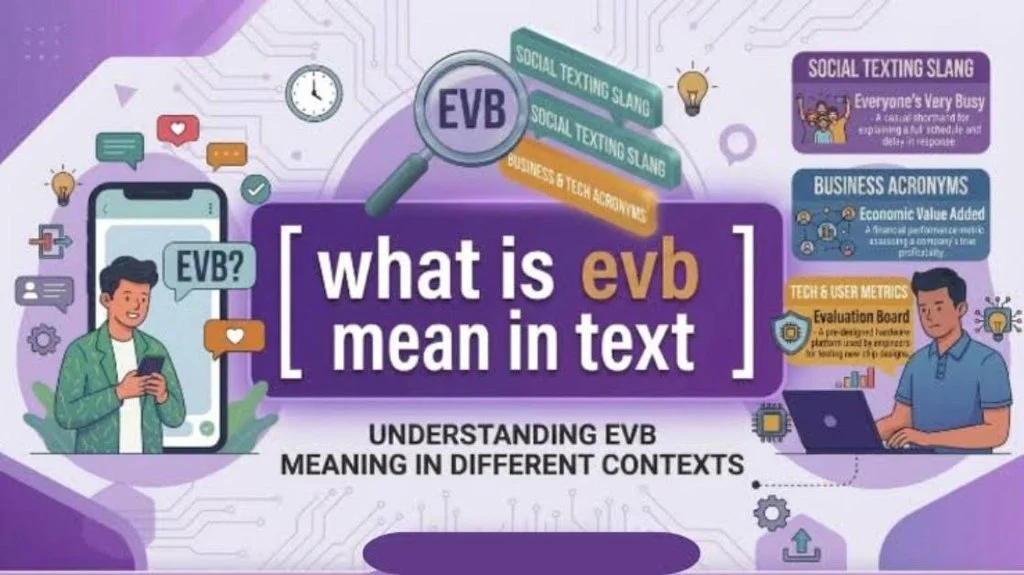
In casual texting and online chat, EVB usually means “everybody.” It is an informal shortened form used when someone wants to refer to all people in a group.
Think of EVB as a quick replacement for words such as:
- Everybody
- Everyone
- All the people
- The whole group
For example:
- “EVB is ready.” → Everybody is ready.
- “Did EVB see this?” → Did everybody see this?
- “Tell EVB to come over.” → Tell everybody to come over.
- “EVB loved the movie 😂” → Everybody loved the movie.
The exact tone depends on the conversation. In a friendly group chat, EVB may sound relaxed and natural. In a serious conversation, the sender may simply be trying to save time.
One important point is that EVB is informal texting shorthand, not standard formal English. If you are writing an email, school assignment, business report, or professional message, it is better to write “everybody” or “everyone.”
Context also matters. If EVB appears in a technical document, product name, scientific paper, or engineering discussion, it may have a completely different meaning. For example, EVB is used for Evaluation Board in electronics.
So, when you see EVB in a normal text, start with “everybody.” Then check the rest of the sentence to confirm it.
Full Form, Stands For & Short Meaning of EVB
The simplest answer is:
EVB = Everybody
In texting, EVB is best understood as a shortened spelling rather than a formal acronym where each letter must represent a separate word.
EVB at a glance
- EVB: Everybody
- Meaning: All people in a group
- Type: Informal texting shorthand
- Common setting: Chats, DMs, comments, group messages
- Tone: Casual and conversational
- Formal writing: Usually avoid it
Here are some quick examples:
- “EVB knows.” = Everybody knows.
- “EVB is invited.” = Everybody is invited.
- “Thanks EVB ❤️” = Thanks, everybody.
- “EVB coming at 8?” = Is everybody coming at 8?
There is no need to search for a hidden meaning when the conversation is clearly about a group of people. The surrounding words usually make the meaning obvious.
For example, compare these two sentences:
- “EVB is coming to dinner.” → Almost certainly “everybody.”
- “EVB is connected to the test board.” → This could be a technical abbreviation.
This difference is important because EVB is not limited to texting. In electronics, manufacturers use EVB for evaluation boards used to test or demonstrate hardware. Microchip, for example, labels several development products as EVB evaluation boards.
In chemistry, EVB can mean Empirical Valence Bond, a computational approach used to study chemical reactions.
For the search phrase “EVB meaning in text,” however, “everybody” is the meaning to check first.
Origin, History & First Known Use of EVB
There is no clear, authoritative record showing one person, message, or website that created EVB as a texting abbreviation for “everybody.” That is common with internet slang.
Many chat abbreviations develop naturally. People shorten words because they want to type faster, especially on phones and in fast-moving conversations. Over time, a shortened form can spread from one group to another.
EVB fits this pattern. It is a compact way to write everybody without typing the complete word.
The growth of texting and social media created a space where short forms became normal. Terms such as “LOL,” “BRB,” “IDK,” “TBH,” and “BTW” became familiar to millions of users. EVB follows the same general idea, although it is much less universal than some of those older abbreviations.
It is important not to claim that EVB has a specific invention date without strong evidence. Internet slang often has no single starting point.
What we can say with confidence
- EVB is used as casual shorthand for everybody.
- Its use fits the wider culture of shortening words in digital communication.
- There is no widely established “official” creator of the texting form.
- Its texting history should not be confused with technical uses of the letters EVB.
- The abbreviation can appear in lowercase as “evb” or uppercase as “EVB.”
The capital letters do not automatically create a different slang meaning. In a casual message, “evb” and “EVB” can both mean “everybody.”
The history of EVB is therefore less about one famous origin and more about the way online language keeps becoming shorter, faster, and more casual.
How People Use EVB in Daily Conversations
People mainly use EVB when they are talking about a group. It can describe friends, classmates, coworkers, family members, gaming teammates, followers, or anyone else included in the conversation.
The easiest way to understand it is to replace EVB with everybody.
Talking about a group
- “EVB was laughing 😂”
- “EVB already knows.”
- “EVB liked your idea.”
- “EVB came to the party.”
Talking directly to a group
- “Hey EVB, are we meeting at 7?”
- “EVB listen for a second 😭”
- “Thanks EVB for helping me!”
Asking about a group
- “Is EVB ready?”
- “Did EVB get the message?”
- “Is EVB coming tonight?”
The abbreviation can make a message feel shorter and more relaxed. It may also fit the fast style of group chats, where people do not worry about perfect spelling.
However, using EVB too often can make your writing harder to understand, especially if the reader is unfamiliar with the slang.
For example:
Easy to understand:
“Is everybody ready?”
More casual:
“Is EVB ready?”
Both communicate the same basic idea.
The choice depends on your audience. With close friends, EVB may feel perfectly normal. With teachers, customers, managers, or new contacts, “everyone” is usually the safer choice.
EVB Meaning Across WhatsApp, Instagram, TikTok & Snapchat
The basic EVB meaning in text stays the same across most social platforms: “everybody.” The platform may change the style of the message, but it does not automatically change what EVB means.
EVB may appear in group chats when someone is talking to everyone.
- “EVB ready for tomorrow?”
- “Tell EVB dinner starts at 8.”
You may see it in comments, captions, or DMs.
- “EVB needs to see this 😂”
- “Thank you EVB for the support!”
TikTok
TikTok comments often use short, casual language. Someone might write:
- “EVB is doing this trend now.”
- “Why does EVB know this song? 😭”
Snapchat
In quick messages, EVB can save typing time.
- “EVB coming?”
- “EVB saw the story already.”
The key point is that the app does not define the abbreviation. The sentence around it does.
Also, not every person uses EVB. Some people may prefer “everyone,” “everybody,” or another abbreviation. That is why you should not assume that every three-letter term is universally understood.
If you see EVB in a social post and the sentence is about people, “everybody” is usually the natural interpretation.
Different Meanings of EVB in Other Fields
Although EVB means “everybody” in casual texting, the same three letters have established meanings in other fields.
This is where context becomes very important.
1. Evaluation Board
In electronics, EVB can refer to an Evaluation Board. An evaluation board is a development tool used to test, demonstrate, or evaluate an electronic component or system.
For example, Microchip uses EVB in product names for evaluation boards.
2. Empirical Valence Bond
In chemistry, EVB means Empirical Valence Bond. It refers to a computational approach used to model chemical reactions and reaction free energies.
The method has a long history in computational chemistry and has been used to study chemical reactions and enzyme-related processes.
3. Other specialized uses
EVB may also appear as an abbreviation in specific companies, projects, products, organizations, or technical documents.
That means you should always ask:
- Is this a casual message?
- Is it about people?
- Is it a technical document?
- Is it a product name?
- Is it related to science or engineering?
If it is a normal message such as “EVB is coming,” “everybody” is the likely answer.
If it appears in an engineering manual, do not assume it means everybody.
Common Confusions, Mistakes & Wrong Interpretations
EVB is easy once you know it, but several mistakes can happen when you first see it.
Mistake 1: Thinking EVB is a typo
A reader may assume the sender accidentally typed random letters.
For example:
“EVB knows about it.”
This may look strange at first, but it simply means:
“Everybody knows about it.”
Mistake 2: Assuming it has a secret romantic meaning
EVB does not automatically mean something romantic, flirty, or personal. If someone sends:
“EVB is coming tonight.”
They are normally referring to a group of people.
Mistake 3: Treating it as formal English
EVB is casual shorthand. It is not a good replacement for “everybody” in formal writing.
Avoid it in:
- Job applications
- Business emails
- Academic assignments
- Official documents
- Formal reports
Mistake 4: Ignoring context
This is the biggest mistake.
In a group chat:
- “EVB is ready.” → Everybody
In an electronics discussion:
- “Connect the EVB to the controller.” → Likely Evaluation Board
In a chemistry discussion:
- “The EVB method was used.” → Empirical Valence Bond
Context solves the problem.
Similar Terms, Alternatives & Related Slang
If you understand EVB, you may also want to learn other short forms used in casual online conversations.
Direct alternatives
- Everybody — standard English
- Everyone — standard English
- All — short and simple
- Peeps — casual way to refer to people
- Y’all — informal group address, especially in some varieties of English
Related texting abbreviations
- PPL = People
- U = You
- UR = Your / You’re, depending on context
- TBH = To Be Honest
- IDK = I Don’t Know
- BTW = By The Way
- FYI = For Your Information
- LOL = Laughing Out Loud
- BRB = Be Right Back
EVB is different from terms such as LOL or BRB because it is mainly a shortened form of a normal word rather than a phrase.
For SEO and internal linking, a page about EVB could naturally link to related abbreviation guides such as:
- [Internal link suggestion: PPL Meaning in Text]
- [Internal link suggestion: TBH Meaning in Text]
- [Internal link suggestion: IDK Meaning in Text]
- [Internal link suggestion: BTW Meaning in Text]
- [Internal link suggestion: LOL Meaning in Text]
- [Internal link suggestion: BRB Meaning in Text]
These links can help readers move from one texting abbreviation to another without forcing unrelated keywords into the article.
Examples of EVB in Real Chat Situations
The best way to understand EVB is to see it in natural conversations.
Example 1: Making plans
- Alex: “EVB coming to the party?”
- Sam: “I think so. I’m definitely coming!”
Here, EVB means everybody.
Example 2: Group project
- Mia: “Did EVB finish their part?”
- Noah: “Almost. Two people are still working.”
Meaning: Did everybody finish their part?
Example 3: Social media
- Friend: “EVB is talking about that new video 😂”
- You: “I know! It’s everywhere.”
Here, EVB means everyone or everybody.
Example 4: Thanking a group
- You: “Thanks EVB for the birthday wishes ❤️”
This means:
- Thanks, everybody, for the birthday wishes.
Example 5: Asking a group to wait
- You: “EVB wait, I need to explain something 😭”
Meaning:
- Everybody, wait.
Example 6: A possible technical meaning
- Engineer: “The EVB is connected to the development system.”
Here, EVB is probably Evaluation Board, not “everybody.” Technical manufacturers commonly use EVB in evaluation-board names.
How to Reply When Someone Says EVB
Your reply depends on what the person means and whether you are part of the group.
If EVB means everybody, you can respond normally. You do not need to repeat the abbreviation.
If they ask whether everyone is coming
- “Yeah, I think everyone is coming.”
- “Yep, I’ll be there!”
- “Most of us are coming 👍”
- “I’m not sure about everyone yet.”
If they are addressing the whole group
- “I’m here!”
- “What’s up? 😂”
- “Yep, we’re listening.”
- “Got it!”
If you are unsure what EVB means
It is completely fine to ask:
- “What do you mean by EVB?”
- “Does EVB mean everybody?”
- “Sorry, what does EVB stand for here?”
There is nothing awkward about asking. Abbreviations can have different meanings, especially outside casual texting.
A simple rule is:
If the message is clearly about a group of people, read EVB as “everybody.”
Is EVB Still Popular? Trends & Online Usage
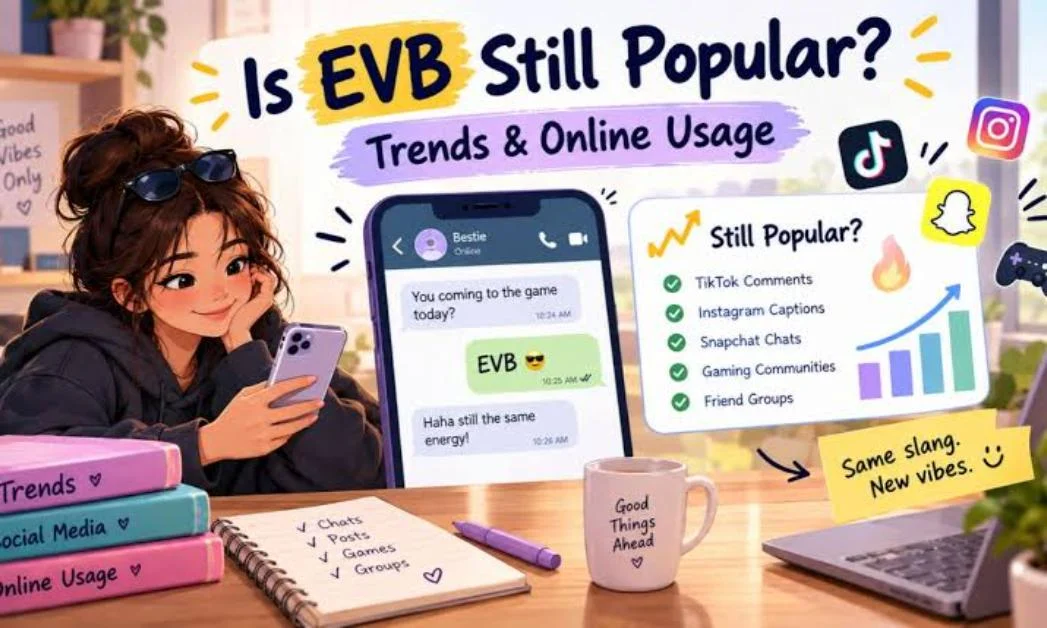
EVB is still used in casual online communication, but it is not one of the most universally recognized texting abbreviations.
That distinction matters.
Everyone knows common abbreviations such as LOL, OMG, BRB, and IDK. EVB is more niche. Some people use it often, while others may never have seen it before.
Its continued use fits a larger trend in online communication: people regularly shorten words to make messages faster and more casual. Social platforms also encourage short comments, quick replies, and informal language.
However, there is no reason to assume that EVB is equally popular among every age group, country, or online community. Slang varies widely.
What affects its use?
- The person’s age and online habits
- The social platform
- The type of group chat
- Regional language habits
- Whether the group already uses abbreviations
- The level of formality
EVB is therefore best described as current informal internet shorthand, rather than a universal abbreviation.
If you want maximum clarity, use everybody or everyone. If you are chatting with people who already understand the abbreviation, EVB can be a quick and natural choice.
The most important thing is not to force slang into your messages just because it is available. Good communication is about being understood.
FAQs
What does EVB mean in text?
In casual texting, EVB usually means “everybody.” It is a short and informal way to refer to all the people in a group.
What does EVB stand for in chat?
EVB is commonly used as a shortened form of everybody. For example, “EVB is ready” means “Everybody is ready.”
Is EVB a slang word?
Yes. In texting, EVB is informal internet shorthand. It is more suitable for casual conversations than formal writing.
What does EVB mean on WhatsApp?
On WhatsApp, EVB generally means everybody when the conversation is about a group of people.
What does EVB mean on Instagram?
On Instagram, EVB can mean everybody in comments, captions, DMs, or casual conversations.
What does EVB mean on TikTok?
On TikTok, EVB can be used as casual shorthand for everybody, especially when someone is talking about a large group or audience.
Does EVB have other meanings?
Yes. In electronics, EVB can mean Evaluation Board, while in chemistry it can mean Empirical Valence Bond. The context determines the meaning.
Should I use EVB in a professional email?
Usually, no. Write “everybody” or “everyone” instead. They are clearer and more professional.
Is EVB the same as everyone?
In casual texting, EVB can communicate the same basic idea as everyone or everybody. “Everybody” is the most direct expansion.
Conclusion:
The most common EVB meaning in text is simple: everybody. It is an informal shortcut people use in chats, comments, DMs, and group conversations when they want to refer to all the people involved.
For example, “EVB is coming” means “Everybody is coming,” while “Thanks EVB” means “Thanks, everybody.”
The important thing is context.
EVB does not always mean everybody. In electronics, it can refer to an Evaluation Board, and in chemistry, it can mean Empirical Valence Bond.
For casual conversations, though, you can usually read EVB as everybody. If you are writing professionally, stick with “everyone” or “everybody” for better clarity.
Once you know this simple meaning, seeing EVB in a group chat should no longer be confusin
