If you have seen someone type “ONG” in a text, chat, comment, or social media post, you may wonder what it means. Internet slang can be confusing because short forms often have different meanings depending on the conversation. In most casual online conversations, ONG means “On God.”
People use it to show that they are being completely honest, serious, or strongly agreeing with something. It is similar to saying “I swear,” “I’m serious,” or “Honestly.”
The ONG meaning in text is especially common among younger internet users and can appear on platforms such as WhatsApp, Instagram, TikTok, Snapchat, and other messaging apps.
This guide explains what ONG means, where it came from, how people use it, and how you can reply when someone sends it.
What Does ONG Mean in Text & Chat?
In text messages and online chats, ONG usually means “On God.” It is an expression people use to emphasize that they are telling the truth or strongly mean what they are saying.
The phrase is closely related to “on God,” which has been used in spoken language to make a strong statement. Online, people often shorten it to ONG because abbreviations are quick to type.
For example, imagine a friend says:
- “ONG that was the funniest movie ever 😂”
- “I’m not lying, ONG.”
- “ONG, I thought you were coming!”
- “She is the best singer, ONG.”
In each example, ONG adds emphasis. It can make a statement sound more serious, honest, or emotional.
However, the exact feeling behind ONG depends on the conversation. It can express:
- Strong agreement
- Honesty
- Surprise
- Excitement
- Frustration
- Seriousness
- Emphasis
Sometimes people use ONG at the beginning of a sentence. Other times, they put it at the end.
Examples:
- “ONG, I forgot my homework.”
- “That game was crazy, ONG.”
- “ONG you need to watch this.”
- “I’m telling you the truth, ONG.”
So, when someone writes ONG in a casual chat, the safest interpretation is usually “On God.”
Full Form, Stands For & Short Meaning of ONG
The most common full form of ONG in texting is “On God.”
In simple terms, it means something like:
“I swear this is true.”
It can also mean:
“I am completely serious.”
Or:
“I strongly agree.”
The meaning changes slightly depending on how the person uses it.
For example:
- “ONG, that happened.” → “I swear that happened.”
- “ONG, you are right.” → “I completely agree with you.”
- “ONG this food is amazing.” → “I seriously think this food is amazing.”
- “I’m tired, ONG.” → “I’m genuinely very tired.”
The abbreviation is popular because online conversations often favor short, fast expressions. Instead of typing “on God,” someone can simply type ONG.
It is also worth remembering that ONG is not always an abbreviation for “On God” in every situation. In business, technology, education, or other specialized contexts, the same letters can represent something completely different.
That is why context matters.
If you see ONG in a TikTok comment or casual text conversation, “On God” is usually the intended meaning. If you see it in a professional document, organization name, or technical discussion, you should look at the surrounding words before deciding what it means.
Quick meaning:
- ONG = On God
- Used mainly in informal online communication
- Shows strong emphasis or sincerity
- Similar to “I swear” or “seriously”
- Meaning depends on context
Origin, History & First Known Use of ONG
The online abbreviation ONG comes from the phrase “on God.” The expression itself is older than texting and social media. People have used “on God” in spoken language to emphasize that they are telling the truth or making a serious statement.
As internet communication became more casual and fast-paced, users began shortening common phrases into abbreviations. This created many forms of online slang, including expressions such as “LOL,” “OMG,” “IDK,” and eventually ONG.
There is not one universally accepted date when ONG was first created as internet slang. Instead, its development is part of a broader trend in online communication where users shorten phrases to save time and create a shared style of communication.
Social media helped these abbreviations spread quickly. Short-form video platforms, messaging apps, comments, and online communities made it easy for slang to move between different groups.
The phrase “on God” also became strongly associated with casual speech, especially when someone wanted to make their statement sound sincere or emphatic.
For example:
- “On God, I saw him there.”
- “On God, that was amazing.”
- “I’m telling you, on God.”
Over time, ONG became a convenient written version of the phrase.
It is important not to confuse the history of the abbreviation with the history of the phrase itself. The phrase “on God” has existed in spoken language for much longer than the modern abbreviation ONG.
Today, ONG is mainly recognized as informal internet language rather than formal English.
How People Use ONG in Daily Conversations
People use ONG when they want to add extra weight to what they are saying. It can make a simple sentence sound more convincing or emotional.
One common use is to confirm that something is true.
Example:
- “ONG, I saw him at the mall.”
Here, the speaker is emphasizing that they really saw the person.
Another common use is agreement.
Example:
- Person A: “That was the best episode.”
- Person B: “ONG!”
In this case, ONG is similar to saying “Absolutely!” or “I completely agree.”
It can also appear when someone is excited.
Example:
- “ONG, you have to see this video 😂”
The abbreviation adds emotion without requiring a longer explanation.
People may also use it sarcastically. The surrounding conversation usually makes the tone clear.
Examples:
- “ONG, I definitely remembered the test.”
- “ONG, I’m never staying up late again.”
The second example could be serious or humorous depending on what happened.
In everyday texting, ONG is generally casual. You would normally see it between friends, in comments, gaming chats, group conversations, or social media posts.
It is usually better to avoid slang like ONG in formal writing unless you are specifically discussing internet language.
ONG Meaning Across WhatsApp, Instagram, TikTok & Snapchat
The ONG meaning in text is generally the same across major social platforms: “On God.” However, the way people use it can change slightly depending on the platform and conversation.
On WhatsApp, ONG often appears in private messages and group chats.
- “ONG bro, that was crazy 😂”
- “I’m not joking, ONG.”
It is usually used between people who already have a casual relationship.
Instagram users may use ONG in comments, direct messages, captions, or replies.
For example:
- “ONG this outfit is fire 🔥”
- “ONG, I need this.”
In comments, ONG can act as a quick reaction to a post.
TikTok
TikTok has helped many slang terms spread quickly. ONG may appear in comments or replies when users strongly agree with a video.
Examples include:
- “ONG this is so true.”
- “ONG I thought I was the only one 😭”
- “ONG, this happened to me too.”
Snapchat
Snapchat conversations are usually informal, so ONG fits naturally into quick messages.
- “ONG where are you?”
- “That was so funny ONG 😂”
Across all four platforms, the basic idea remains the same: ONG adds emphasis, sincerity, or agreement.
The tone depends on the words around it, punctuation, emojis, and the relationship between the people chatting.
Different Meanings of ONG in Other Fields
Although “On God” is the common meaning of ONG in casual texting, the abbreviation can have other meanings in different fields.
This is important because abbreviations are not universal. The same three letters can represent different words, organizations, or concepts.
For example, ONG may appear as an abbreviation or acronym connected to organizations, technical terms, names, or other specialized subjects.
When you see ONG outside social media, do not automatically assume it means “On God.”
Consider the setting:
- Text message: likely “On God”
- TikTok comment: likely “On God”
- Instagram DM: likely “On God”
- Professional document: may have another meaning
- Organization-related content: could refer to an organization or group
- Technical material: may have a specialized definition
The surrounding words are the best clue.
For example, if someone writes:
“ONG, I’m telling you the truth.”
The meaning is clearly the slang expression.
But if ONG appears in the name of an institution, company, research project, or formal document, it may be an acronym unrelated to texting slang.
This is why it is useful to check context before interpreting an abbreviation.
SEO tip for related content: You can internally link this article to pages explaining related abbreviations such as [OMG meaning in text], [IDK meaning in text], [FR meaning in text], and [ISTG meaning in text].
Common Confusions, Mistakes & Wrong Interpretations
One common mistake is assuming that ONG always has only one meaning. In casual texting, “On God” is usually correct, but context can change the meaning.
Another mistake is confusing ONG with similar slang abbreviations.
For example:
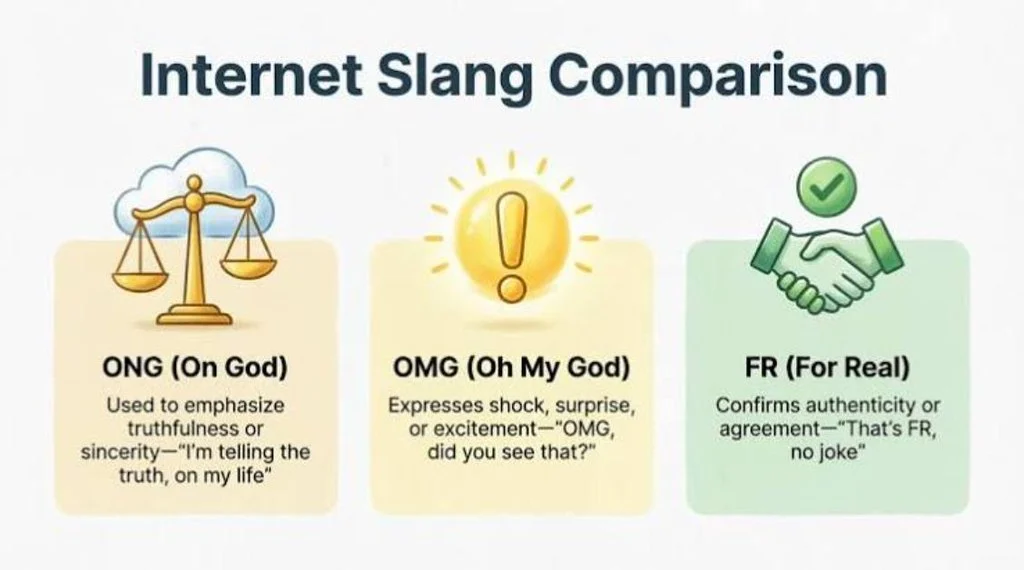
- OMG = Oh My God
- ONG = On God
- ISTG = I Swear to God
- FR = For Real
- TBH = To Be Honest
These expressions can sometimes appear in similar conversations, but they are not identical.
Another confusion comes from treating ONG as formal English. It is mainly informal internet slang. You would not normally use it in a business email, academic paper, job application, or formal report.
Tone can also cause confusion. If someone says:
“ONG 😂”
they may be agreeing with you in a playful way.
But:
“ONG, I am serious.”
has a much stronger and more serious tone.
Some users also assume that ONG is always connected to religion because it contains the word “God.” In everyday slang, however, it is generally functioning as an expression of emphasis or sincerity rather than a formal religious statement.
Common mistakes to avoid:
- Assuming ONG has the same meaning everywhere
- Confusing ONG with OMG
- Treating it as formal language
- Ignoring the surrounding conversation
- Assuming every use is religious
Similar Terms, Alternatives & Related Slang
Several internet slang terms can express a similar idea to ONG.
“I swear”
This is one of the closest alternatives.
- “I swear, that really happened.”
- “I swear, you need to watch this.”
“ISTG”
ISTG stands for “I Swear to God.” It can be stronger or more dramatic than ONG.
Example:
- “ISTG, I told you already.”
“FR”
FR means “For Real.” It is often used to show agreement or confirm that something is genuine.
Example:
- “That movie was amazing.”
- “FR!”
“Honestly”
This is a normal English alternative to ONG.
Example:
- “Honestly, that was the best part.”
“No cap”
“No cap” generally means that someone is being truthful or not exaggerating.
Example:
- “No cap, this is the best burger I’ve had.”
“I’m serious”
This is a clear, non-slang alternative.
Example:
- “I’m serious. You should try it.”
Related abbreviation pages for internal links:
- OMG meaning in text
- ISTG meaning in text
- FR meaning in text
- No cap meaning
- TBH meaning in text
- IDK meaning in text
- IMO meaning in text
- WDYT meaning in text
These related pages can help readers understand other common internet abbreviations.
Examples of ONG in Real Chat Situations
Seeing ONG in realistic conversations makes its meaning easier to understand.
Example 1: Strong agreement
- Friend: “That restaurant has the best burgers.”
- You: “ONG! 🍔”
Here, ONG means something like “Absolutely!”
Example 2: Confirming the truth
- Friend: “Did you really see him there?”
- You: “ONG, I did.”
Here, ONG emphasizes that the speaker is telling the truth.
Example 3: Excitement
- Friend: “The new game is finally out!”
- You: “ONG 😭🔥 I’m downloading it now.”
The abbreviation expresses excitement.
Example 4: Frustration
- Friend: “He forgot the meeting again.”
- You: “ONG, he does this every time.”
Here, ONG adds emphasis to the speaker’s frustration.
Example 5: TikTok comment
- User: “When you open the fridge five times hoping new food appears.”
- Comment: “ONG 😂”
The commenter is saying that the situation is very relatable or true.
Example 6: Casual disagreement
- Friend: “That was an easy exam.”
- You: “ONG no way 😭”
Here, the meaning is still related to “On God,” but the surrounding words show that the person disagrees.
How to Reply When Someone Says ONG
Your reply depends on what the other person means.
If they use ONG to agree with you, you can simply continue the conversation.
Examples:
- “Exactly!”
- “For real 😂”
- “I know, right?”
- “Same!”
- “That’s what I’m saying.”
If someone uses ONG to emphasize a claim, you can respond naturally to the claim itself.
Example:
- Them: “ONG, that movie was terrible.”
- You: “For real, the ending made no sense 😭”
If you are unsure what they mean, you can ask:
- “You mean on God?”
- “ONG as in ‘on God’?”
Usually, you do not need to ask because the meaning becomes obvious from context.
Quick reply ideas
- Agreement: “FR!”
- Excitement: “ONG 😂🔥”
- Surprise: “No way!”
- Confirmation: “I know!”
- Casual: “Exactly!”
- Clarification: “You mean ‘on God’?”
The best reply is usually a natural response to the rest of the message rather than focusing only on the abbreviation.
Is ONG Still Popular? Trends & Online Usage

Yes, ONG is still recognizable as informal internet slang, especially in casual conversations and social media.
Its use is closely tied to the broader trend of short online expressions. People often prefer quick abbreviations because they are easy to type and work well in comments, direct messages, and short replies.
However, slang changes quickly. Some abbreviations become extremely popular for a period and later become less common. Usage can also differ by age group, platform, country, and online community.
You may see ONG more often in:
- TikTok comments
- Instagram conversations
- Snapchat messages
- Gaming chats
- Group chats
- Casual texting
- Short social media replies
You are less likely to see it in:
- Academic writing
- Business reports
- Formal emails
- Professional applications
- Official documents
The important thing is that ONG remains easy to understand when used in a casual online setting. Even when someone does not use the abbreviation themselves, the surrounding context often makes its meaning clear.
As with most slang, popularity can shift over time. New expressions may appear, while older ones may become less common. Still, knowing ONG is useful because it can appear across several major social platforms.
FAQs
What does ONG mean in text?
ONG usually means “On God.” People use it to show that they are serious, honest, or strongly agreeing with something.
What does ONG mean on Snapchat?
On Snapchat, ONG generally means “On God.” It is used in casual messages to add emphasis or show agreement.
What does ONG mean on TikTok?
On TikTok, ONG usually means “On God.” Users often write it in comments when they strongly agree with a video or find something very relatable.
Is ONG the same as OMG?
No. OMG usually means “Oh My God,” while ONG usually means “On God.” They can appear in similar conversations but have different meanings.
Is ONG a bad word?
No. ONG is generally an informal slang abbreviation. However, because it uses the phrase “On God,” some people may prefer not to use it depending on their personal or cultural preferences.
What is the difference between ONG and ISTG?
ONG means “On God,” while ISTG means “I Swear to God.” Both can emphasize honesty or seriousness, but ISTG is often used more strongly.
Can ONG mean something else?
Yes. In specialized fields, organizations, or formal contexts, ONG can have meanings unrelated to internet slang. Context is important.
Conclusion:
The most common ONG meaning in text is “On God.” People use it to show that they are being honest, serious, excited, or strongly agreeing with someone.
You may see ONG in WhatsApp messages, Instagram comments, TikTok discussions, Snapchat chats, gaming conversations, and other informal online spaces.
The exact tone depends on the conversation. Sometimes ONG simply means “for real,” while other times it works more like “I swear” or “I completely agree.”
It is best understood as casual internet slang rather than formal English.
If you see ONG in a message, look at the words around it before deciding what the sender means. In most casual chats, however, “On God” is the meaning you are looking for. Understanding this abbreviation can make modern texting and social media conversations much easier to follow.