If someone sends you “OHR” in a text message, you may wonder what those three letters mean. Is it slang, an abbreviation, or simply a typo?
The answer depends on the conversation, but in casual online chat, OHR is commonly used to mean “Oh, really?” It can show surprise, curiosity, doubt, or playful interest in something another person has said.
People search for OHR meaning in text because short internet expressions are not always easy to understand. Unlike popular abbreviations such as LOL or BRB, OHR is not a universally fixed texting term.
Some sources and users give it different meanings, so context matters.
This guide explains what OHR means, how people use it, where it appears, what it can mean in other fields, and how to reply naturally.
What Does OHR Mean in Text & Chat?
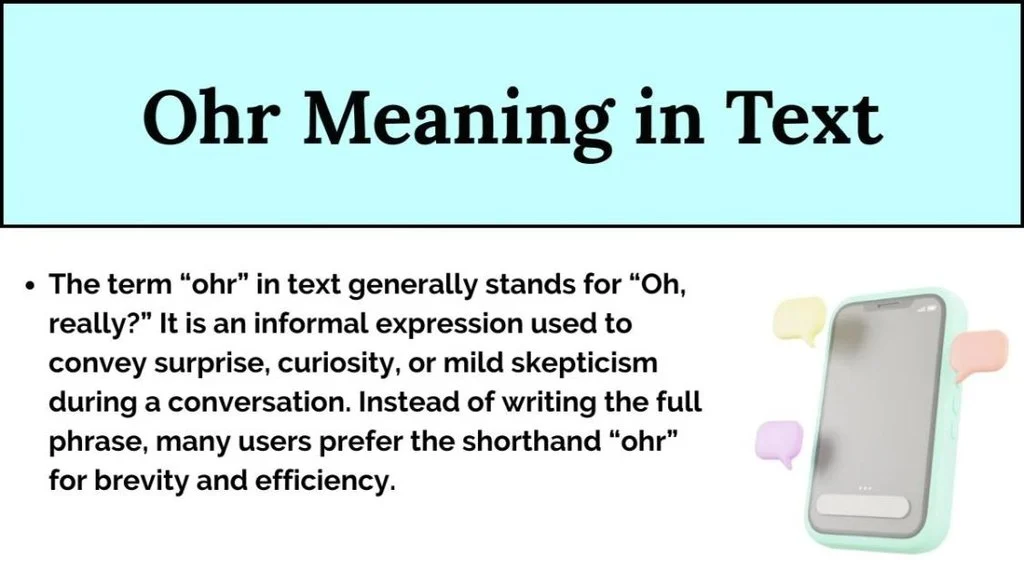
In casual texting, OHR most commonly means “Oh, really?”
People use it as a short reaction when someone shares information that sounds surprising, unexpected, interesting, or doubtful.
For example:
- Person 1: “I met your favorite singer yesterday.”
- Person 2: “OHR? 😮”
Here, “OHR?” is basically asking, “Oh, really?”
The exact feeling can change depending on punctuation, emojis, and the conversation.
OHR can express:
- Surprise
- Curiosity
- Mild disbelief
- Interest
- Playful teasing
- Skepticism
- A request for more information
Compare these examples:
- “OHR? 😮” — sounds surprised.
- “OHR 😂” — can sound playful.
- “OHR…” — may sound doubtful.
- “OHR!” — can show strong surprise.
- “ohr” — may simply be a casual reaction.
One important point is that OHR is not as standardized as LOL, OMG, IDK, or BRB. Acronym references list several unrelated meanings, while slang sources show different informal uses.
So, if you receive “OHR” from someone, do not automatically assume there is a hidden meaning. Read the messages before and after it.
Full Form, Stands For & Short Meaning of OHR
The most useful short answer to “What does OHR stand for in texting?” is:
OHR = “Oh, really?”
It works as a compressed version of a common conversational reaction.
Quick meaning
- OHR: Oh, really?
- Tone: Casual and conversational
- Main use: Reacting to surprising information
- Common setting: Informal chats and social media
- Formal use: Not recommended when you mean “Oh, really?”
- Meaning: Depends on context
For example:
- “I got tickets to the concert.”
- “OHR? 🔥”
The second person is showing interest and surprise.
However, OHR can also stand for other phrases outside casual texting. In professional settings, for example, OHR may be used as an abbreviation for Office of Human Resources. Acronym databases also list other organizational, government, scientific, and business meanings.
This is why the sentence around OHR is important.
If a friend writes:
“OHR? You actually did it?”
the conversational meaning is likely “Oh, really?”
But if an employee writes:
“Please send the documents to OHR.”
the writer may be referring to a human resources office.
Simple rule
Casual conversation + reaction = likely “Oh, really?”
Workplace or organization + department = possibly “Office of Human Resources.”
Never treat OHR as having only one meaning in every situation.
Origin, History & First Known Use of OHR
There is no reliable, universally accepted record showing exactly when OHR first became popular as a texting abbreviation for “Oh, really?”
This is important because many internet slang terms develop naturally. People shorten phrases to type faster, especially in chats where quick replies are common. OHR appears to fit this broader pattern of digital shorthand rather than having a clearly documented inventor or launch date.
The phrase “oh, really?” itself is much older than texting. It is a normal English reaction used to express surprise, interest, or doubt. As digital communication became faster, users naturally began shortening familiar expressions.
Early SMS and internet chat culture encouraged this kind of compression. Later, messaging apps and social platforms made short reactions even more common.
However, it would be inaccurate to claim that OHR definitely began on one particular platform or in one particular year. Available acronym references show that OHR has multiple meanings, while online slang dictionaries contain different informal interpretations.
What we can say with confidence
- “Oh, really?” is an established English conversational phrase.
- OHR is used by some people as a shortened written reaction.
- There is no strong evidence for one official creator of the texting form.
- OHR has other meanings in professional and specialized contexts.
- Its online meaning depends heavily on context.
So, rather than giving OHR a made-up “first use” date, it is better to describe it as an informal digital abbreviation whose usage developed organically.
How People Use OHR in Daily Conversations

People generally use OHR as a quick reaction. It can replace a longer sentence when the meaning is obvious from the conversation.
For example:
- Friend: “I finally passed my driving test.”
- You: “OHR? Congrats! 🎉”
Here, OHR shows surprise before the speaker adds a congratulatory response.
Another example:
- Friend: “She knows about the surprise party.”
- You: “OHR 😳 How did she find out?”
In this case, OHR communicates surprise and immediately leads into a question.
Common situations where OHR may appear
- Someone shares unexpected news.
- A friend reveals something interesting.
- Someone makes a surprising claim.
- A person wants clarification.
- Friends are teasing each other.
- Someone reacts to gossip.
- A person wants to show mild disbelief.
The tone can be positive, neutral, or skeptical.
Compare the tone
Friendly:
“OHR? You got the job? 😄”
Doubtful:
“OHR… Are you sure?”
Playful:
“OHR 😂 So you finally admitted it?”
Surprised:
“OHR! I didn’t know that!”
The word itself does not tell you everything. The surrounding conversation does.
That is why you should not assume that OHR is rude, romantic, sarcastic, or negative without looking at the full message.
OHR Meaning Across WhatsApp, Instagram, TikTok & Snapchat
The OHR meaning in text can appear differently across social platforms because each platform has its own communication style.
OHR on WhatsApp
On WhatsApp, OHR can work as a quick reaction between friends or family members.
Example:
“I just bought the phone we talked about.”
“OHR? 😮 Which one?”
The abbreviation keeps the conversation short.
OHR on Instagram
Instagram DMs often contain short reactions. Someone might respond to a story or personal message with:
“OHR 😂 You actually went there?”
Here, it can mean “Oh, really?” with a playful tone.
OHR on TikTok
TikTok comments and messages often use short expressions. If someone posts an unexpected story, a viewer might write:
- “OHR 😳”
- “OHR? No way!”
- “OHR 😂 I didn’t know this.”
However, OHR is not a universally recognized TikTok-specific abbreviation. Its meaning should still be determined from context.
OHR on Snapchat
Snapchat conversations often move quickly, so short reactions can be useful.
For example:
“I saw your teacher at the mall.”
“OHR? 😂”
The person is likely asking, “Oh, really?”
Important reminder
There is no universal rule saying that OHR always means the same thing on WhatsApp, Instagram, TikTok, or Snapchat. Online slang changes between communities, and some people may use the letters differently.
Different Meanings of OHR in Other Fields
Although “Oh, really?” is a possible casual-chat interpretation, OHR has many other meanings outside texting.
This is one reason the abbreviation can be confusing.
Office of Human Resources
In workplace communication, OHR can refer to Office of Human Resources. This is a formal abbreviation rather than casual internet slang.
Example:
“Please contact OHR about your benefits.”
Here, OHR clearly refers to a department or office.
Government and organizational use
OHR can also appear in names of offices, programs, departments, and organizations. Government documents, for example, use OHR for specific organizational titles.
Scientific and technical meanings
Acronyms such as OHR may also appear in specialized fields. The exact definition depends on the industry, document, or organization using it. Acronym databases list multiple OHR definitions across areas such as business, government, science, medicine, and other categories.
Hebrew word “Ohr”
There is another important distinction. Ohr is also a Hebrew word commonly translated as “light.” In Jewish thought and mystical traditions, the term can carry broader symbolic meanings connected with illumination.
That meaning is different from the casual texting abbreviation.
German “Ohr”
In German, Ohr means “ear.” Cambridge Dictionary lists Ohr as the German noun for the body part used for hearing.
Therefore:
- OHR in casual chat: often “Oh, really?”
- OHR at work: may mean Office of Human Resources.
- Ohr in Hebrew: “light.”
- Ohr in German: “ear.”
- OHR in specialized fields: may have a field-specific definition.
Context is everything.
Common Confusions, Mistakes & Wrong Interpretations
Because OHR is not a fixed universal slang term, people can easily misunderstand it.
One common mistake is assuming that every use of OHR means “Oh, really?” That may be correct in a casual conversation, but it is not correct in every setting.
Another mistake is treating OHR like a highly standardized abbreviation such as LOL or BTW. It is not.
Common mistakes include:
- Assuming OHR has only one meaning.
- Thinking OHR is always internet slang.
- Assuming it has a secret romantic meaning.
- Reading sarcasm into a neutral message.
- Using OHR in a formal email.
- Ignoring the words surrounding the abbreviation.
- Assuming capitalization changes the meaning.
- Treating a possible typo as intentional slang.
For example, imagine someone writes:
“Send your documents to OHR before Friday.”
This is very different from:
“You met him yesterday? OHR? 😂”
The first sounds professional. The second sounds like casual conversation.
Another issue is tone. “OHR?” may sound curious, while “OHR…” may sound doubtful. An emoji can also change the feeling.
If you are unsure, a simple clarification is better than guessing.
You can say:
- “What do you mean by OHR?”
- “Do you mean ‘oh, really?’”
- “What does OHR stand for here?”
That avoids unnecessary confusion.
Similar Terms, Alternatives & Related Slang
If someone uses OHR to mean “Oh, really?”, there are several clearer alternatives.
Similar reactions
- Oh really? — the full phrase.
- Really? — short and direct.
- FR? — “For real?”
- Seriously? — shows surprise or disbelief.
- No way! — strong surprise.
- OMG — “Oh my God,” often used for shock or excitement.
- Wait, what? — confusion or surprise.
- Is that true? — clearer and more neutral.
- Wow, really? — surprised and friendly.
When to use each one
OHR
Best for casual conversations when both people understand the style.
Really?
Good when you want a simple, natural reaction.
Seriously?
Useful when something sounds hard to believe.
No way!
Better when you are genuinely shocked.
Is that true?
Better when you want clarity rather than slang.
Related abbreviation pages for internal linking
If you are building an abbreviation or slang website, you could naturally link OHR to related pages such as:
- LOL meaning in text
- OMG meaning in text
- BRB meaning in text
- IDK meaning in text
- BTW meaning in text
- FR meaning in text
- TBH meaning in text
- WYD meaning in text
- WYM meaning in text
- RN meaning in text
These internal links can help readers move from one slang definition to another without interrupting the main topic.
Examples of OHR in Real Chat Situations
Seeing OHR in realistic conversations makes its meaning much easier to understand.
Example 1: Surprise
- Alex: “I won the competition!”
- Sam: “OHR? 😮 That’s amazing!”
Meaning: “Oh, really?”
Example 2: Curiosity
- Mia: “I’m moving to another city next month.”
- Lena: “OHR? Which city?”
Meaning: “Oh, really?” followed by a request for more information.
Example 3: Playful teasing
- Tom: “I never eat sweets.”
- Jake: “OHR 😂 I saw you eating chocolate yesterday.”
Here, OHR sounds teasing and doubtful.
Example 4: Surprise on social media
- Person 1: “Guess who I saw today?”
- Person 2: “OHR 👀 Who?”
The expression creates curiosity.
Example 5: Doubt
- Person 1: “I finished the whole project in one hour.”
- Person 2: “OHR…”
Here, the response may mean:
“Oh, really?”
but with a doubtful tone.
Example 6: Workplace meaning
- Employee: “Where should I send my benefits form?”
- Coworker: “Send it to OHR.”
Here, OHR may mean Office of Human Resources, not “Oh, really?”
Example 7: Asking for confirmation
- Friend: “She’s coming with us tonight.”
- You: “OHR? I thought she was busy.”
Again, the likely meaning is “Oh, really?”
How to Reply When Someone Says OHR
Your best reply depends on what the other person seems to mean.
If OHR means “Oh, really?”, you can simply continue the conversation.
If they sound interested
“Yeah! It happened this morning 😊”
If they sound surprised
“Yep, I couldn’t believe it either!”
If they sound doubtful
“Seriously! I can show you the message.”
If they are being playful
“Haha, yes! Don’t act surprised 😂”
If you are unsure what they mean
Ask directly:
- “Do you mean ‘oh, really?’”
- “What do you mean by OHR?”
- “Is that OHR as in ‘oh, really?’”
There is nothing wrong with asking for clarification.
In fact, clarification is usually better than assuming an abbreviation has a particular meaning.
Avoid overthinking it
If someone sends:
“OHR?”
after you share surprising news, they probably want you to explain more.
You can simply answer the question behind the reaction.
For example:
“OHR? 😮”
You could respond:
“Yeah 😂 I actually got the job yesterday!”
That keeps the conversation natural.
Is OHR Still Popular? Trends & Online Usage

OHR is best described as a less standardized and less widely recognized abbreviation rather than a major internet slang term like LOL, OMG, TBH, or IDK.
Current online references show that OHR is still discussed in connection with texting and social media, but they do not show one universally accepted meaning. Some sources identify “Oh, really?” as a casual use, while others focus on professional or organizational definitions.
This tells us something important: OHR is context-driven.
People may recognize it immediately in one online community and have no idea what it means in another.
Why short expressions continue to change
Online language changes quickly because:
- People want faster communication.
- Social platforms encourage short messages.
- New communities create their own slang.
- Emojis add emotional meaning.
- Typing habits influence new abbreviations.
- Users often reuse older words in new ways.
Because of this, a term’s popularity can vary by age group, country, platform, and friend group.
It is also worth noting that there is no strong evidence that OHR has one dominant, platform-wide meaning across WhatsApp, Instagram, TikTok, and Snapchat.
So if you are writing for a general audience, the safest explanation is:
In casual text, OHR can mean “Oh, really?” but it is not a universal abbreviation. Always check the context.
That answer is more accurate than presenting OHR as a fixed slang definition.
FAQs
What does OHR mean in text?
In casual texting, OHR commonly means “Oh, really?” It is used as a quick reaction to surprising, interesting, or doubtful information.
Is OHR a slang word?
It can be used as informal texting slang, but OHR is not as standardized as popular abbreviations such as LOL, BRB, or OMG. Its meaning can change depending on context.
What does OHR mean on WhatsApp?
On WhatsApp, OHR may be used as a casual reaction meaning “Oh, really?” For example, someone may reply “OHR? 😮” after hearing unexpected news.
What does OHR mean on Instagram?
In an Instagram DM or casual conversation, OHR can mean “Oh, really?” The exact tone may be curious, surprised, playful, or doubtful.
Does OHR mean “Oh, really?” on TikTok?
It can. However, OHR is not a universal TikTok abbreviation. The surrounding comment or message should be checked before deciding what it means.
What does OHR mean in the workplace?
In professional communication, OHR may refer to Office of Human Resources or another organization-specific department. Context is necessary to identify the exact meaning.
Is OHR rude?
Usually, no. If it means “Oh, really?”, it is generally harmless. However, punctuation and context can make it sound sarcastic or doubtful.
Can OHR have a romantic meaning?
OHR does not have one standard romantic meaning. Someone may use it during flirting or playful conversation, but the romantic tone comes from the wider conversation rather than the abbreviation itself.
Is OHR the same as “really?”
Not exactly. OHR is commonly used as a shortened reaction similar to “Oh, really?” The tone can be more casual than simply saying “Really?”
What should I do if I don’t understand OHR?
Look at the surrounding messages first. If the meaning is still unclear, ask the sender what they mean. A quick clarification is better than making the wrong assumption.
Conclusion:
The OHR meaning in text is usually understood in casual conversation as “Oh, really?” It can express surprise, curiosity, mild disbelief, or playful interest.
However, OHR is not a universal texting abbreviation, so its meaning can change depending on the person, platform, and situation.
In WhatsApp, Instagram, TikTok, Snapchat, or ordinary messages, context is the best clue. In professional conversations, OHR may instead refer to Office of Human Resources or another organization-specific term.
The abbreviation can also appear in cultural, linguistic, scientific, and other specialized contexts.
The safest approach is simple: read the conversation around OHR before deciding what it means. If it appears as a quick reaction after surprising news, “Oh, really?” is a strong possibility. When in doubt, ask the sender. That keeps communication clear and avoids unnecessary misunderstandings.